
For generations, the story has seemed almost too perfect to be true.
After ten exhausting years of war, the Greeks appear to give up. Their camp is abandoned. Their ships vanish from the coast. Outside Troy’s walls, however, they leave behind one extraordinary object: a gigantic wooden horse.
Believing the siege to be over, the Trojans drag it inside the city and celebrate.
Then night falls.
Greek warriors hidden inside the structure emerge, the gates are opened, the army returns, and Troy is destroyed from within.
Few stories from the ancient world have survived with such force. Nearly three thousand years later, “Trojan horse” still means the same thing: a threat disguised as something harmless and willingly allowed inside.
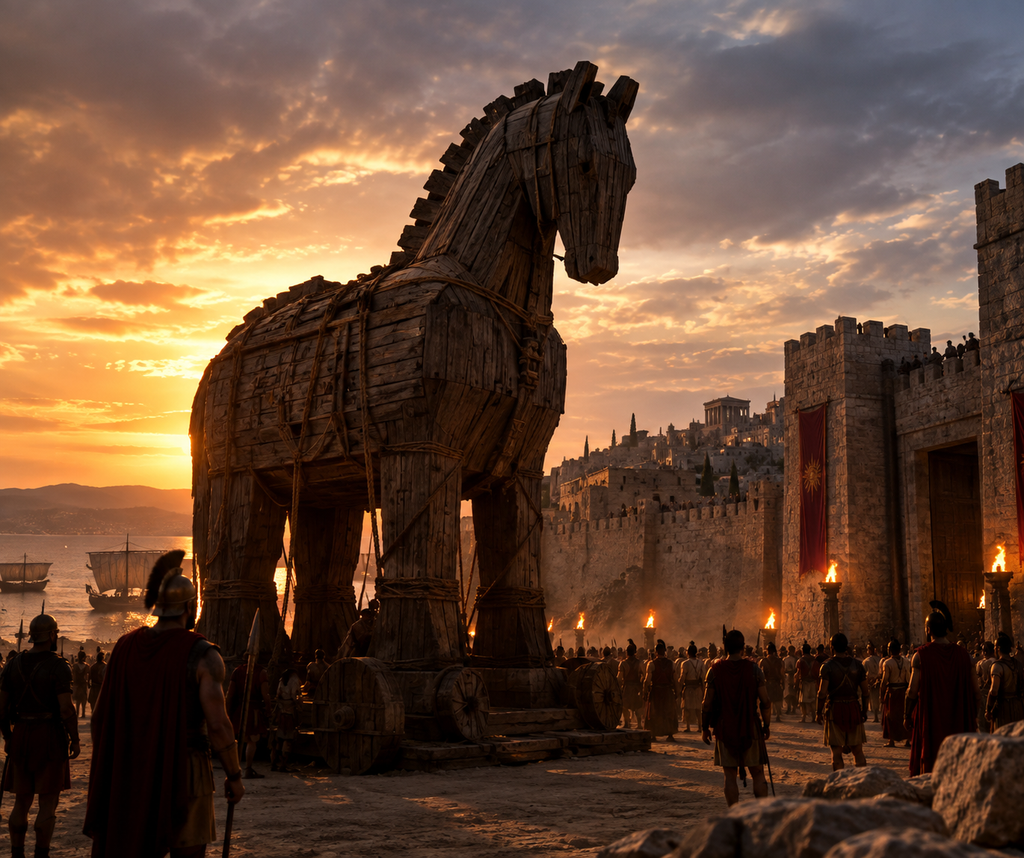
But there is a crucial distinction between the legend and what history can actually prove.
Troy was real.
The Mycenaean world was real.
Hittite texts show that powers from the Aegean were politically and militarily involved in western Anatolia.
The enormous wooden horse, however, has never been archaeologically confirmed.
And that may be what makes the story even more fascinating.
The Trojan Horse is not actually part of the main story of the Iliad
One of the most persistent misconceptions about the Trojan War is that Homer’s Iliad tells the entire story, ending with the famous horse and the destruction of Troy.
It does not.
The Iliad covers only a relatively short period near the end of the legendary ten-year war. Its central subjects are Achilles’ anger, the death of Patroclus, the fighting around the Greek camp and, ultimately, the confrontation between Achilles and Hector.
The poem ends with Hector’s funeral.
Troy is still standing.
Achilles is still alive.
Paris is still alive.
And no wooden horse has yet entered the city.
The horse is mentioned in the Odyssey, the other great epic traditionally associated with Homer. There, the poem refers to Greek warriors hiding inside the wooden structure and to Odysseus’ role in the deception.
The fuller story of Troy’s destruction was assembled from a much wider body of ancient tradition. Some episodes appeared in later epic poems that are now lost, while other details became famous through authors writing centuries afterward.
So the Trojan War story familiar to modern audiences was never contained in one single ancient book.
It grew over time.
Odysseus wins with something Achilles could never provide: deception
Achilles represents overwhelming force.
Odysseus represents intelligence.
That difference lies at the heart of the horse story.
According to tradition, the Greeks had spent years trying unsuccessfully to defeat Troy through direct warfare. Its defenses resisted them.
So the final solution was not to break the walls.
It was to make the Trojans open them themselves.
The idea of the deception is traditionally associated with Odysseus, while the construction of the horse is credited to Epeius, a Greek warrior remembered for his craftsmanship.
A selected group of fighters hid inside the structure.
The rest of the Greek army appeared to abandon the siege and sail away.
To the defenders of Troy, the message must have seemed obvious: after years of failure, the Greeks were finally gone.
But in later versions of the story, their fleet had not returned home. It was waiting nearby, often said to have hidden around the island of Tenedos.
The entire plan now depended on one extraordinary gamble.
The Trojans had to bring the horse inside.
Why would anyone drag an enemy object into their own city?
This is the part of the legend that often sounds least believable to a modern audience.
An enemy army suddenly disappears after ten years and leaves behind a gigantic wooden structure.
Why not burn it?
Why not break it apart?
Why not inspect it?
Ancient storytellers developed an answer to precisely that problem.
His name was Sinon.
In the elaborate version made especially famous by Virgil’s Aeneid, Sinon is deliberately left behind by the Greeks. He convinces the Trojans that he has been mistreated by his own people and tells them that the horse is a sacred offering dedicated to Athena.
The deception goes further.
Sinon explains that the horse was deliberately built so large that the Trojans would be unable to bring it through their defenses.
Why?
Because if they somehow succeeded in taking it into Troy, divine protection would supposedly pass to them.
The object therefore ceased to look merely suspicious.
It became sacred.
For an ancient audience, that distinction mattered enormously.
Laocoön understands what is happening
Not everyone in Troy accepts the story.
The priest Laocoön suspects a trap.
In the version immortalized by Virgil, he warns the Trojans against trusting the Greeks even when they bring gifts.
He strikes the horse with a spear.
Then the story takes one of its darkest turns.
Two enormous serpents emerge from the sea and kill Laocoön and his sons.
The Trojans do not interpret his death as proof that his warning was correct.
They interpret it as divine punishment for attacking a sacred object.
The man who tried to save them therefore becomes, through his own death, part of the reason they trust the horse.
It is one of the most powerful elements of the entire myth: a true warning is transformed into apparent evidence that the warning was false.
Troy brings the enemy inside
The horse is taken into the city.
The Trojans celebrate.
According to the legend, after ten years of warfare they finally believe they have survived.
When the city falls asleep, the Greek soldiers hidden inside the horse emerge.
In later versions of the story, Sinon assists them and helps signal the Greek fleet.
The ships return.
The gates are opened from within.
The army that could not force its way through Troy’s defenses finally enters because Troy itself has allowed the breach to happen.
The fall of Troy is much darker than the image of the horse suggests
Modern retellings often present the Trojan Horse as a clever military trick.
Ancient traditions about what happens afterward are far less romantic.
Troy is burned.
Men are killed.
King Priam dies.
Women from the royal household are taken captive.
Andromache, Hector’s widow, becomes a prisoner.
In later traditions, her young son Astyanax is killed so that he can never grow up to avenge Troy.
Cassandra is taken by Agamemnon.
Hecuba, queen of Troy, becomes a captive.
The horse, therefore, is not merely the final move in an ingenious military plan.
It is the beginning of a catastrophe.
Troy itself was real
This is where myth meets archaeology.
The city traditionally identified with Troy stood at Hisarlık in northwestern Turkey, close to the Dardanelles.
Archaeologists did not uncover one single city there.
They found a settlement that had been built, destroyed and rebuilt repeatedly over many centuries, creating numerous archaeological layers.
For the period that could conceivably lie behind the Trojan War tradition, two phases attract particular attention: Troy VI and Troy VIIa.
Troy VI was a substantial fortified settlement with impressive defensive walls.
Its destruction appears to have involved an earthquake, although details surrounding its end continue to be debated.
A new settlement, known as Troy VIIa, developed afterward.
That city was also destroyed toward the end of the Late Bronze Age, during a broader period of instability across the eastern Mediterranean marked by warfare, population movements and the collapse of major political centers.
Troy VIIa shows evidence of fire and destruction, but the precise cause of its end cannot be established with certainty.
This is where the temptation to connect archaeology directly to the epic becomes strong.
There was a real city.
It suffered real destruction.
The chronology falls within the broad era later associated with the Trojan War.
What we do not have is an inscription saying that Priam ruled there, Agamemnon attacked it, or a wooden horse brought about its downfall.
Hittite records make the story even more intriguing
The Aegean world of the Late Bronze Age was dominated by the Mycenaean civilization.
Centers such as Mycenae, Tiryns and Pylos controlled important territories and maintained long-distance political and commercial relationships.
Hittite documents from Anatolia refer to a power called Ahhiyawa, which many scholars associate with the Achaeans or, more broadly, with an important part of the Mycenaean world.
The same archives mention a region called Wilusa, widely considered a strong candidate for the place known in Greek tradition as Ilios or Troy.
These documents do not describe Homer’s war.
But they do show that western Anatolia was a politically contested region and that Ahhiyawa was involved in its affairs.
Some Hittite texts even refer to earlier disputes connected with Wilusa.
That means conflict between Aegean powers and the region around Troy is historically plausible.
What cannot be demonstrated is that any one of those conflicts was the same war later transformed into Greek epic.
Has archaeology ever found the Trojan Horse?
No.
There is no archaeological object that can be identified as the famous horse.
If such a structure had really existed and had been made from wood, its disappearance would hardly be surprising.
Wood decays.
Troy experienced destruction, fire, rebuilding and centuries of later occupation.
But that point needs to be handled carefully.
The fact that a wooden object could have vanished does not prove that it ever existed.
Archaeology confirms Troy.
It does not confirm the horse.
We do, however, have a remarkably early image of the legend
One archaeological object shows that the story itself was already circulating very early in Greek culture.
The Mykonos Pithos, a monumental vessel from the seventh century BCE, commonly dated to around 670 BCE, includes a striking image of an enormous horse.
Small openings in its body reveal the heads of warriors hidden inside.
It is considered one of the earliest known visual representations of the Trojan Horse.
That makes it extremely important.
But it does not prove that the event happened.
The vessel tells us that by the seventh century BCE the story was already well enough known to be represented visually.
If the historical events behind the Trojan tradition belonged roughly to the Late Bronze Age, several centuries still separate the possible war from this surviving image.
Those centuries matter.
Stories can change dramatically while being transmitted from one generation to another.
What if the horse was never really a horse?
This question has inspired a number of modern theories.
One proposes that the legend may preserve a distorted memory of a siege engine. A wooden military structure used against the walls could, over generations of storytelling, have become an enormous animal.
Another theory connects the horse with a ship, drawing on the complicated symbolic relationships between horses, the sea and navigation in Greek culture.
There is also the earthquake interpretation.
Poseidon was associated not only with the sea but also with horses and earthquakes. Since one phase of Bronze Age Troy seems to have suffered seismic destruction, some have suggested that the “horse” could symbolically represent an earthquake linked with Poseidon.
It is an elegant idea.
But it is not proven.
Neither is the siege-engine theory.
Neither is the ship theory.
These are attempts to explain how a real event might have been transformed into myth.
At present, none can be treated as the historical solution to the mystery.
Could a giant wooden horse have been built at all?
Technically, yes.
Nothing about Bronze Age engineering makes a large hollow wooden structure impossible.
These societies could construct ships, monumental buildings, defensive works and complicated wooden structures.
The hardest part of the story is not the engineering.
It is the psychology.
Why would the defenders accept it?
That is precisely why the stories surrounding Sinon, Athena and divine punishment became so important to the tradition.
Remove those elements and the plan looks foolish.
Restore the religious worldview of the ancient story, and the Trojans’ decision becomes far more understandable.
For them, divine favor was not a decorative element of life.
It was part of how reality itself was interpreted.
How many warriors were inside?
Ancient sources do not agree.
Different traditions preserve different lists and different numbers.
Odysseus appears consistently, while Menelaus, Diomedes, Neoptolemus and Epeius are among the other names associated with the group in various accounts.
That disagreement matters.
It reminds us that we are not reading a military report written by an eyewitness.
We are reading a tradition that changed over time.
The 2004 film Troy removes much of what made the ancient version work
The film Troy keeps the basic structure of the story.
Odysseus develops the strategy. The Greeks appear to leave. The Trojans bring the horse inside. Greek warriors emerge at night.
But much of the ancient mechanism behind the deception disappears.
Sinon is largely absent from the familiar version presented on screen.
So is Laocoön.
The religious logic that explains why the Trojans might have trusted the object is stripped away.
The film therefore presents the horse mostly as an ingenious piece of military strategy.
Ancient tradition made the trap much more sophisticated.
It did not merely exploit carelessness.
It exploited belief.
So was there a real event behind the legend?
Possibly.
But we do not know what it was.
Perhaps a Mycenaean force attacked Troy.
Perhaps the city was taken through deception.
Perhaps someone opened a gate from inside.
Perhaps a siege device played an important role.
Perhaps several separate conflicts and destructions were gradually merged into one enormous legendary war.
Or perhaps the wooden horse was entirely fictional.
That is where the boundary between history and myth becomes impossible to cross with certainty.
Archaeology can uncover walls.
It can identify destruction layers.
It can date fires.
It can confirm that a city existed.
Hittite documents can show that western Anatolia was a real arena of competition between major powers.
But none of those sources allows us to say that Odysseus built a wooden horse, that Priam ordered it brought inside, or that Greek soldiers climbed out of it on one particular night.
Perhaps that uncertainty is why the Trojan Horse survived
History has known weapons far more destructive than a wooden horse.
There have been larger cities.
Better-documented battles.
Military inventions that genuinely changed the course of empires.
Very few, however, became symbols as powerful as this one.
Because the Trojan Horse is not really a story about wood.
It is about trust.
It is about persuading someone to mistake danger for safety.
It is about defeating a wall without breaking it.
And that is why, nearly three thousand years later, we still call malicious software a “Trojan”: something that appears harmless long enough to be invited inside.
Troy was real.
Its destruction was real.
Aegean powers were involved in western Anatolia, and conflict there was historically possible.
But between the archaeological ruins at Hisarlık and the story preserved by Greek poets lies a silence of several centuries.
Inside that silence may be the memory of a real event we will never fully recover.
Or there may be nothing more than the imagination of an extraordinary storyteller.
The most famous weapon of the Trojan War may never have existed.
And yet, of all the weapons associated with Troy, the Trojan Horse is the one that still keeps finding its way inside our walls.