
A sting can turn an ordinary summer afternoon into a surprisingly painful experience. There may be only a tiny mark on the skin, yet within minutes the area can become red, hot, itchy and swollen.
For most people, a bee or wasp sting is uncomfortable rather than dangerous. The reaction remains confined to the area around the sting and gradually settles. But that is not always the case. Some people develop extensive swelling, while a much smaller number experience a serious systemic allergic reaction.
Knowing the difference matters. So does knowing which popular first-aid advice is genuinely useful and which remedies are supported more by tradition than by evidence.
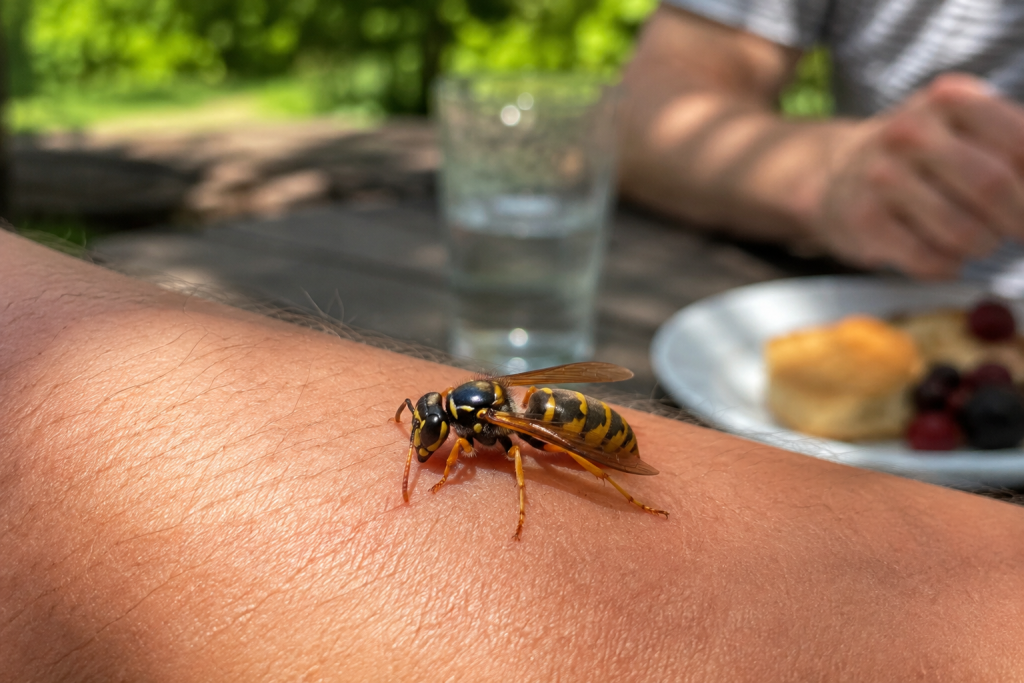
Bees and wasps don’t sting in quite the same way
People often talk about bee and wasp stings as though they were identical, but there is an important practical difference.
A honeybee’s barbed stinger commonly becomes lodged in human skin. When the bee pulls away, the stinger and associated venom apparatus may remain behind. Wasps generally retain their stingers, which means the same insect can sting repeatedly.
This is why one of the first things to do after a suspected bee sting is look closely at the skin. If a stinger is still there, removing it promptly matters.
The pain and swelling are caused by more than the physical puncture itself. Hymenoptera venoms contain complex mixtures of biologically active substances capable of producing pain, inflammation and immune responses.
In most people, those effects remain local. In someone who has become allergic to components of the venom, however, the immune response can extend well beyond the sting site.
The old “never use tweezers” rule is not as clear-cut as it sounds
For years, first-aid advice often insisted that a bee stinger should only be scraped sideways with a card. Pinching it or using tweezers was said to squeeze additional venom into the skin.
There is an important piece of evidence behind why modern advice tends to emphasize something else: speed.
An experimental study published in The Lancet examined what happened when bee stingers were removed in different ways. The researchers found that the amount of venom delivered increased with the time the stinger remained in place. How the stinger was removed was much less important than how quickly it happened.
In practical terms, don’t spend valuable seconds searching for a credit card because you have been told there is only one acceptable technique. If you can immediately brush or scrape the stinger away, do that. If tweezers are already available and allow you to remove it quickly, delaying removal in pursuit of a supposedly perfect method makes little sense.
The priority is simple: get the stinger out promptly.
What to do immediately after a sting
Once you are safely away from the insect and any retained stinger has been removed, gently wash the area with soap and water.
A cold pack wrapped in cloth can then be applied for around 10 to 20 minutes at a time. Cooling the area may help reduce both pain and swelling. When the sting is on an arm or leg, elevating the limb can also help with swelling.
There is another small precaution that can become surprisingly important. If you’ve been stung on a finger or hand, remove rings before swelling develops. Jewelry that feels perfectly loose immediately after the sting may become difficult to remove later.
Depending on the symptoms, over-the-counter treatments may sometimes be used for itching, inflammation or pain. Antihistamines, topical preparations and common pain relievers are among the options used in appropriate circumstances. However, the suitable medication depends on factors including age, allergies, medical conditions and other medicines being taken.
A dramatically swollen arm doesn’t necessarily mean anaphylaxis
This distinction can prevent a great deal of unnecessary panic.
A typical local reaction causes pain, redness, itching and swelling around the sting. Some people, however, experience what allergists call a large local reaction.
Imagine being stung on the hand and finding that a substantial part of the hand or arm becomes swollen afterward. The appearance can be alarming, and the swelling may continue to increase rather than disappearing within a few hours.
According to allergy practice guidance, large local reactions can peak roughly 48 to 72 hours after a sting and may take several days — sometimes a week or longer — to resolve.
That is very different from saying that every expanding area of swelling should simply be ignored. Symptoms still need to be considered in context. But extensive swelling confined to the region surrounding the sting is not, by itself, synonymous with anaphylaxis.
Large inflammatory reactions can also occasionally be mistaken for bacterial infection. Antibiotics are not automatically required simply because an area is red and swollen; evidence of an actual secondary infection needs to be considered.
Anaphylaxis is a different kind of reaction
The situation changes when symptoms begin affecting parts of the body beyond the immediate sting site, particularly the respiratory or cardiovascular systems.
Warning signs can include difficulty breathing, wheezing, swelling of the tongue or throat, trouble swallowing, widespread hives, severe dizziness, fainting or signs of circulatory collapse. Gastrointestinal symptoms such as vomiting, abdominal symptoms or diarrhea can also occur as part of a systemic allergic reaction.
Anaphylaxis can progress rapidly and is a medical emergency.
Emergency services should be contacted immediately when anaphylaxis is suspected. A person who has been prescribed an epinephrine auto-injector should use it according to their emergency treatment plan.
This is also where an important misconception needs to be addressed: an antihistamine is not a substitute for epinephrine during anaphylaxis.
Antihistamines may help certain allergic symptoms, particularly itching and hives, but they do not act rapidly enough to treat the potentially life-threatening airway and circulatory problems caused by anaphylaxis. Epinephrine remains the first-line treatment.
Medical evaluation is still necessary even if symptoms improve after epinephrine because allergic symptoms can sometimes recur.
Multiple stings create another risk — even without an allergy
A severe reaction following many stings does not necessarily have to be allergic.
One sting introduces a relatively small amount of venom. Dozens or potentially hundreds of stings create a very different exposure. At sufficiently high doses, venom itself can produce systemic toxic effects.
Symptoms after numerous stings can include nausea, vomiting, diarrhea, headache, fever, dizziness and other systemic problems. Severe envenomation can have much more serious consequences.
There is no single number of stings that is guaranteed to be dangerous for every person. Body size, age, underlying health, insect species and the amount of venom delivered all matter.
This is particularly important with children, older adults and anyone who has sustained a large number of stings. In these circumstances, seeking medical advice is sensible even when the person has no known insect-venom allergy.
A sting inside the mouth deserves special attention
Wasps are attracted to sweet drinks and food, which creates an unusual but important hazard during summer.
A wasp can enter an open can, bottle or glass without being noticed. A person taking the next sip may then be stung on the lips, tongue or inside the mouth.
Swelling in these areas deserves more caution than the same degree of swelling on an arm or leg because the tissues are close to the airway.
Difficulty breathing or swallowing, rapidly increasing swelling of the tongue or throat, or a sensation that the throat is tightening requires immediate emergency assistance.
What about vinegar, baking soda and toothpaste?
Home remedies for insect stings have been passed down for generations. Among the most familiar are vinegar, baking soda and toothpaste, often accompanied by the idea that one substance can chemically “neutralize” another.
The chemistry of an actual sting is considerably more complicated.
Bee and wasp venoms are mixtures containing numerous biologically active components, and the venom is injected into tissue rather than simply sitting on the skin waiting to be neutralized. The neat acid-versus-alkali explanation often presented online therefore oversimplifies what is happening biologically.
Evidence-based first aid focuses instead on measures with a clearer practical benefit: rapidly removing a retained bee stinger, washing the skin, applying a cold compress and watching for signs of a serious reaction.
Putting potentially irritating substances on already inflamed skin may offer little benefit, while applying soil or mud introduces an unnecessary source of microorganisms.
Sometimes the least dramatic treatment is the better one.
Previous anaphylaxis changes the conversation
Someone who has previously experienced a systemic allergic reaction after a bee or wasp sting should not simply hope that the next sting will be milder.
An allergist can assess the history, determine whether additional testing is appropriate and decide whether the person should carry an epinephrine auto-injector.
For selected patients, venom immunotherapy is another important option. Rather than merely treating symptoms after a sting occurs, venom immunotherapy is designed to substantially reduce the risk of serious systemic reactions to future stings.
It is one reason a significant previous reaction deserves proper allergy assessment rather than being dismissed as an unfortunate one-off event.
The most useful lesson is surprisingly simple
Most bee and wasp stings can be managed with straightforward first aid and careful observation. Pain, redness and even substantial local swelling do not automatically mean that something dangerous is happening.
What matters is recognizing when the pattern changes.
Swelling around the sting that develops over the following day or two can be part of a large local reaction. Difficulty breathing, throat or tongue swelling, faintness and other systemic symptoms are an entirely different situation and require urgent action.
And if a honeybee has left its stinger behind, there is little reason to turn its removal into a complicated procedure. The evidence suggests that those first few seconds matter more than whether you happened to have the “correct” tool in your hand.
Sources and further reading
This article is based on clinical guidance and medical literature from the American Academy of Allergy, Asthma & Immunology (AAAAI), Mayo Clinic, and research on honeybee stinger removal published in The Lancet and indexed by PubMed.