
A bloodstained dog. An overturned cradle. A missing child.
For the man who had just returned home, the scene seemed to tell him everything he needed to know.
According to one of Wales’s most enduring legends, the man was Llywelyn the Great, a powerful medieval Welsh ruler, and the dog was Gelert, his trusted hunting hound. What Llywelyn supposedly did next turned the story into a warning that would survive for centuries.
He killed Gelert.
Only moments later, he discovered that he had misunderstood everything.
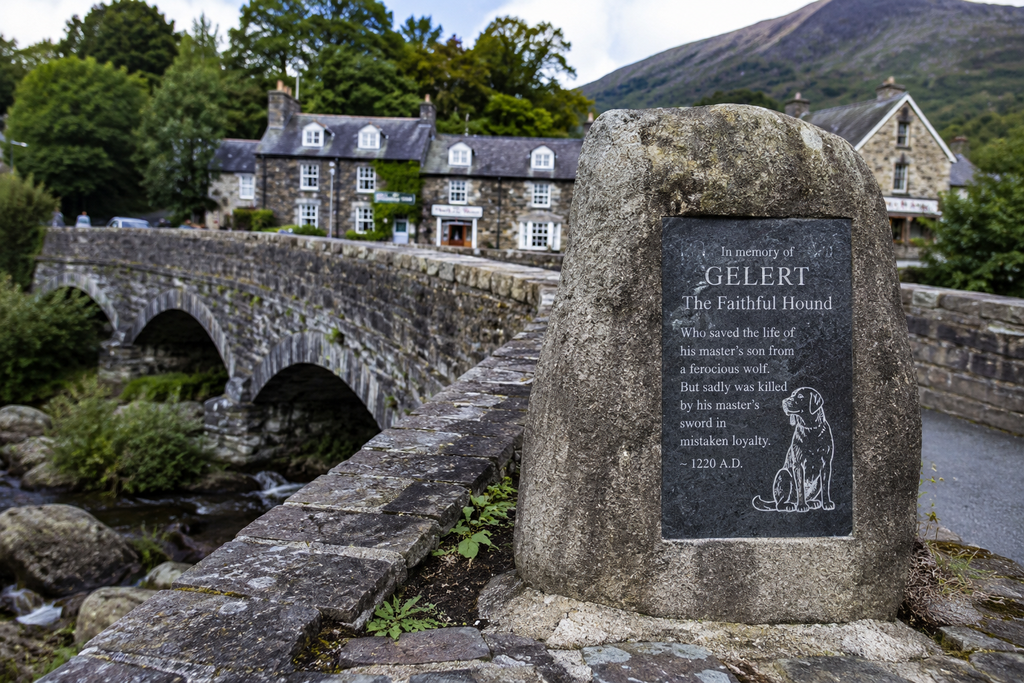
Today, visitors to the Welsh village of Beddgelert can even walk to a monument known as Gelert’s Grave. It makes the story feel remarkably tangible.
But there is a problem.
The ruler was real. The village is real. The monument is real.
The tragedy itself is almost certainly legend.
And the history of how that legend became attached to this particular place may be just as fascinating as the story itself.
The terrible discovery that begins the legend
There are several versions of Gelert’s story, but they share the same devastating sequence of events.
Llywelyn leaves his home to go hunting. When he returns, Gelert approaches him with blood around his mouth.
Something is wrong.
Llywelyn rushes to where his child had been left and discovers a scene of apparent violence. The cradle has been overturned, there are signs of a struggle, and the baby is nowhere to be seen.
He looks at the blood on his dog and reaches what seems, in that instant, to be the only possible conclusion.
Gelert has attacked the child.
Overcome by rage and grief, Llywelyn draws his sword and kills the dog.
Then he hears something he never expected to hear.
His child crying.
The baby is alive and unharmed. Nearby lies a dead wolf.
Only then does Llywelyn understand what the blood on Gelert actually meant. The dog had not harmed the child. He had fought the wolf and protected him.
The faithful animal was killed for the very evidence that should have proved his loyalty.
The National Trust still recounts the tale as part of the folklore associated with Beddgelert, while clearly presenting it as a legend rather than established medieval history.
There really was a Llywelyn the Great
The historical setting gives the story an unusual sense of credibility.
Llywelyn ap Iorwerth, better known as Llywelyn the Great or Llywelyn Fawr, was not invented for a folktale. He was one of the most significant Welsh rulers of the Middle Ages and became the dominant political figure across much of Wales during the first half of the 13th century.
There are also genuine historical connections between Llywelyn and the Beddgelert area.
St Mary’s Church in Beddgelert belonged to an important medieval religious community, and the National Churches Trust notes that the church was rebuilt in the 13th century under Llywelyn’s patronage.
This matters because legends often become more persuasive when they are anchored to people and places that unquestionably existed.
But a real historical figure does not make every later story told about that person historically accurate.
No known contemporary medieval account establishes that Llywelyn owned a dog named Gelert who died after saving his child from a wolf.
The trail becomes much clearer only centuries later.
The famous grave is not medieval
Visitors to Beddgelert can still find a stone monument identified as Gelert’s Grave.
Its existence can create a powerful impression: if there is a grave, surely there must once have been a dog buried there.
Yet the monument belongs to a very different period.
Cadw, the Welsh Government’s historic environment service, dates the monument to approximately 1802 — almost six centuries after Llywelyn’s lifetime.
Its records associate the memorial with David Pritchard, who was connected with the Beddgelert Hotel, later known as the Royal Goat Hotel.
And this is where the story takes an unexpected turn.
According to Cadw’s official listing, Pritchard revived and partly reinvented existing mythology, introducing Llywelyn the Great as Gelert’s master. The monument became part of an effort to encourage visitors to come to the area.
In modern language, it was remarkably effective destination marketing.
The memorial eventually became historically significant in its own right and is now Grade II listed.
That distinction is worth understanding.
Gelert’s Grave has genuine heritage value — just not because historians have established that a medieval dog was buried beneath it.
Its significance comes partly from what it tells us about the development of tourism and the creation of romantic historical attractions in Wales around the beginning of the 19th century.
A legend can become attached to a real landscape
By the time visitors encountered the grave, several elements worked together perfectly.
There was a real medieval prince.
There was a dramatic story.
There was a physical monument.
And there was a village whose name appeared to reinforce the entire tale.
In Welsh, bedd means “grave,” which made the popular interpretation of Beddgelert as “Gelert’s grave” especially compelling.
But a memorable interpretation of a place name is not historical proof.
The area’s religious history extends much further back than the monument. National Churches Trust records a tradition of a religious community at Beddgelert dating to around the seventh century, with the site later developing into an Augustinian priory.
The origins of the place name have been debated, and its similarity to the name Gelert cannot be used as evidence that Llywelyn’s supposedly faithful dog was buried there.
Once the monument, landscape and story were combined, however, separating them became difficult.
The legend had acquired a physical home.
Gelert’s story has relatives far beyond Wales
Perhaps the strongest reason for caution comes from folklore itself.
The essential plot of the Gelert legend did not originate with Llywelyn.
Stories built around an innocent animal being killed after its owner misinterprets bloody evidence are found in traditions far removed from medieval Wales.
A particularly striking parallel appears in the Indian literary tradition associated with the Panchatantra, an ancient collection of animal tales and moral stories.
In one version, the hero is not a dog but a mongoose.
The threat is not a wolf but a snake.
The mongoose kills the snake and protects a child. When the mother returns and sees blood on the animal, however, she assumes the worst and kills it. Only afterward does she discover that her child is alive and that the mongoose had actually saved the baby.
The emotional mechanism is unmistakably similar.
Evidence is seen.
A conclusion is reached.
Punishment comes immediately.
The truth arrives too late.
This does not mean someone in Wales simply copied a Panchatantra story and replaced a mongoose with a dog. Folklore rarely travels in such a simple, traceable line. Stories can pass between cultures for centuries, changing characters, animals, locations and details along the way.
What the comparison does show is that Gelert belongs to a much older and broader family of cautionary tales.
So was there ever a real Gelert?
That question requires a more careful answer than either “yes” or “no.”
It is certainly possible that Llywelyn owned hunting dogs. For a medieval ruler involved in hunting, that would hardly be surprising. Tradition even claims that Gelert was given to Llywelyn by King John of England.
What is missing is reliable contemporary evidence connecting a particular dog to the dramatic incident described in the legend.
There is no solid medieval documentation establishing the famous sequence involving the missing child, the blood-covered hound, the dead wolf and Llywelyn’s fatal mistake.
By contrast, there is strong documentary evidence for the much later monument and for the promotion of the legend around the beginning of the 19th century.
That changes how the story should be told.
It should not be presented as a documented medieval tragedy.
It is better understood as a Welsh legend attached to a genuine historical ruler, a genuine landscape and, eventually, a genuine monument.
Why the story still works hundreds of years later
Stripping away the claim of historical certainty does surprisingly little to weaken Gelert’s story.
Its power was never really dependent on knowing the exact year in which it happened.
The legend survives because the mistake at its center remains instantly understandable.
Imagine what Llywelyn supposedly saw.
His child was missing. The cradle was overturned. His dog was covered in blood.
Each detail supported the conclusion forming in his mind.
The tragedy was that he had enough information to feel certain, but not enough information to be right.
That distinction gives the story a relevance far beyond medieval Wales.
People routinely construct explanations from incomplete evidence. Usually the consequences are far less dramatic than those described in the legend. But the underlying tendency — deciding that we understand an event before all the facts are known — is deeply familiar.
That may explain why versions of this story appeared in different cultures and why Gelert’s version became so enduring.
More than two centuries after a monument was created for visitors in Beddgelert, people still walk to the place known as Gelert’s Grave.
Whether a faithful hound ever lay beneath those stones is another question entirely.
The dog may belong to legend, but the warning attached to his story remains remarkably real: sometimes the most dangerous conclusion is the one that appears obvious before we have had time to discover the rest of the truth.