
Social media loves simple explanations for dramatic transformations. One photo shows someone carrying noticeably more body fat; the next shows a leaner physique, visible abs, and much sharper muscle definition. Somewhere between those two images comes the supposed secret: a short daily routine that takes only a few minutes.
In one such video, a man demonstrates roughly nine minutes of Tai Chi-inspired movements performed barefoot outdoors. The before-and-after images are striking enough to make the message feel obvious: do this every day, and perhaps your body could change in the same way.
But that conclusion goes much further than the evidence allows.
Tai Chi is real physical activity. Research suggests that regular practice can improve fitness, balance, waist circumference, and some metabolic markers. What science does not show is that a brief nine-minute routine, performed in isolation, is normally enough to explain a major transformation from a higher-body-fat physique to a lean and visibly muscular one.
The difference matters.
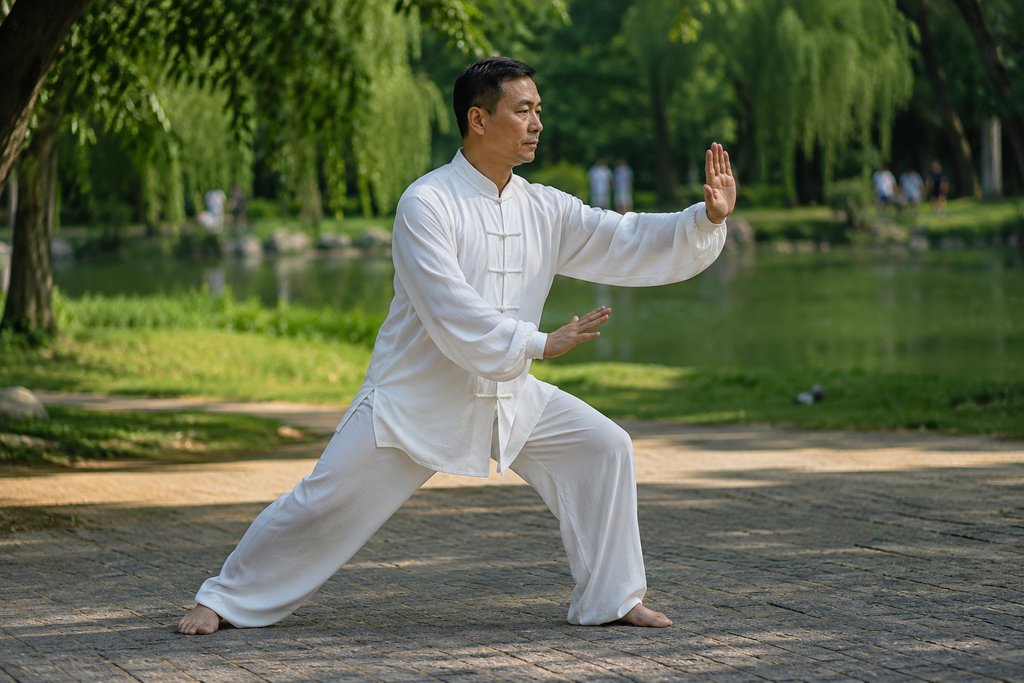
Tai Chi may look gentle, but your body is still working
Tai Chi is often described as a meditative form of movement, which can make it seem almost too easy to count as exercise.
Yet the body remains active throughout the practice. Weight shifts continuously from one leg to the other, the knees stay flexed, the trunk stabilizes the body, and balance, coordination, and muscular control are required from one movement to the next.
The Compendium of Physical Activities, a widely used reference for estimating the energy cost of different activities, assigns general Tai Chi and Qigong an intensity of around 3.3 METs. Some more physically demanding forms of Tai Chi are rated considerably higher.
That means Tai Chi really does require energy. It is not simply standing still while moving your arms.
But there is an important distinction between saying an activity burns calories and saying a very short session burns enough calories to produce major weight loss on its own.
Those are not the same claim.
Nine minutes a day adds up to 63 minutes a week
One of the biggest attractions of a nine-minute routine is obvious: it feels achievable.
Almost anyone can imagine finding nine minutes in a day. There is no need for a gym membership, complicated equipment, or a long workout schedule.
Over one week, however, nine minutes per day adds up to 63 minutes of activity.
The World Health Organization recommends that adults generally aim for 150 to 300 minutes of moderate-intensity aerobic activity per week, or 75 to 150 minutes of vigorous activity. It also recommends muscle-strengthening activity involving the major muscle groups on at least two days per week.
So if nine minutes of Tai Chi represents someone’s entire weekly exercise routine, the overall volume is relatively modest.
If those nine minutes are added to walking, sports, resistance training, cycling, an active job, or other daily movement, the picture changes considerably.
The routine may still be useful. It simply should not be confused with the person’s total activity unless we actually know that it is.
Research does suggest Tai Chi can reduce waist circumference
This is where the science becomes more interesting.
A randomized clinical trial published in Annals of Internal Medicine studied 543 adults aged 50 and older who had central obesity. Participants were assigned to Tai Chi, conventional exercise, or a control group.
After 12 weeks, the Tai Chi group showed a reduction in waist circumference that was about 1.8 centimeters greater than the control group. Changes in body weight were also observed.
That result is significant because it challenges the assumption that only high-intensity exercise can affect body composition.
Gentler forms of movement can matter.
But the study does not show that nine minutes a day are enough to produce similar results. Participants followed a structured intervention over a period of weeks.
That is a very different situation from watching a short routine online and assuming that the routine alone explains an extreme physical transformation.
The evidence goes beyond a single trial
Other research has reached broadly similar conclusions.
A systematic review and meta-analysis involving 24 randomized trials and more than 1,600 participants examined the effects of Tai Chi and Qigong on body composition. Some of the included studies found meaningful improvements in measures such as body mass index, although the researchers also reported substantial differences between studies.
A more recent meta-analysis involving more than 1,700 participants with cardiometabolic risk factors found that Tai Chi was associated with reductions in waist circumference and improvements in several metabolic markers when compared with inactive control groups.
So it would be inaccurate to dismiss Tai Chi as useless for weight management.
It may help.
The key question is how much it helps, how often it is practiced, what the rest of the person’s lifestyle looks like, and how long the routine is maintained.
Weight loss still depends heavily on overall energy balance
This is the part that transformation videos rarely show.
Body fat decreases when the body consistently uses more energy than it takes in over time.
Physical activity can contribute to that deficit because movement increases energy expenditure. But food intake also plays a major role.
The U.S. Centers for Disease Control and Prevention notes that physical activity helps increase the number of calories the body uses, while combining increased activity with reduced calorie intake creates the energy deficit that leads to weight loss. The CDC also points out that reducing calorie intake generally contributes more to initial weight loss, while physical activity is especially important for overall health and long-term weight maintenance.
A short video can show us an exercise routine.
It cannot show us everything that happened in the kitchen.
We usually do not know whether the person reduced portion sizes, increased protein intake, stopped drinking high-calorie beverages, started walking more, changed meal timing, or altered their diet in other significant ways.
We may also have no idea whether they lift weights, cycle, run, swim, play a sport, or simply spend much more of the day on their feet.
And we often do not know how much time passed between the two photographs.
All of those details matter.
Losing fat and building muscle are two different things
Another source of confusion comes from the way body transformations look in photographs.
Someone who loses a considerable amount of fat may suddenly appear much more muscular, even if they did not build large amounts of new muscle during the weight-loss phase.
The muscle was already there. It simply became more visible as the layer of fat covering it became thinner.
That can create an impressive visual change.
But when an after-photo also appears to show substantial muscular development, it becomes harder to explain the result through a few minutes of slow movement alone.
Tai Chi certainly uses muscles, particularly the legs, hips, and muscles responsible for posture and balance. That does not make a nine-minute Tai Chi-inspired routine equivalent to progressive resistance training.
This is also why public-health recommendations distinguish between aerobic activity and muscle-strengthening exercise.
For people who want to become not only lighter but also stronger and more muscular, some form of resistance training is usually an important part of the picture.
Does that mean the transformation in the video is fake?
No.
That would be another conclusion we cannot support simply by looking at a few images.
We do not know everything the person did during the months or years between the before and after photos.
The Tai Chi routine may genuinely be part of his daily life. It may have helped him become more active. It may even have been the habit that encouraged broader lifestyle changes.
What we cannot determine from the video is whether those nine minutes were his only form of exercise.
We also cannot know his diet, training history, previous muscle mass, daily activity level, or the exact timeline of the transformation.
The scientifically responsible conclusion is therefore not, “The transformation is fake.”
It is this:
The photographs do not prove that nine minutes of Tai Chi per day were solely responsible for the transformation.
That is a much more defensible statement.
Before-and-after photos can exaggerate differences without being fake
There is another reason transformation photos should be interpreted carefully.
The same body can look surprisingly different depending on how the photograph is taken.
Posture alone can change the apparent shape of the waist and chest. Contracting the abdominal muscles can dramatically improve definition. Side lighting creates shadows that make individual muscles more visible. Camera angle, distance, hydration, clothing, and even the time of day can change the appearance of the body.
None of this automatically means a photograph has been manipulated.
Someone may have genuinely lost a large amount of weight while also choosing much more flattering conditions for the after-photo.
The problem begins when the visual contrast is treated as proof that one specific method caused the transformation.
A photograph can show that a person looks different.
It cannot, by itself, tell us why.
What about doing the movements barefoot and “grounding”?
Videos involving outdoor Tai Chi sometimes add another claim: that exercising barefoot and maintaining direct contact with the ground provides additional health benefits.
This idea is often called grounding or earthing.
There is some published research exploring possible physiological effects of grounding, but the evidence base remains much smaller and less established than the research supporting conventional physical activity.
Some studies and reviews have proposed potential effects on sleep, inflammation, stress, and other physiological measures, but methodological limitations and small study sizes make strong conclusions difficult.
More importantly, the existing evidence does not show that standing or exercising barefoot on the ground creates a special fat-burning effect.
If someone enjoys practicing outside without shoes, that can still be perfectly reasonable. Being outdoors may be relaxing, and enjoying an activity makes it more likely that a person will continue doing it.
But taking off your shoes does not change the fundamental biology of weight loss.
The nine-minute idea may still have real value
This is where the story becomes more positive.
Rejecting an exaggerated promise does not mean rejecting the activity itself.
For someone who currently does almost no exercise, nine minutes may be an excellent starting point.
A short routine feels manageable. It does not require major preparation. It can be done before work, after waking up, during a break, or outside in a park.
And consistency matters.
The World Health Organization emphasizes that some physical activity is better than none and encourages inactive people to start with small amounts of movement before gradually increasing duration, frequency, and intensity.
That is exactly where a nine-minute routine can become useful.
Nine minutes may become a habit.
A habit may become 15 minutes.
Fifteen minutes may turn into a longer walk.
Feeling better physically may encourage someone to become more active during the rest of the day.
And a person who starts taking exercise seriously may begin paying more attention to food, sleep, strength training, and other health behaviors.
Several months later, the combined effect of those changes could be substantial.
In that sense, nine minutes really could be part of an impressive transformation.
Being part of the transformation, however, is not the same as causing the entire transformation.
So, can you lose weight by doing nine minutes of Tai Chi every day?
Potentially, yes — but probably not for the reason a dramatic social media transformation might suggest.
Tai Chi is legitimate physical activity, and research indicates that regular practice may help improve waist circumference, body composition, balance, fitness, and some metabolic health markers.
What the evidence does not show is that a very short daily routine can reliably produce dramatic fat loss and a visibly muscular physique without other changes.
Major body transformations usually involve several factors working together: food intake, total daily movement, muscle-strengthening activity, consistency, sleep, individual biology, and time.
That makes the real message less spectacular than the one social media often sells, but also more useful.
There is probably no magical nine-minute sequence capable of bypassing the basic physiology of weight loss.
There is, however, real value in finding nine minutes of movement that you actually enjoy enough to repeat every day.
And sometimes that small, sustainable habit is where a much larger change begins.