
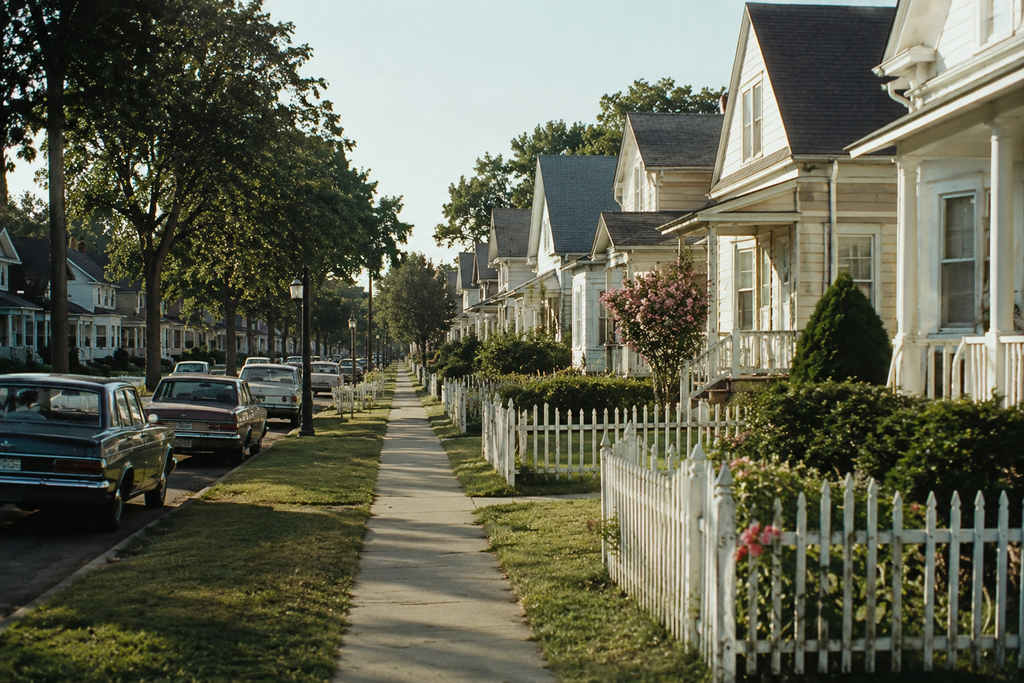
A quiet suburban street. Neat lawns. Similar-looking houses. Families posing outside their homes. The footage looks convincingly old, almost like something recovered from a forgotten box of home movies.
Then comes the disturbing claim.
According to a story circulating on social media, a real-estate man named Harold Whitmore created an ideal residential neighborhood in 1965. Families moved in, life appeared completely normal, and then, one by one, the residents supposedly disappeared without explanation.
It sounds like the beginning of a true-crime documentary. It is also exactly the kind of story that spreads quickly online because it combines nostalgia, mystery and apparently authentic historical imagery.
But once the claims are examined as history rather than storytelling, the case becomes much harder to support.
The Story Gives Us Just Enough Detail to Sound Real
The name Harold Whitmore is specific. So is the year 1965. The visual setting also fits the era remarkably well.
What is missing, however, is far more important.
The viral versions of the story do not clearly identify the town, state, subdivision, development company, police department or families involved. There are no names of missing residents and no newspaper references tied to the alleged disappearances.
Those omissions matter because they prevent meaningful verification.
A genuine historical case involving several missing families would normally leave behind multiple independent records. There could be property transactions, school enrollments, employment records, newspaper coverage, police reports, relatives searching for missing people, court documents or later historical references.
In the Whitmore story, that documentary trail has not surfaced.
Harold Whitmore Is a Real Name, but That Does Not Validate the Story
There have been many real people called Harold Whitmore.
Obituary databases, for example, contain numerous individuals with that name.
But the existence of people with the same name does not establish that the man described in the viral story existed in the role attributed to him.
One documented Harold Whitmore from Auburn, New York, was born in 1964, making it impossible for him to have been the developer described in a 1965 story.
Another Harold B. Whitmore, from Ohio, was born in 1945 and graduated from high school in 1965. Available biographical information connects him with Goodyear rather than with a mysterious suburban development.
None of this proves that no real-estate professional with that name ever existed. It simply means that the viral story has not been matched to a verifiable historical figure.
That distinction is important.
“I Can’t Find It Online” Is Not Proof That Something Never Happened
There is a useful caution here.
Historical research is not the same as running a quick internet search. Many American local newspapers from the mid-20th century are only partially digitized. Some municipal, police and property records remain in physical archives, on microfilm or behind databases that are not indexed by ordinary search engines.
So the absence of a Google result does not automatically make an old story false.
But the scale of the claim matters.
If the story concerned a single poorly documented disappearance in a small town, the lack of an online record might not be especially surprising.
Several families vanishing from the same residential development is a different kind of event.
The larger the alleged incident, the more people and institutions it would normally involve, and the more difficult it becomes for every trace of it to disappear.
That is one of the strongest reasons to be skeptical here.
A Neighborhood Full of Missing Families Should Leave a Paper Trail
Consider what would exist around an ordinary suburban family in 1965.
They might own or rent property. Their children could attend school. Adults could have employers, tax records, bank accounts and driver’s licenses. Relatives would know where they lived. Neighbors would notice their absence.
If several households vanished, police agencies and journalists would almost certainly have become involved.
Even if the original records never made it online, later references would be likely to survive somewhere: local-history books, anniversary newspaper stories, genealogy discussions, archived investigations or references to an unsolved case.
So far, the alleged Whitmore development appears to have none of those identifiable anchors.
The story has a memorable premise, but almost no verifiable geography or documentation.
The Old Footage May Still Be Genuine
This is where the story becomes more interesting than a simple “real or fake” verdict.
The photographs and video clips used in these posts may genuinely be old.
Their architecture, clothing, suburban layout and overall appearance are consistent with mid-century American home movies and family photographs.
But an authentic image does not automatically make the caption attached to it authentic.
That distinction has become increasingly important online.
A creator can take a genuine photograph from 1962 and write beneath it:
“This was the last picture ever taken of the family before they vanished.”
The photograph itself has not been manipulated.
The falsehood, if there is one, lies entirely in the story attached to it.
That makes this kind of content especially persuasive. Viewers correctly recognize the visual material as old and then unconsciously extend that authenticity to the narration.
Why the Setting Feels Historically Accurate
The neighborhood shown in the clips does not look implausible because developments like it really did exist.
Postwar America experienced an enormous suburban expansion. New residential developments spread around major cities, and large numbers of families moved into communities characterized by detached houses, lawns, driveways and relatively standardized designs.
That historical reality gives the story an extremely convincing backdrop.
A fictional storyteller does not need to invent 1960s suburbia.
The era already provides everything necessary: recognizable architecture, family home movies, optimistic advertising and the image of a safe, orderly neighborhood.
All that remains is to introduce something sinister.
The Name Itself Adds a Sense of Authenticity
A specific name such as “Harold Whitmore” also changes how a viewer perceives a story.
“An unknown developer built a strange neighborhood” sounds like folklore.
“Harold Whitmore built it in 1965” sounds like something researched.
That is one reason fictional and semi-fictional social-media stories often contain precise names and years, even while withholding the information needed to verify them.
Interestingly, Harold Whitmore also appears as a character name in unrelated modern fictional writing. One storytelling site, for example, uses the name for an elderly businessman in a narrative while openly presenting a mixture of real stories and fiction.
That does not establish the origin of the viral video, but it illustrates how an ordinary, believable name can easily be used to give fictional storytelling a documentary tone.
The Most Important Question Is Not Whether the Pictures Look Real
When encountering this type of viral historical mystery, the most useful question is not:
“Does this photograph look authentic?”
Instead, ask:
Who are the people?
Where did this happen?
What was the neighborhood called?
Which police department investigated?
What newspapers reported the disappearance?
Are any of the alleged victims named?
A story involving extraordinary events should become easier to investigate as more specific details are provided.
The Whitmore story does the opposite.
It sounds detailed at first, but becomes increasingly difficult to pin down once basic verification begins.
Could It Be a Forgotten Case That Has Simply Never Been Digitized?
It cannot be ruled out with absolute certainty.
Historical archives are incomplete, and it would be irresponsible to claim that the absence of readily available documentation mathematically proves that no related person or development ever existed.
But historical claims are normally judged by evidence, not by whether they remain theoretically possible.
At present, there is no credible documentary evidence connecting a real-estate developer named Harold Whitmore with a 1965 neighborhood whose residents mysteriously vanished.
There are also no clearly identified families, addresses, law-enforcement records or contemporary news reports supporting that narrative.
That makes the viral claim extraordinarily weak as history.
So What Is the Most Likely Explanation?
The most reasonable conclusion is that the video uses genuine-looking, and possibly genuinely historical, imagery as the foundation for a fictional or heavily embellished horror story.
That format has become extremely effective on social media because it occupies an uncomfortable space between history and fiction.
Nothing on screen needs to look obviously fake.
The houses can be real.
The families can be real people.
The footage can genuinely be decades old.
Only the connection between those images and the frightening story has to be invented.
Final Verdict
There is currently no reliable evidence that a man named Harold Whitmore created a residential neighborhood in 1965 from which multiple families subsequently disappeared.
The imagery may be authentic period material, but the specific narrative attached to it has not been supported by identifiable historical records.
Until a real location, named residents, contemporary newspaper coverage, property documentation or law-enforcement records can be produced, the story is better treated as viral horror storytelling rather than an unsolved historical case.
And that may actually be the most fascinating part of it.
The video shows how little is sometimes required to manufacture a believable piece of “lost history”: a few genuine-looking photographs, an ordinary name, a precise year and a narrator who speaks as though everything has already been proven.