
Roller coasters are designed to make the extraordinary feel controlled.
For a few minutes, riders willingly surrender themselves to steep drops, sudden changes in direction, high speeds and forces that would be alarming almost anywhere else. Then the train returns to the station, the restraints open, and the experience is supposed to become nothing more than a story.
In the summer of 2026, two visitors to Six Flags Magic Mountain in California had a very different ending.
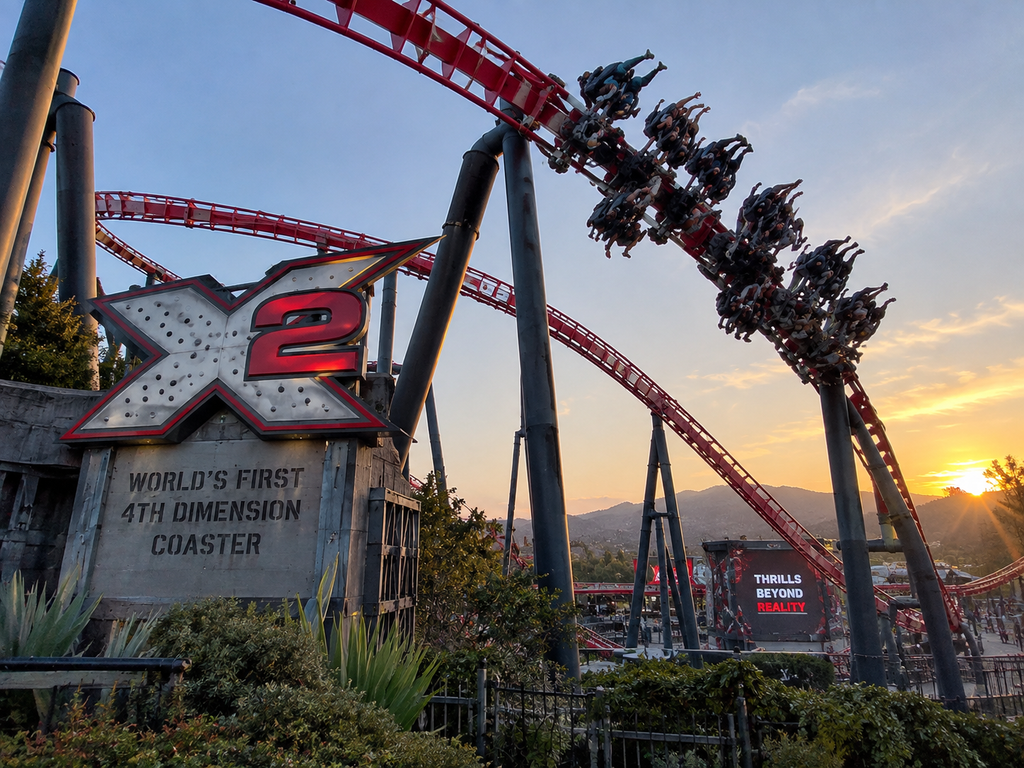
Both had ridden X2.
Both suffered severe brain injuries requiring emergency surgery.
And their rides took place just six days apart.
The cases attracted attention for an obvious reason. How could an amusement park ride potentially be associated with an injury as serious as bleeding around the brain?
The scientific answer is more complicated than the headlines suggest.
Rare neurological injuries following roller coaster rides have appeared in medical literature for decades. At the same time, biomechanical research has found that head accelerations measured on normally operating roller coasters can remain far below conventional injury thresholds.
Understanding how both statements can be true requires looking beyond speed and G-forces.
A birthday trip that ended in emergency brain surgery
On July 5, 2026, Pamela “Pam” Guillen visited Six Flags Magic Mountain with her family to celebrate her daughter’s 16th birthday.
One of the rides they chose was X2.
Even by roller coaster standards, X2 is unusual. Riders sit in seats capable of rotating 360 degrees forward and backward independently of the train’s movement along the track. The ride includes a drop of roughly 200 feet, or 61 meters, and can reach approximately 76 mph, or 122 km/h.
What happened after Pam rode X2 turned a family celebration into a medical emergency.
She was taken by ambulance to a hospital, where doctors discovered an acute subdural hematoma causing dangerous pressure on her brain.
Emergency neurosurgery was required.
CNN later reported that her doctors attributed the severe injury to a rapid acceleration-deceleration traumatic event during the X2 ride.
While Pam was hospitalized, X2 continued operating.
Six days later, 25-year-old Naomi Greer-Wilkinson rode it.
After getting off, she collapsed.
Naomi was transported to the same hospital and also required emergency brain surgery. Her parents later described the severity of her condition to CNN, and her prognosis remained uncertain at the time the network investigated the cases.
Two patients suffering catastrophic neurological injuries after riding the same attraction within less than a week inevitably raised questions.
But two cases alone cannot tell us precisely what happened.
X2 had faced serious allegations before
The 2026 incidents were not the first time X2 had been associated with allegations of major injury.
As part of its investigation, CNN examined earlier lawsuits involving riders who allegedly suffered serious brain injuries.
Among the cases was that of 22-year-old Christopher Hawley, who died after riding X2 in 2022. CNN reported that the medical examiner listed his cause of death as blunt head trauma sustained in an amusement-ride accident.
A wrongful-death lawsuit followed and was ultimately settled. A settlement, however, is not the same thing as a court finding that a ride’s design caused an injury.
That distinction matters.
Six Flags has argued in litigation cited by CNN that X2 undergoes daily inspections and that the forces experienced by riders using the attraction as instructed should not be sufficient to cause traumatic brain injury.
Following the July incidents, X2 was taken out of operation. Six Flags told CNN that the ride had been closed since shortly after Naomi’s injury.
Yet the central medical question extends far beyond one ride in California.
Can rapid movement cause bleeding around the brain even when there is no obvious high-speed collision?
What happens during a subdural hematoma?
The brain is protected by several layers of tissue called the meninges. One of them, the dura mater, sits close to the inside of the skull.
Veins known as bridging veins travel between structures surrounding the brain and its venous drainage system.
When these vessels tear, blood can collect beneath the dura. This is known as a subdural hematoma.
The danger comes partly from the skull itself.
Unlike swelling elsewhere in the body, an expanding collection of blood inside the skull has nowhere to go. As the hematoma grows, pressure on the brain can increase, sometimes making emergency surgery necessary.
A direct blow to the head is one well-established way such an injury can occur.
But researchers have also examined another mechanism: rapid acceleration, deceleration and rotation of the head.
These movements can create stretching and shearing forces within the structures surrounding the brain. Under certain circumstances, researchers have proposed that those forces could damage bridging veins.
This possibility did not emerge because of X2.
Doctors had been reporting unusual neurological events following roller coaster rides long before the 2026 cases.
The medical literature contains some unsettling cases
In 1994, physicians reported the case of a 26-year-old man who developed a progressively worsening headache after riding a roller coaster.
Imaging revealed bilateral chronic subdural hematomas.
More than a decade later, doctors described a teenager diagnosed with a subdural hematoma 14 days after a roller coaster ride.
The authors discussed the combination of vertical, front-to-back and rotational acceleration and deceleration as a possible mechanism. Such movements, they proposed, could create stretching and shearing forces capable of damaging bridging veins.
Then, in a case published in 2019, a previously healthy teenage girl arrived at a pediatric emergency department two days after riding a roller coaster.
Her symptoms were not subtle.
She had developed a new seizure and hemiplegia, meaning paralysis affecting one side of her body.
Doctors diagnosed a subdural hematoma.
Read in isolation, cases like these can make roller coasters sound alarmingly dangerous.
That would be the wrong conclusion.
Why a collection of frightening cases does not tell us your risk
Case reports serve an important purpose in medicine. They allow clinicians to document unusual events, identify patterns and alert other doctors to diagnoses they might otherwise overlook.
But there is an important limitation.
A case report does not establish how frequently something happens in the general population. And the fact that one event follows another does not automatically prove that the first caused the second.
A review published in Annals of Emergency Medicine in 2002 examined neurological complications associated with roller coaster rides that had appeared in medical literature since 1979.
The authors identified reports involving four subdural hematomas, four internal carotid artery dissections, two vertebral artery dissections, two subarachnoid hemorrhages, one intraparenchymal hemorrhage and one carotid thrombosis accompanied by stroke.
Those reports establish that serious neurological events following roller coaster rides have been documented.
They do not establish that such outcomes are common.
A 2025 review focusing on pediatric neurological injuries associated with roller coasters similarly described intracranial hemorrhage and vascular injuries as rare events.
And this leads to an intriguing problem.
If roller coaster forces are capable of causing these injuries, why aren’t they seen far more often?
Researchers put the rides themselves to the test
Instead of studying only people who became ill after riding, researchers have also measured what happens to the head during an actual roller coaster ride.
One study published in the Journal of Neurotrauma recorded three-dimensional head movements on three roller coasters and compared them with other events, including a simulated low-speed car crash.
The comparison produced a result that may seem surprising given the medical cases.
One biomechanical measure used to assess head injury risk reached 28.1 during the simulated car crash but only 4.1 during the roller coaster rides. Another head-motion measure was also more than six times higher in the simulated crash.
The researchers found that linear and rotational head accelerations recorded on the roller coasters were below those associated with many other activities they examined.
Their conclusion was that head movements produced by the roller coasters under the conditions tested presented an extremely low risk of traumatic brain injury.
That finding does not make the medical cases disappear.
Instead, it changes the question.
Perhaps the issue is not whether a normally operating roller coaster routinely exposes the average brain to traumatic forces.
Perhaps the harder question is why a very small number of people appear to experience serious injuries under circumstances that most riders tolerate without such outcomes.
The “average rider” does not represent every human body
Individual vulnerability matters in medicine.
Age, vascular anatomy, previous head injuries and underlying abnormalities can potentially affect how a person responds to mechanical forces.
One published case demonstrates why medical history can be crucial.
A 20-year-old man developed a chronic subdural hematoma after riding a large roller coaster. But there was an important detail: months earlier, he had been involved in a motorcycle accident and had subsequently been diagnosed with a subdural fluid collection.
The roller coaster experience therefore did not occur in an otherwise uncomplicated neurological history.
That does not explain every case.
A 2009 report, for example, described a 45-year-old woman without significant previous medical problems who developed a subdural hematoma after a roller coaster ride.
The 2025 pediatric review also highlighted previous head trauma and vascular abnormalities among factors that may deserve particular consideration when assessing susceptibility.
This is one reason safety statistics and individual outcomes can look so different.
Engineering standards must necessarily deal with populations and expected tolerances.
Medicine eventually deals with the person who is actually lying in the hospital bed.
G-force is only part of the story
Roller coaster discussions often revolve around one number: G-force.
It is easy to assume that a ride producing more Gs must automatically be more dangerous to the brain.
Brain biomechanics are considerably more complicated.
Researchers studying head injury consider not only the magnitude of acceleration but also its direction, duration and rotational component.
The acceleration experienced by the entire body is therefore not interchangeable with the mechanical forces acting on brain tissue.
An earlier analysis of high-G roller coasters likewise concluded that estimated head accelerations remained substantially below conventional head-injury thresholds, even when researchers used deliberately conservative assumptions.
This helps explain an apparent contradiction.
A ride can operate within biomechanical ranges considered safe for typical riders while medicine can still document rare neurological events occurring afterward.
Those statements describe different parts of the same problem.
The symptoms may not always begin immediately
There is another reason these cases matter.
Not every serious neurological complication announces itself the moment the restraints open.
The 26-year-old man described in the 1994 report developed a progressively worsening headache. The teenager described in the 2006 report was diagnosed two weeks after the ride. Other published cases have also involved delayed neurological symptoms.
This should not be interpreted to mean that an ordinary headache after a theme park visit is evidence of bleeding around the brain.
The serious complications described in the literature are rare.
But a sudden or unusually severe headache, repeated vomiting, loss of consciousness, confusion, difficulty speaking or seeing, weakness or numbness affecting one side of the body, severe balance problems or a seizure after intense acceleration or head movement should not simply be dismissed as an adrenaline hangover.
Those are neurological warning signs that warrant urgent medical assessment.
So, can a roller coaster cause a brain bleed?
The most accurate answer is not a dramatic yes or a reassuring no.
Medical literature contains documented cases of subdural hematomas and other neurological injuries occurring after roller coaster rides. Researchers have proposed plausible mechanisms involving rapid acceleration, deceleration and rotational movement.
At the same time, biomechanical studies of normally operating roller coasters have measured head accelerations far below conventional traumatic brain injury thresholds.
The available evidence therefore does not support the claim that ordinary roller coaster riding commonly causes brain injury.
Nor does it justify pretending that serious neurological events following these rides have never occurred.
That distinction is exactly what makes the X2 story worth examining.
When CNN interviewed Pam Guillen after her injury, she was walking again, but recovery had not returned her immediately to her previous life. She described continuing headaches and becoming exhausted by simple activities.
Naomi Greer-Wilkinson remained hospitalized when CNN reported on the cases, with her family facing uncertainty about what recovery would look like.
For everyone else, the story leaves behind an uncomfortable lesson about the way we understand safety.
“Very unlikely” and “impossible” are not synonyms.
Modern thrill rides are built around the idea that extreme sensations can exist inside controlled limits. Most of the time, that is exactly what riders experience: a few intense minutes followed by an ordinary walk back through the park.
Medicine, however, tends to encounter the exceptions.
And sometimes those rare exceptions reveal something that statistics alone cannot: a risk can be extremely small at the population level while becoming life-changing for the individual who happens to experience it.