
Some travel stories sound exaggerated until you start checking the details.
One such story comes from Sakhalin, the large Russian island in the North Pacific. In the autumn of 2010, Romanian seafarer Cristi Ioancea recalled arriving at a terminal there and noticing several men beside a shallow stream. From the ship, the crew watched them through binoculars as they repeatedly struck the water with sticks.
At first, nobody understood what they were doing.
According to Ioancea, a Russian pilot on board explained that the men were catching salmon. The fish had entered the shallow water during their spawning migration, making them unusually easy to reach.
Taken on its own, the scene sounds almost absurd. But the biology of Pacific salmon — and the history of poaching on Sakhalin — makes the broader setting surprisingly believable.
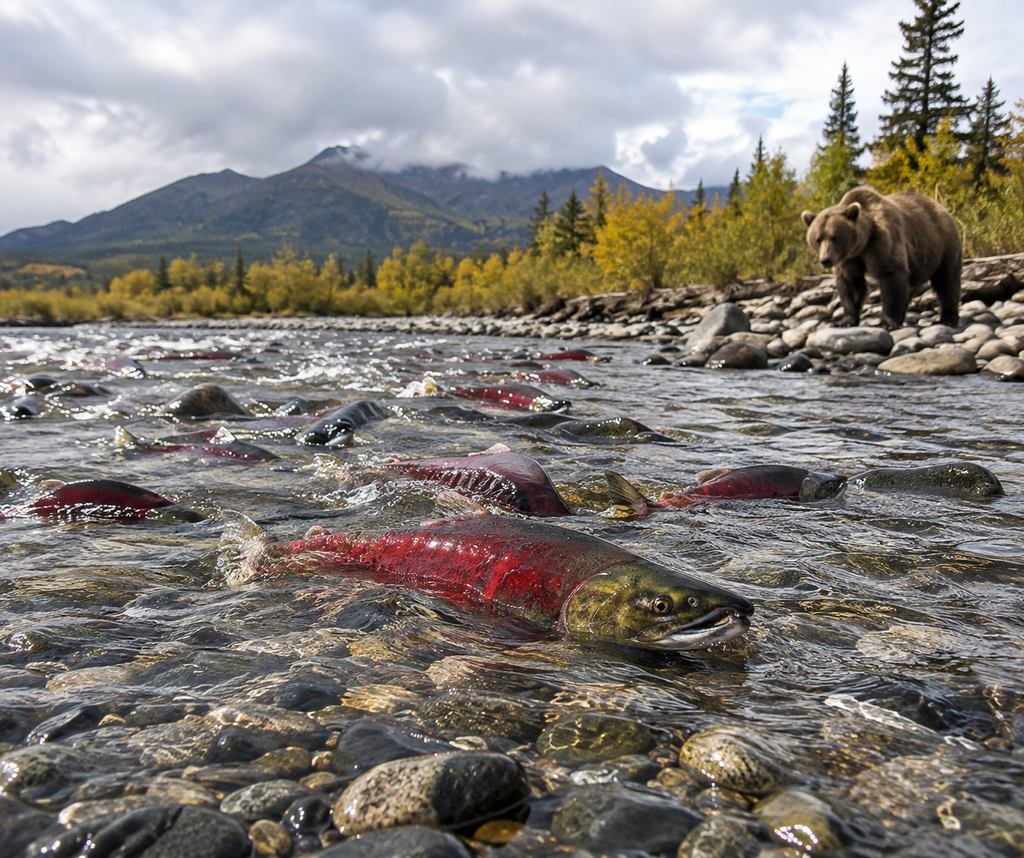
Sakhalin is one of the great salmon landscapes of the Russian Far East
Sakhalin lies between the Sea of Okhotsk and the Sea of Japan, just north of Hokkaido. Its rivers support several species of Pacific salmon, including pink salmon, Oncorhynchus gorbuscha, and chum salmon, Oncorhynchus keta.
Their life cycle is extraordinary.
The fish hatch in freshwater, migrate toward the ocean, spend part of their lives feeding at sea and later return to freshwater to reproduce. During major runs, large numbers of adult salmon can enter river systems within a relatively short period.
Historical reporting from Sakhalin gives some idea of the scale involved. A 1998 Christian Science Monitor report described a river near Korsakov where the concentration of salmon moving upstream was so intense that the water appeared to boil with fish. The same report focused on illegal harvesting driven largely by the value of salmon roe.
The Wild Salmon Center has documented similarly important spawning systems elsewhere on the island. On the Tym River, salmon historically traveled deep into the watershed, in some cases reaching spawning areas roughly 150 kilometers upstream.
In smaller tributaries, the spectacle can become even more dramatic. Large adult fish may be forced through narrow stretches of relatively shallow water, often in dense concentrations.
That is the biological background that makes Ioancea’s account less implausible than it initially sounds.
Why salmon enter such shallow streams
The fish are not trapped there by accident.
They are completing their reproductive migration.
Female salmon search for suitable gravel beds with well-oxygenated water. Using their tails, they disturb the riverbed and create nests where eggs are deposited. Males then fertilize them.
For species such as pink and chum salmon, spawning is also the final stage of life. They are semelparous, meaning they reproduce once and die afterward.
This life strategy creates a remarkable seasonal event: fish that spent much of their lives in the ocean suddenly concentrate in rivers, streams and tributaries that may be vastly smaller than the marine environment they came from.
The timing in Ioancea’s account also fits known salmon biology. Research involving chum salmon from the Sakhalin-Kuril region examined spawning adults collected between September 19 and November 4, showing that late September falls well within the reproductive period for some regional populations.
Could someone really catch salmon with a stick?
This is the part of the story that requires the most caution.
There is not enough reliable evidence to describe striking salmon with sticks as a standard or lawful fishing method on Sakhalin.
Regional fishing rules restrict or prohibit a range of methods that injure fish or capture them through unauthorized means.
But a distinction needs to be made between saying that something is an established fishing technique and saying that it could physically happen.
A large salmon moving through very shallow water is far more exposed than the same fish in the open sea or in a deep river channel. During heavy spawning runs, many fish may pass through a confined stretch at once.
Reports on illegal salmon fishing in Sakhalin show how readily that vulnerability can be exploited.
A detailed assessment of pink salmon fisheries in northeastern Sakhalin described poachers using nets in rivers and, in some smaller streams, barriers that could prevent fish from continuing toward spawning grounds.
Another Wild Salmon Center report noted that some Sakhalin rivers are narrow enough for a net stretched from bank to bank to interfere with virtually the entire salmon migration.
So the exact method described by Ioancea remains an eyewitness account that cannot be independently confirmed. What can be confirmed is the underlying situation: large salmon really do become highly exposed in shallow spawning streams, and illegal interception of those fish has been repeatedly documented.
The real prize was often the roe
Another detail from the story becomes particularly significant once the wider context is examined.
Ioancea recalled that members of the crew could buy containers of salmon roe and that a local agent was expected to bring additional quantities before the ship departed.
Salmon roe has long had substantial commercial value in the Russian Far East, and that value has also helped drive illegal fishing.
Reports from northeastern Sakhalin describe poachers targeting female salmon close to spawning areas, removing the roe, salting it and sometimes discarding the remaining fish.
The scale could be remarkable.
During a 2014 operation on the Pilngi River, authorities and conservation workers seized more than 2,000 pounds — over 900 kilograms — of salmon roe from a poaching camp, according to the Wild Salmon Center. The organization also reported discarded salmon carcasses associated with the operation.
Similar practices were documented on the Tym River, where fish could be opened for their roe while the rest of the carcass was treated as having relatively little value.
Anti-poaching operations eventually became a major part of salmon conservation efforts on the island. In 2013, the Wild Salmon Center reported more than 200 patrols covering at least 60 rivers across Sakhalin.
Why catching a spawning salmon matters more than it seems
Removing a fish from a spawning stream is not simply the loss of one adult salmon.
That fish may represent part of the next generation.
Fisheries science therefore pays close attention to how many adults survive fishing pressure and successfully reach spawning grounds. The concept is commonly known as spawning escapement.
If too many salmon are intercepted before they reproduce, the consequences can extend beyond a single season.
The Tym River provides an instructive example. The Wild Salmon Center has reported that heavy poaching once prevented many salmon from reaching upstream habitat. As enforcement and river protection improved, stronger migrations began appearing farther into the watershed again.
The ecological importance of a spawning run therefore lies not only in the number of fish visible in the water, but in how many of them are able to complete the journey.
Salmon do something else remarkable: they carry the ocean inland
There is another dimension to salmon migration that is easy to miss.
The fish do not return to rivers carrying only eggs and sperm. They also bring marine nutrients into freshwater ecosystems.
Much of a salmon’s body mass is built while feeding in the ocean. After spawning, the adults die, and their remains become food for birds, mammals, insects and microorganisms.
Some of those nutrients eventually enter the surrounding soil and vegetation.
In this way, salmon form an extraordinary biological link between ocean, river and forest. A spawning stream is not simply a place where fish reproduce. It is part of a much larger nutrient cycle that supports an entire ecosystem.
So how much of the original story can be verified?
The exact scene witnessed from the ship in 2010 cannot be independently reconstructed.
We cannot establish who the men beside the stream were, exactly what they were doing, or whether the pilot’s explanation captured every detail correctly.
That portion remains a personal recollection.
The world around the story, however, is well documented.
Sakhalin really does support major Pacific salmon runs. Fish enter rivers and small tributaries in large numbers to reproduce. Late September is consistent with the spawning migration of some local populations. Shallow water can leave large adult salmon unusually exposed, and poaching in spawning rivers has been a serious and extensively documented problem.
The enormous value of salmon roe adds another layer that fits the historical record.
There are even older reports from the Korsakov area describing rivers so full of migrating salmon that the surface seemed alive with fish, alongside illegal harvesting connected with roe.
Perhaps that is why the story remains so memorable.
From the deck of a ship, watching people strike the water of a small stream may have looked almost incomprehensible.
For the salmon beneath them, however, that narrow stretch of water represented the end of a journey that began far out at sea — and the place where the next generation was supposed to begin.