
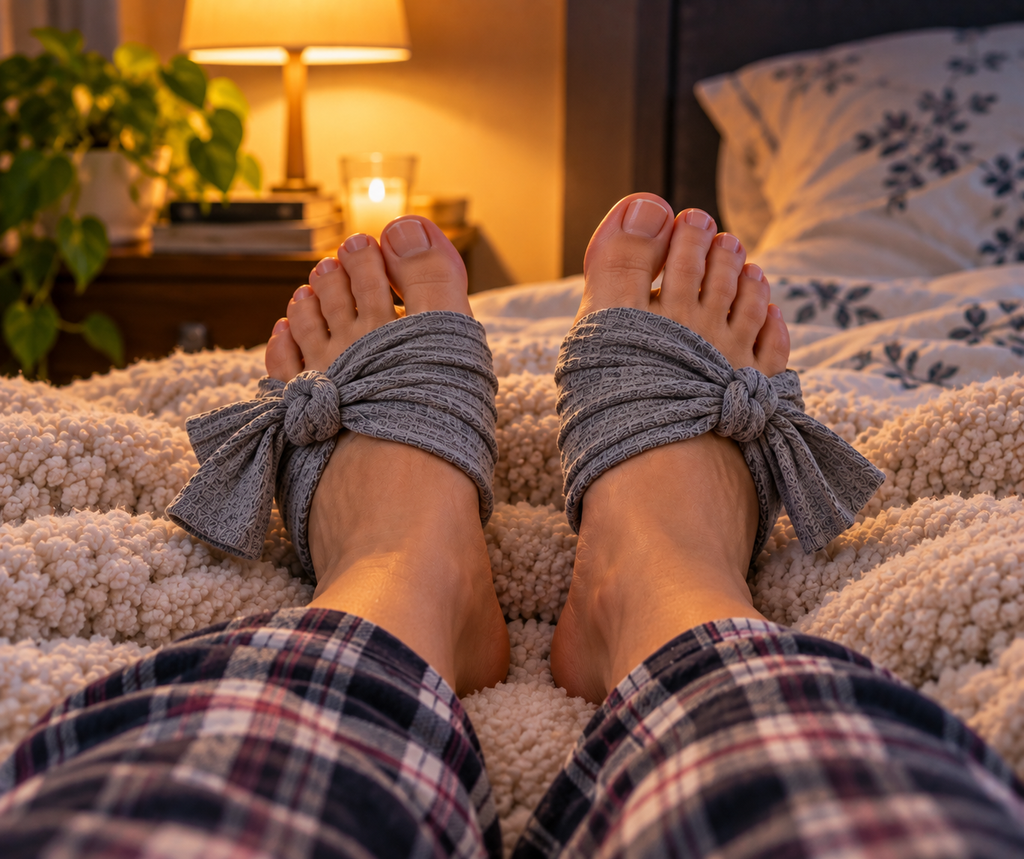
A strange sleep hack has been making the rounds on social media: tie a sock or a strip of fabric around your foot, and the maddening urge to move your legs at night supposedly disappears.
The comments beneath videos demonstrating the trick make the story even more intriguing. Some people swear that pressure on their feet helps them sleep. One person says the symptoms vanish when a cat settles across their legs. Others recommend heated blankets, hot baths, Epsom salts or magnesium glycinate.
It would be easy to dismiss the entire discussion as another collection of internet remedies.
But that would miss the most interesting part of the story.
There is legitimate research suggesting that certain kinds of controlled pressure and sensory stimulation may reduce restless legs symptoms in some people. The science, however, is very different from the idea that cutting off circulation with a tightly knotted sock is a good treatment.
Restless legs syndrome is more than simply feeling fidgety
Restless legs syndrome, or RLS, is also known as Willis-Ekbom disease. It is a neurological and sleep-related disorder characterized by a powerful urge to move the legs, often accompanied by uncomfortable sensations that can be surprisingly difficult to describe.
People may talk about crawling, pulling, tingling, aching or an internal restlessness that seems to come from deep inside the legs.
What matters diagnostically is not simply the sensation itself but the pattern in which it occurs.
Symptoms typically begin or become worse during periods of inactivity, such as sitting for a long time or lying in bed. Moving the legs provides at least temporary relief, and symptoms tend to become more troublesome in the evening or at night.
These characteristics are central to the clinical definition of RLS described by sleep-medicine specialists. The American Academy of Sleep Medicine (AASM) also emphasizes this characteristic relationship between rest, movement and time of day. American Academy of Sleep Medicine guidance on RLS
That distinction matters because restless legs syndrome is not synonymous with nighttime leg cramps.
A cramp involves a sudden, painful and involuntary muscle contraction. With RLS, the defining feature is the urge to move, particularly during rest.
The pressure idea isn’t entirely invented
This is where the viral story takes an unexpected turn.
Researchers really have investigated whether applying pressure to the legs can reduce RLS symptoms.
A randomized, double-blind, sham-controlled study published in Chest evaluated pneumatic compression devices in 35 people with restless legs syndrome. Participants used either therapeutic compression or a sham device for at least an hour each day, generally before their symptoms would normally begin.
After one month, the therapeutic group showed greater improvement across several measures, including RLS severity, than the sham group. Study on pneumatic compression devices and RLS
That is genuinely interesting evidence.
It is also a small study, and it certainly does not establish that any object tied around a foot will reproduce the effect.
Controlled compression delivered by a device and constriction produced by a tightly knotted sock are two very different things.
Pressure is not the same thing as cutting off circulation
This is the most important problem with copying the viral trick literally.
The goal of therapeutic compression is not to deprive the foot of blood.
A sock, band or piece of fabric tied tightly enough around the foot or ankle can compress nerves and blood vessels. Increasing the tightness does not turn it into a more effective RLS treatment.
Numbness, unusual tingling, increasing pain, a cold foot or changes in skin color should never be interpreted as signs that the method is “working.”
They can instead indicate excessive compression.
So the evidence does support a fascinating proposition — sensory input and some carefully controlled forms of compression may influence RLS symptoms — but it does not support turning a sock into an improvised tourniquet.
What about the person whose cat apparently cured their restless legs?
One of the more memorable comments beneath the viral post came from someone who said their cat sleeps on their legs and the restless sensation stops.
Obviously, that is not a clinical trial.
But the experience itself is not as absurd as it might initially sound.
A cat lying across someone’s legs provides several sensations simultaneously: warmth, gentle pressure and continuous sensory stimulation.
We already know that RLS symptoms can temporarily change in response to physical stimulation, particularly movement. Some people also report relief from massage or temperature changes.
That makes temporary relief from comfortable pressure plausible.
What we cannot conclude is that cats are a treatment for restless legs syndrome. An individual’s experience can be genuine without establishing that the same intervention will work for other people.
This distinction — between a credible personal experience and evidence of an effective treatment — is important throughout health discussions on social media.
Hot baths may help, but hotter isn’t necessarily better
Another common suggestion is taking an extremely hot bath, sometimes with Epsom salts added.
Warm baths are among the simple measures people with RLS sometimes use for temporary symptom relief. Mayo Clinic also discusses measures such as massage and the use of heat or cold as possible ways of easing symptoms. Mayo Clinic: Restless legs syndrome diagnosis and treatment
But “warm” should not be translated into “as hot as you can possibly tolerate.”
Extremely hot water adds a risk of burns without evidence that pushing the temperature to uncomfortable levels makes RLS treatment more effective.
Epsom salts create another common misconception. They contain magnesium, but that fact alone does not demonstrate that soaking in an Epsom salt bath delivers enough magnesium through the skin to treat restless legs syndrome.
The comforting effects of a warm bath and claims about transdermal magnesium are separate questions.
Magnesium is much less settled than social media makes it sound
Magnesium has become one of the internet’s favorite explanations for nighttime leg symptoms.
The evidence for restless legs syndrome is considerably less straightforward.
A systematic review published in Sleep Medicine Reviews examined magnesium supplementation for RLS and periodic limb movement disorder. The available evidence was too limited to establish whether magnesium was an effective treatment or determine which patients might benefit. Systematic review of magnesium and restless legs syndrome
There have been positive findings since then. A randomized study involving 75 participants reported improvement after two months among participants receiving magnesium or vitamin B6 compared with placebo. Importantly, the magnesium used in that study was magnesium oxide — not magnesium glycinate, the formulation frequently recommended in social-media comments. Randomized trial of magnesium and vitamin B6 in RLS
A 2026 systematic review examining randomized trials of magnesium and sleep-related outcomes, including RLS, nevertheless found inconsistent results and generally low or very low certainty of evidence. 2026 systematic review of magnesium supplementation and sleep
Someone saying “magnesium glycinate helped me” may therefore be accurately describing their own experience.
That is very different from saying magnesium glycinate is an established treatment for restless legs syndrome.
The mineral that matters much more in modern RLS guidelines is iron
Iron receives less attention in viral comment sections, but considerably more attention in contemporary medical guidance.
The AASM’s current clinical practice guideline emphasizes routinely assessing iron status in people with clinically significant RLS. This involves more than simply asking whether someone has anemia.
The guideline specifically discusses serum ferritin and transferrin saturation, with iron, total iron-binding capacity and related measurements used to assess iron status. AASM clinical practice guideline for RLS and periodic limb movement disorder
This is particularly important because the thresholds used when considering iron treatment in RLS differ from the way iron deficiency may be approached in the general population.
For adults, the guideline’s good-practice statement cites expert-consensus thresholds under which oral or intravenous iron may be considered when ferritin is at or below 75 ng/mL or transferrin saturation is below 20%. It also notes that intravenous iron may be considered when ferritin is between 75 and 100 ng/mL.
The guideline explicitly notes that these thresholds are based on consensus and have not themselves been empirically tested as absolute cutoffs. AASM RLS guideline: iron evaluation and treatment
For appropriately selected adults, the guideline gives a strong recommendation to intravenous ferric carboxymaltose. AASM summary of the updated RLS treatment recommendations
None of this means that people experiencing restless legs should begin taking iron on their own.
It means that persistent RLS symptoms provide a reason to discuss iron testing with a healthcare professional rather than automatically reaching for whichever supplement happens to be trending online.
You can have relevant iron issues without being anemic
This point is easy to overlook.
A normal hemoglobin result does not by itself answer all the questions about iron status that can be relevant to restless legs syndrome.
That is why contemporary RLS guidance looks specifically at measures such as ferritin and transferrin saturation rather than using anemia alone as the deciding factor. AASM clinical practice guideline
At the same time, finding a particular ferritin level does not prove that iron is causing someone’s symptoms. Laboratory values have to be interpreted alongside the person’s medical history and symptoms.
Sometimes the first treatment question is what might be making RLS worse
Another major change in the way restless legs syndrome is approached is the emphasis on aggravating factors.
The AASM guideline recommends addressing these before simply adding medication. Potential exacerbating factors include alcohol, caffeine, certain antihistaminergic, serotonergic and antidopaminergic medications, as well as untreated obstructive sleep apnea. AASM clinical practice guideline
This can be especially relevant when symptoms suddenly become more frequent.
A new medication, increased caffeine intake, changes in sleep or another medical issue may provide more useful clues than the assumption that a single vitamin or mineral deficiency must be responsible.
When restless legs deserve a medical evaluation
Occasional restlessness after a long day does not automatically mean someone has RLS.
The pattern becomes more suggestive when the urge to move repeatedly appears during rest, becomes worse in the evening or at night, improves with movement and begins interfering with falling asleep or staying asleep.
Persistent pain, swelling, weakness, continuous numbness or other neurological or vascular symptoms deserve particular attention because they may point toward something other than classic RLS.
Restless legs syndrome is largely a clinical diagnosis. Laboratory testing is useful not because there is a single “RLS blood test,” but because it can uncover contributing factors — particularly abnormalities involving iron.
So does the viral sock trick actually work?
There is no good evidence that tying a sock tightly around your foot is a treatment for restless legs syndrome.
But dismissing the entire phenomenon as nonsense would also miss something important.
Controlled compression has been studied, and there is evidence that it can reduce RLS symptoms in at least some patients. The randomized trial of pneumatic compression provides a scientific reason to take the broader pressure phenomenon seriously, although its small size means the findings should not be stretched beyond what was actually tested. Randomized controlled trial of pneumatic compression for RLS
What the research does not tell us to do is restrict blood flow with a homemade band around the foot.
And perhaps that distinction captures something larger about health advice on social media.
One person feels better after applying pressure. Another finds relief in warmth. Someone takes magnesium and sleeps better. Another notices that the symptoms disappear whenever a cat curls up across their legs.
Those experiences do not necessarily have to be imaginary for the conclusions drawn from them to be wrong.
The leap happens when “this helped me” quietly becomes “this is the treatment.”
The science of restless legs syndrome tells a more nuanced story. Sensory stimulation and some forms of controlled compression may help. The evidence for magnesium remains uncertain. Iron status plays an important role in modern clinical management. And deliberately impairing circulation with a tightly tied sock is not what researchers mean when they study therapeutic compression.
That may be the most useful question to ask the next time an oddly specific health hack goes viral.
Not simply, “Does it work?”
But “What, exactly, was shown to work — and is that actually the same thing people on social media are doing?”