
Reusable stainless steel bottles have become an everyday item for adults and children alike. They are durable, easy to carry, resistant to breaking, and often chosen as an alternative to single-use plastic.
So it is understandable that a viral warning suggesting these bottles could be exposing people to potentially harmful metals has attracted attention.
The claim usually goes something like this: stainless steel contains nickel and chromium, acidic drinks such as lemon water can cause those metals to migrate into the liquid, and repeatedly drinking from the bottle may therefore expose the body to unwanted metals. Some versions of the claim go even further, connecting stainless steel bottles with histamine reactions, hives, inflammation, and risks to children.
There is one important reason the story sounds convincing: stainless steel really can release small amounts of certain metals under particular conditions.
What the viral version often leaves out is everything that determines whether that observation actually represents a meaningful health risk.
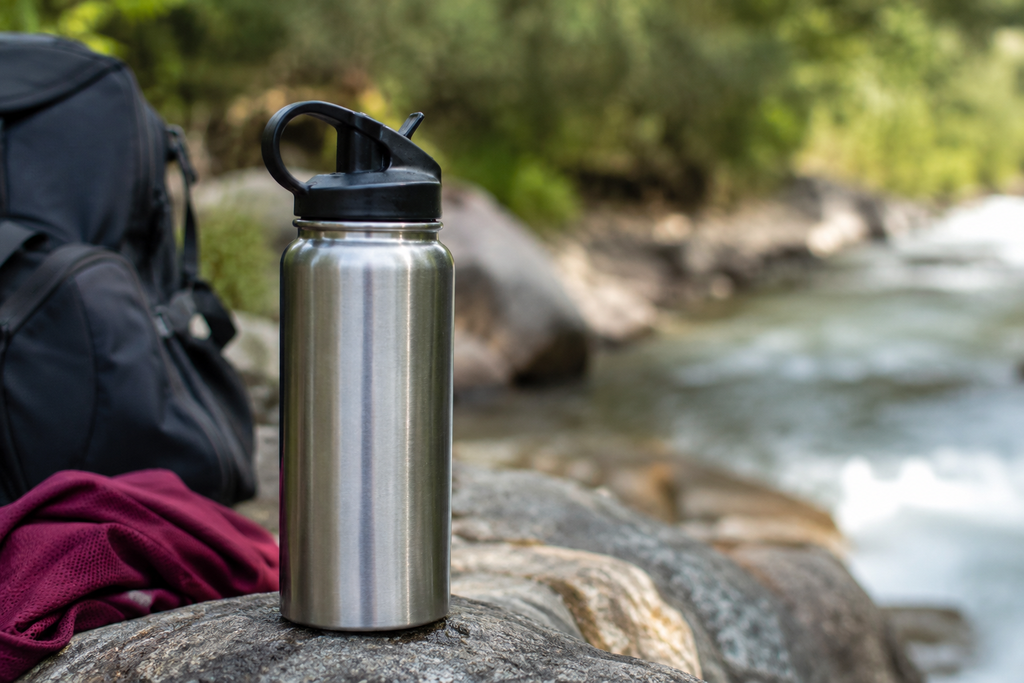
Stainless steel isn’t a single metal
Despite its name, stainless steel is an alloy rather than a pure substance. Different grades contain different combinations of iron, chromium, nickel and, in some cases, elements such as molybdenum or manganese.
Chromium is especially important because it helps stainless steel resist corrosion. When exposed to oxygen, chromium at the surface contributes to the formation of an extremely thin protective layer, commonly described as a passive film.
Nickel is also present in many common stainless steel grades. It helps stabilize the structure of the alloy and contributes to properties that make stainless steel useful in kitchens, food-processing environments and many other applications.
In other words, discovering that a bottle contains chromium or nickel is not evidence that something has gone wrong. These metals are part of the material itself.
The more useful question is whether they can migrate from that material into a beverage — and, if they do, in what amounts.
Can metals migrate from stainless steel into food and drinks?
Yes.
Researchers have measured the release of nickel and chromium from stainless steel under various experimental conditions.
One frequently cited study published in the Journal of Agricultural and Food Chemistry investigated stainless steel cookware used to prepare tomato sauce. Researchers found that nickel and chromium could migrate into the food, with the amounts influenced by factors including cooking time and previous use of the cookware.
Laboratory research involving stainless steel and organic acids has also demonstrated that the chemical environment surrounding the metal matters.
This establishes something important: stainless steel should not be described as perfectly inert under every imaginable condition.
But it does not establish that drinking water from a stainless steel bottle causes metal poisoning.
Those are two very different conclusions.
Modern analytical equipment can detect extremely small concentrations of substances. Detecting a chemical does not, by itself, tell us whether the dose is large enough to produce harm.
Why lemon water gets so much attention
Acidity is one of the factors that can influence metal release.
This is why lemon juice, orange juice, tomato-based foods and other acidic products frequently appear in discussions about stainless steel.
Organic acids can interact with metal surfaces differently from ordinary drinking water. Temperature and contact time can further affect that interaction.
That distinction matters enormously in everyday life.
A laboratory experiment involving an acidic solution exposed to metal for an extended period is not equivalent to filling a bottle with cold tap water and drinking it over the next few hours.
Similarly, lemon water consumed shortly after it is prepared cannot automatically be treated as equivalent to a strongly acidic drink stored in a metal container overnight.
The combination of acidity, temperature and prolonged contact generally deserves more attention than any one of those factors considered alone.
For someone who regularly stores strongly acidic beverages for long periods, a glass container is an easy alternative. That is a precautionary choice, not evidence that briefly putting lemon water into stainless steel is inherently dangerous.
What do 18/8 and 18/10 actually mean?
Many bottles are advertised as being made from “18/8 stainless steel.” Cookware may also carry the designation 18/10.
These numbers broadly refer to the proportions of chromium and nickel in the material.
A common 18/8 stainless steel contains roughly 18% chromium and 8% nickel. The familiar 18/10 designation indicates a similar chromium content with approximately 10% nickel.
These descriptions are commonly associated with austenitic stainless steels used in food-related products.
One of the most widespread grades is 304 stainless steel, which is frequently used in kitchenware, food-processing equipment and reusable bottles.
The fact that it contains nickel does not mean that 304 stainless steel should automatically be considered unsafe. Its behavior depends on the finished material and how it is used, not simply on the presence of nickel in the alloy.
Is 316 stainless steel better?
Grade 316 stainless steel is sometimes marketed as a premium alternative.
Unlike 304, it contains molybdenum, which improves resistance to certain types of corrosion, particularly in challenging environments involving chlorides.
This is one reason 316 stainless steel is used in demanding industrial, marine and medical applications.
That additional corrosion resistance can certainly be desirable, but social-media discussions sometimes turn this into an overly simplistic rule: 316 is “safe” while 304 is “unsafe.”
The science does not support such a binary distinction.
Both grades have extensive practical applications. Whether a particular bottle is appropriate also depends on manufacturing quality, surface treatment, its intended use and what is stored inside it.
Paying more for 316 can provide greater corrosion resistance. It does not mean that a properly manufactured 304 bottle intended for drinking water is inherently hazardous.
What about cheaper 201 stainless steel?
Grade 201 has a different composition and generally contains less nickel than 304, with other elements such as manganese helping achieve the desired properties.
It also does not have exactly the same corrosion resistance as 304 or 316.
That does not make every product manufactured from 201 stainless steel dangerous. However, for something that will repeatedly hold beverages for years, it makes sense to buy a product from a manufacturer that clearly identifies the material and confirms that the item is intended for food or beverage contact.
A bottle with no meaningful material information from an unknown source gives the consumer much less information with which to judge its quality.
How much nickel is actually relevant to health?
This is where the conversation changes from chemistry to toxicology.
The European Food Safety Authority (EFSA) has evaluated dietary exposure to nickel and established a tolerable daily intake for chronic exposure of 13 micrograms per kilogram of body weight per day.
For a 70-kilogram adult, that corresponds to approximately 910 micrograms per day.
That number should not be interpreted as a boundary between “safe” and “poisoned.” A tolerable daily intake is a toxicological reference value designed to evaluate repeated exposure over time.
It does, however, illustrate why simply announcing that nickel has been detected in a beverage tells us very little without knowing the concentration.
Dose matters.
Nickel allergy is an important exception
Nickel deserves special attention because it is a well-established contact allergen.
People commonly associate nickel allergy with reactions to jewelry, watch straps, buttons or other objects that touch the skin. However, some individuals who are already sensitized to nickel can also experience symptoms following systemic exposure.
EFSA’s assessment of nickel has considered acute reactions in nickel-sensitized individuals as a distinct issue from the chronic effects evaluated for the general population.
This means that advice appropriate for most people may not necessarily apply in exactly the same way to someone with a significant, medically confirmed nickel sensitivity.
For such individuals, choosing glass for acidic beverages can be a straightforward way of reducing an avoidable source of exposure.
However, restrictive low-nickel diets should not be started simply because of a social-media video. Nickel occurs naturally in many foods, and people with suspected clinically significant sensitivity should discuss appropriate management with a physician or allergist.
Chromium needs context too
The word “chromium” can sound alarming because different chemical forms of chromium have very different toxicological profiles.
In particular, hexavalent chromium, Cr(VI), is associated with serious health hazards in certain occupational and environmental exposure settings.
That fact is sometimes used online to make any reference to chromium sound frightening.
But saying that stainless steel contains chromium is not the same as demonstrating dangerous exposure to hexavalent chromium from drinking out of a bottle.
Chemical form, concentration, exposure route and dose all matter.
Treating every mention of “chromium” as though it referred to the same hazard is scientifically misleading.
Do new stainless steel products release more metals?
Some experimental research involving stainless steel cookware has found that metal release can be influenced by how many times an item has been used.
In the tomato-sauce study, for example, repeated cooking cycles affected nickel and chromium release.
This is useful information, but it also demonstrates why research needs to be interpreted carefully. Cooking acidic tomato sauce in a stainless steel pot is a much more aggressive exposure scenario than keeping room-temperature drinking water in a bottle.
Results from one situation should not automatically be transferred to another without considering those differences.
Is coffee safe in a stainless steel thermos?
Stainless steel vacuum flasks are specifically designed to hold beverages such as coffee and tea.
Both drinks can be mildly acidic, and hot temperatures can affect chemical interactions with surfaces. But the existence of acidity and heat does not automatically make a properly manufactured stainless steel thermos unsafe.
The manufacturer’s intended use remains important. A food-contact product designed for hot beverages should be used according to its care and temperature instructions.
For coffee with milk, hygiene can become a more immediate concern than the metal itself. Milk residues can remain around seals, threads, lids and drinking mechanisms if the container is not thoroughly cleaned.
Milk presents a different problem
Milk is not comparable to lemon juice or vinegar when discussing acidity.
The more significant issue with milk is temperature control. Milk and milk-based drinks are perishable and can support bacterial growth when kept at unsafe temperatures.
A vacuum-insulated bottle may help maintain temperature, but stainless steel does not make milk shelf-stable.
This distinction is worth remembering because sometimes concerns about the material of a container distract from more ordinary food-safety risks.
What if you wash the bottle in a dishwasher every day?
This is another area where absolute rules are unhelpful.
The stainless steel itself is highly durable, but a reusable bottle consists of more than its metal walls. It may include painted coatings, printed designs, seals, plastics, adhesives and an insulated construction.
Dishwasher detergents are also strongly alkaline, while chlorides and other environmental conditions can contribute to certain types of localized corrosion in stainless steel.
The most sensible rule is therefore surprisingly simple: follow the manufacturer’s washing instructions.
If the bottle is marked dishwasher-safe, using the dishwasher as directed is reasonable.
If the manufacturer recommends hand washing, follow that recommendation. The limitation may relate to the exterior coating, lid, vacuum insulation or another component rather than to some hidden toxicity of stainless steel.
And no, putting a stainless steel bottle through a dishwasher once — or routinely washing a dishwasher-safe model that way — does not suddenly turn it into a toxic object.
Should a scratched stainless steel bottle be thrown away?
A small surface scratch does not automatically make stainless steel unsafe.
One of the valuable properties of stainless steel is that its passive surface can re-form in the presence of oxygen under suitable conditions.
Visible deterioration is a different matter.
Deep pitting, significant corrosion, persistent rusting or obvious degradation of the interior surface are sensible reasons to retire a bottle, particularly if it is an inexpensive product with unclear material specifications.
The same principle applies to many food-contact products: normal signs of use are not equivalent to failure, but serious deterioration should not simply be ignored.
Glass, stainless steel or plastic: which is best?
There is no perfect bottle material for every situation.
Glass is chemically resistant and is particularly attractive for acidic beverages. It does not contain the nickel present in many stainless steel alloys. On the other hand, glass is heavier and can break, making it less convenient for school bags, sports and travel.
Stainless steel is extremely durable, resists impact and, when vacuum insulated, can maintain beverage temperature for hours. A good-quality bottle can also last for years.
Plastic is lightweight and inexpensive, but its characteristics vary greatly according to the polymer, manufacturing quality, age of the container and intended use.
Rather than searching for a universally “non-toxic” material, it is more useful to choose a well-made container that is appropriate for the drink and the way it will be used.
What European food-contact rules actually require
Metal migration from food-contact materials is not a newly discovered problem that regulators somehow overlooked.
European food-contact legislation is built around the principle that materials must not transfer their constituents to food in quantities that could endanger human health, cause an unacceptable change in food composition or adversely affect its sensory characteristics.
The Council of Europe’s European Directorate for the Quality of Medicines & HealthCare (EDQM) has also developed technical guidance specifically addressing metals and alloys used in food-contact materials.
Scientists and regulators therefore already recognize that metals and alloys can interact with food.
The relevant question has always been how much migration occurs under realistic conditions and whether the resulting exposure is acceptable.
So should you stop using stainless steel water bottles?
For most people, there is no scientific reason to throw away a good-quality stainless steel bottle intended for food and beverage use.
A few sensible habits are enough.
Use a reputable food-contact bottle and follow its care instructions. Ordinary drinking water is not equivalent to highly acidic food used in laboratory migration experiments. If you routinely store strongly acidic drinks for many hours, glass is an easy alternative. Replace bottles that develop substantial internal corrosion or deterioration.
People with a diagnosed nickel allergy may have additional reasons to minimize unnecessary nickel exposure and can discuss their individual situation with a healthcare professional.
None of this requires treating stainless steel as a hidden poison.
The viral claim gets the chemistry right — and the risk wrong
There is a genuine scientific fact behind the viral warning: stainless steel can release measurable amounts of nickel and chromium, and factors such as acidity, temperature, contact time, alloy composition and previous use can affect that release.
But that fact alone does not demonstrate that drinking from a stainless steel bottle is poisoning you or your children.
This distinction is fundamental to toxicology.
Detection is not the same thing as danger. Exposure is not the same thing as poisoning. And the dose matters.
A social-media video can show metal ions moving dramatically from a bottle into a person’s body in a few seconds. Real-world risk assessment is considerably less dramatic because it has to answer harder questions: What metal? In what chemical form? How much was released? Under what conditions? How often is the person exposed? And is that amount sufficient to produce a biological effect?
For an ordinary stainless steel water bottle used as intended, the available evidence does not justify the claim that the bottle is quietly poisoning its owner.
The more useful takeaway is much less frightening: buy a well-made bottle, use it for what it was designed to hold, follow its cleaning instructions, and use a little extra caution with prolonged storage of highly acidic drinks.
That may not make for a frightening viral video, but it is much closer to what the science actually tells us.