
For thousands of years, humanity has looked up at essentially the same night sky. Ancient sailors navigated by the stars, early civilizations built calendars around the constellations, and generations of astronomers expanded our understanding of the universe beneath a naturally dark sky. While cities have grown brighter and light pollution has hidden many stars from view, the celestial landscape itself has remained remarkably unchanged.
Today, however, scientists are asking a question that would have seemed impossible only a few decades ago: Could human technology permanently alter the appearance of the night sky?
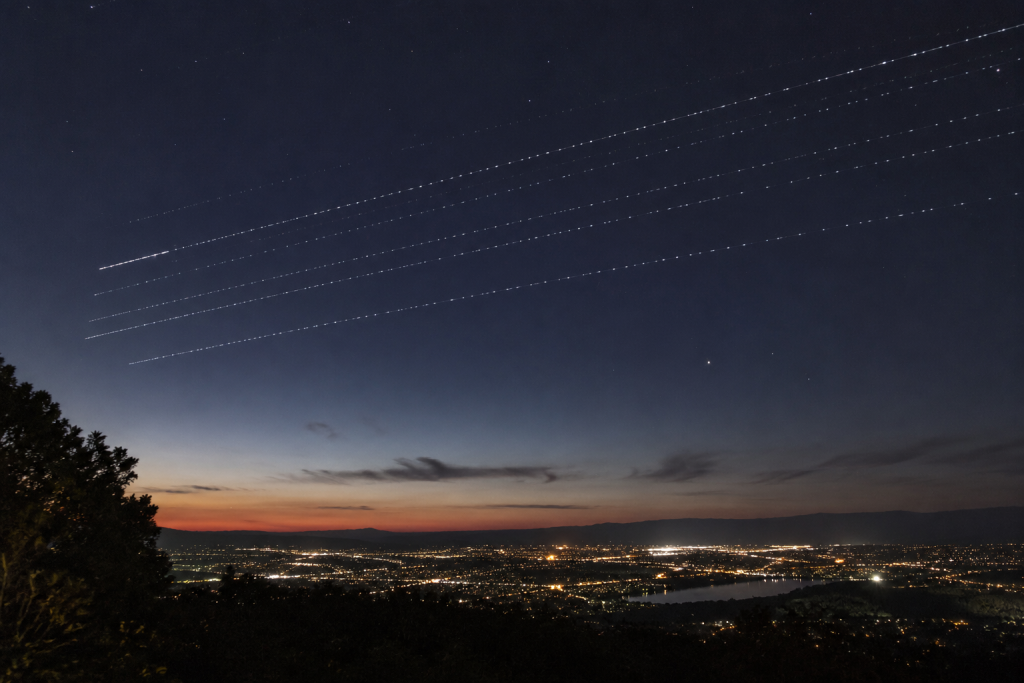
The concern is not driven by science fiction but by a rapid transformation taking place in low Earth orbit. Thousands of satellites are already circling the planet, and many more are planned. Alongside proposals for orbital data centers and even satellites designed to reflect sunlight after sunset, researchers are beginning to examine what these developments could mean for astronomy, wildlife, and the environment.
Space is becoming the next major technological frontier
When the Soviet Union launched Sputnik in 1957, space exploration was almost entirely the domain of governments. Satellites were expensive, relatively few in number, and primarily designed for scientific research, communications, or national security.
That landscape has changed dramatically.
Private companies now see Earth’s orbit as critical infrastructure for the future. Satellite networks promise global broadband internet, real-time communications, climate monitoring, navigation, and support for increasingly demanding artificial intelligence systems. Governments also recognize that space-based infrastructure has become strategically important, fueling a new race that is driven as much by economics as by exploration.
As launch costs continue to fall, placing satellites into orbit has become far more accessible than it was only a decade ago.
Why are scientists discussing 1.7 million satellites?
One figure that has attracted widespread attention is 1.7 million satellites.
At first glance, the number sounds unbelievable. In reality, it comes from scientific discussions evaluating the combined total of satellite constellations proposed by governments and commercial operators around the world. Researchers at the European Southern Observatory (ESO) examined these proposals to explore what Earth’s orbital environment could look like if every major project eventually moved forward.
That figure should not be interpreted as a confirmed forecast.
It is a theoretical scenario rather than an approved deployment plan. Many proposed constellations may never be completed, while others could be reduced, redesigned, or canceled entirely. Nevertheless, the estimate illustrates the extraordinary scale of ambitions currently being considered for Earth’s orbit.
Can satellites really reflect sunlight onto Earth?
Among the most unusual projects is one being developed by the American startup Reflect Orbital.
The company’s concept involves satellites equipped with highly reflective mirrors capable of directing sunlight toward specific locations after sunset. Rather than illuminating entire cities, the idea is to provide temporary lighting for targeted applications such as construction projects, emergency response operations, disaster recovery, or remote infrastructure work.
Although the concept has attracted significant media attention, it remains in its early stages. Demonstration missions are expected before any practical deployment could occur.
Even so, the proposal has sparked an important debate: Should humanity intentionally modify the natural darkness of the night sky, even for practical purposes?
Why astronomers are increasingly concerned
For astronomers, the primary challenge is not the existence of satellites themselves but their growing numbers.
Every satellite reflects sunlight. When only a few are visible, they create occasional streaks across astronomical images. As constellations expand into tens of thousands of spacecraft, those streaks become far more common, complicating observations made by professional observatories.
Some of the world’s most advanced telescopes are designed to capture extremely faint galaxies, distant supernovae, or potentially hazardous asteroids. These observations often require long exposure times, making them particularly vulnerable to interference from passing satellites.
Researchers also warn that a very large population of reflective spacecraft could gradually increase the overall brightness of the night sky. This would not eliminate darkness altogether, but it could reduce the contrast astronomers rely on to detect some of the faintest objects in the universe.
For many scientists, preserving dark skies is not simply about enjoying beautiful views of the stars. It is essential for conducting high-quality astronomical research.
The impact could extend beyond astronomy
Natural darkness plays an important role throughout Earth’s ecosystems.
Many migratory birds navigate using celestial cues. Sea turtles rely on natural light near the horizon during nesting season. Countless insects, bats, and nocturnal animals have evolved behaviors that depend on predictable cycles of daylight and darkness.
Scientists are now investigating whether significant increases in artificial brightness from orbital infrastructure could disrupt some of these natural processes.
At present, there is no evidence that current satellite constellations are causing widespread ecological damage. However, researchers argue that understanding potential long-term effects should be a priority before orbital activity expands dramatically.
What happens when satellites reach the end of their lives?
Every satellite eventually stops operating.
Most modern satellites are designed to re-enter Earth’s atmosphere, where they burn up due to extreme heat generated during descent. For many years, this process attracted little attention.
More recently, scientists have begun studying whether the growing number of satellite re-entries could have subtle effects on the upper atmosphere.
When spacecraft burn up, they release tiny particles made from materials such as aluminum and other metals. Researchers are investigating whether these particles could influence atmospheric chemistry or interact with processes related to the ozone layer.
So far, the available evidence remains limited. While several studies suggest the topic deserves closer examination, there is currently no scientific consensus that satellite re-entries pose a major environmental or public health threat.
Satellites may become part of the AI revolution
Communications are only one part of the picture.
Some companies have proposed placing data centers in orbit, powered primarily by solar energy. The concept is still experimental, but supporters argue that space-based computing could eventually help meet the enormous energy demands associated with artificial intelligence and cloud computing.
If these ideas become technically and economically viable, Earth’s orbit may evolve into far more than a communications network. It could become a new layer of global digital infrastructure.
Balancing innovation with responsibility
There is little doubt that satellites have transformed modern life.
They support weather forecasting, disaster response, GPS navigation, environmental monitoring, telecommunications, scientific research, and countless services that billions of people rely on every day.
At the same time, the rapid expansion of orbital infrastructure raises questions that have never before confronted humanity.
How many satellites can safely share Earth’s orbit?
How should space debris be managed?
Can the benefits of new technologies be achieved without permanently altering one of humanity’s oldest natural resources—the dark night sky?
These questions do not yet have definitive answers.
Looking ahead
Many alarming claims circulating online suggest that the night sky is destined to disappear beneath millions of artificial objects. Current scientific evidence does not support such certainty.
Equally, dismissing researchers’ concerns would ignore legitimate questions that deserve careful investigation.
The future of Earth’s orbital environment will depend largely on decisions made over the coming decades. International regulations, technological innovation, responsible satellite design, and continued scientific research will all play important roles in determining whether expanding space infrastructure can coexist with environmental protection and astronomical discovery.
For the first time in history, humanity is not simply observing the night sky—we are beginning to reshape it. Whether that transformation ultimately represents progress, loss, or a careful balance of both will depend on choices that are only now beginning to be made.