
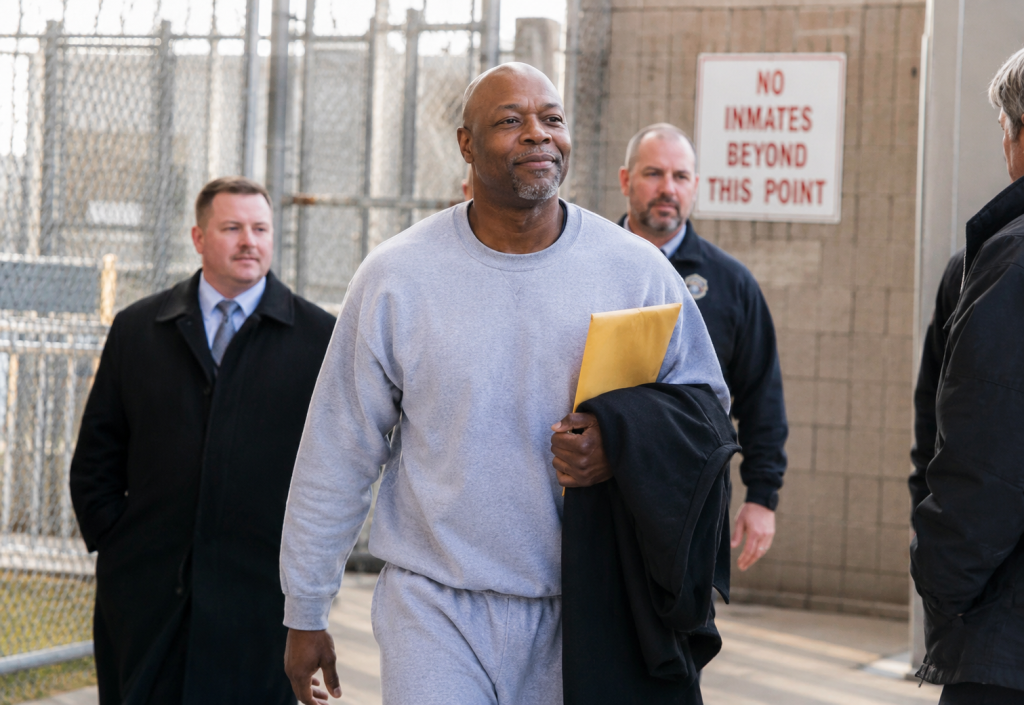
When Rickey Jackson walked out of an Ohio prison in November 2014, he entered a world that barely resembled the one he had left behind. Smartphones had become part of everyday life, the internet connected billions of people, and an entire generation had grown up while he remained behind bars.
Jackson had entered prison as an 18-year-old. He regained his freedom just weeks before turning 58.
For nearly four decades, the American justice system had treated him as a convicted murderer. Then, almost 40 years after his conviction, that same system acknowledged that the case against him could no longer stand.
Today, Rickey Jackson’s story is recognized as one of the longest wrongful imprisonments in United States history and remains a powerful reminder of how a single unreliable witness can change multiple lives forever.
A Murder That Shook Cleveland
The case began on May 19, 1975, in Cleveland, Ohio.
That morning, 56-year-old salesman Harold Franks was making routine deliveries when he was attacked during what investigators believed was a robbery. He was shot and killed before the assailants fled the scene.
At the time, Cleveland was facing rising violent crime, and law enforcement agencies were under intense public pressure to solve serious cases quickly. Detectives searched for leads, but the investigation initially produced little physical evidence.
Everything changed when a young witness came forward.
A Child Became the Key Witness
Edward Vernon was only 12 years old when he told investigators he had witnessed the shooting and could identify the gunman.
His statement transformed the investigation overnight.
Police arrested Rickey Jackson, along with Wiley Bridgeman and Ronnie Bridgeman, who is now known as Kwame Ajamu.
From the beginning, however, the case had significant weaknesses.
Investigators never recovered the murder weapon. There were no fingerprints, no biological evidence, and no physical evidence directly connecting the three men to Harold Franks’ death. DNA testing did not yet exist, and criminal prosecutions often relied heavily on eyewitness testimony.
In this case, prosecutors built almost their entire case around the testimony of one child.
A Death Sentence Based on a Single Testimony
The trial took place at a time when scientific research on eyewitness memory was still in its infancy. Courts generally placed considerable trust in eyewitness identifications, and the limitations of children’s memories were not yet widely understood.
Jurors accepted Edward Vernon’s testimony as credible.
Rickey Jackson was convicted of aggravated murder and sentenced to death at just 18 years old. Wiley Bridgeman and Ronnie Bridgeman also received severe prison sentences.
Years later, after changes to death penalty laws in the United States, Jackson’s sentence was commuted to life imprisonment. His conviction, however, remained unchanged.
As the years turned into decades, every appeal failed to bring him closer to freedom.
Four Decades Behind Bars
While the outside world evolved, Rickey Jackson remained in prison.
He entered the correctional system before personal computers became common, before mobile phones existed, and decades before social media transformed everyday communication.
Technology, politics, and society moved forward without him.
Each new legal appeal offered hope, only to end in disappointment.
Meanwhile, the boy whose testimony had helped secure the convictions grew into adulthood carrying the weight of what had happened.
The Witness Changes His Story
Nearly 40 years after the trial, Edward Vernon came forward with a dramatically different account.
In a sworn affidavit, he stated that he had not actually witnessed the murder. According to his testimony, he had been riding a school bus at the time of the shooting and could not have seen the events he described during the original trial.
Vernon later said that, as a frightened child, he had been influenced during the investigation and eventually repeated a version of events that investigators appeared to accept.
His recantation fundamentally changed the case.
Without his testimony, prosecutors no longer had sufficient evidence to support the convictions.
In 2014, a judge vacated the convictions, and prosecutors dismissed all remaining charges against Rickey Jackson, Wiley Bridgeman, and Kwame Ajamu.
After serving 39 years, three months, and nine days in prison, Rickey Jackson was finally free.
What This Case Revealed About Eyewitness Testimony
Jackson’s case has since become a frequently cited example in discussions about wrongful convictions and the reliability of eyewitness evidence.
Modern psychological research has shown that human memory is not a perfect recording of events. Memories can be altered by suggestion, repeated questioning, stress, the passage of time, and exposure to new information after an event.
Children, in particular, are generally more vulnerable to suggestion than adults, making carefully structured interviews especially important during criminal investigations.
These findings have influenced reforms in several U.S. jurisdictions, leading to improved procedures for eyewitness identification and child witness interviews in an effort to reduce the risk of wrongful convictions.
Race, Justice, and an Ongoing Debate
The case has also become part of a broader discussion about race and the American criminal justice system.
Rickey Jackson and the two other men convicted alongside him were Black. Some legal scholars and historians argue that racial tensions in the 1970s contributed to a system that was willing to accept a conviction supported by remarkably little evidence.
At the same time, there is no definitive proof that racial bias alone determined the verdict.
What is firmly established by court records is that the prosecution’s case depended almost entirely on one eyewitness. Once that testimony collapsed, there was no longer enough evidence to sustain the convictions.
A Freedom That Could Never Restore Lost Time
Following his release, Rickey Jackson received compensation from the State of Ohio. He and the other two exonerees later reached a civil settlement with local authorities.
Financial compensation, however, could never replace nearly four decades of freedom.
Jackson entered prison as a teenager with his entire adult life ahead of him. By the time he was exonerated, he faced the challenge of rebuilding his life in a society transformed by technologies and cultural changes he had never experienced firsthand.
His story is about far more than one wrongful conviction.
It illustrates how profoundly lives can be altered when criminal cases rely on weak evidence, and why every witness statement must be carefully examined before it becomes the foundation of a conviction.
For Rickey Jackson, justice eventually arrived.
It simply arrived far too late to return the 39 years he had already lost.