
Most people never think twice before walking into a basement.
It is simply another part of the house—a place to store potatoes, canned vegetables, old tools, or bottles of wine. Millions of people step into cellars every day without giving the air they breathe a second thought.
In the summer of 2013, one ordinary family in western Russia learned that an enclosed space can become deadly without warning, without flames, and without any obvious signs of danger.
What followed was one of the most unusual household tragedies reported in recent years.
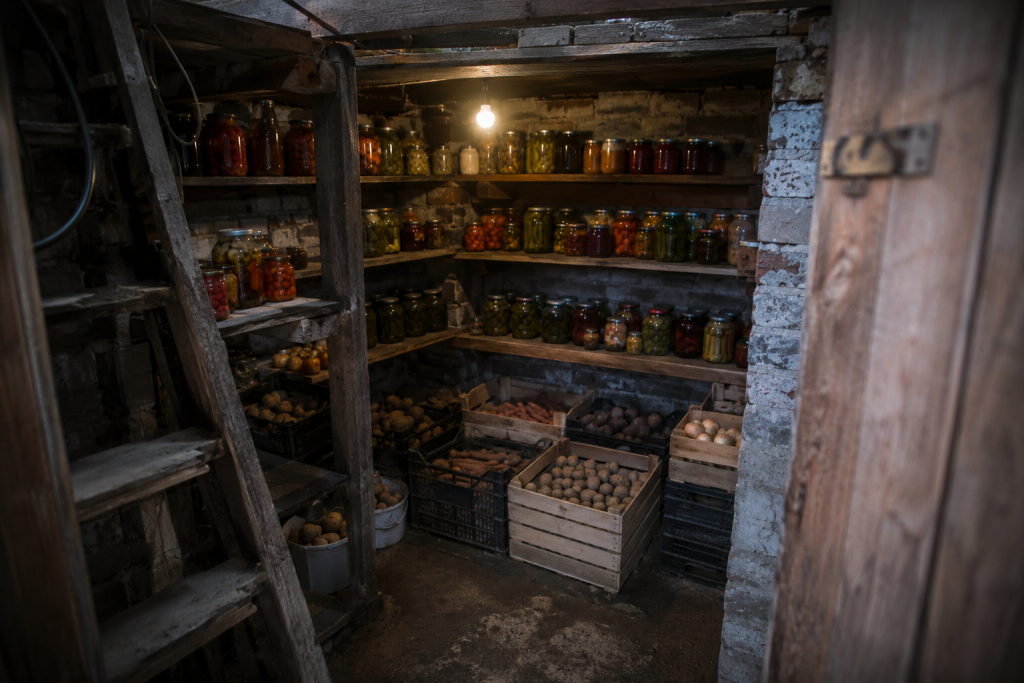
Within a matter of minutes, four members of the same family lost their lives after entering the same basement one after another. The only survivor was an eight-year-old girl named Maria Chelysheva.
As the story spread across the internet, it became surrounded by myths. Countless websites claimed that “rotting potatoes released a deadly gas,” while others insisted the victims had been killed by something called “solanine gas.”
The real story is both more complex and more important.
Official findings, scientific evidence, and decades of research into confined-space accidents paint a very different picture—one that has little to do with mysterious toxins and everything to do with invisible hazards that emergency responders have warned about for years.
An Ordinary Family in Rural Tatarstan
The tragedy occurred in Laishevo, a small town in the Republic of Tatarstan, about 60 kilometers (37 miles) southeast of Kazan. Winters in this part of Russia are long and harsh, making underground storage cellars a common feature of family homes.
For generations, residents have relied on these cool, dark spaces to preserve potatoes, carrots, beets, onions, and other vegetables throughout the winter months.
To the Chelyshev family, the basement was nothing unusual.
Forty-two-year-old Mikhail Chelyshev was a respected legal scholar who headed the Department of Civil and Business Law at Kazan Federal University. Colleagues later described him as a dedicated academic and an admired professor.
He lived with his wife, Anastasia, their 18-year-old son Georgy, and their youngest child, Maria, who was only eight years old.
There was nothing about that August day to suggest it would become the family’s last together.
A Routine Task That Turned Fatal
According to the official investigation, the sequence of events began with an ordinary household chore.
Mikhail went into the basement to collect potatoes that had been stored there for an extended period.
When he failed to return, Anastasia went downstairs to check on him.
She never came back.
Soon afterward, their son Georgy entered the cellar looking for his parents.
He also failed to emerge.
The last person to enter was Anastasia’s mother, Iraida. Before going into the basement herself, she reportedly managed to call a neighbor, telling them something was terribly wrong and that the rest of the family was inside.
By the time emergency services arrived, all four adults had died.
Maria was the only member of the immediate family left alive.
A Detail That Remains Unclear
One of the most frequently repeated claims about this case is that Maria survived because she never entered the basement.
However, contemporary reports are not entirely consistent.
Some accounts state that she stayed outside the cellar altogether, while others suggest she approached the entrance later, after conditions inside had changed.
The official investigation did not publicly resolve this discrepancy.
What is firmly established is that Maria became the sole survivor of her immediate family and was later cared for by relatives.
Although this detail may seem minor, it illustrates how real events often become simplified as they circulate online. Uncertain facts are gradually replaced by cleaner, more dramatic versions that are easier to remember and share.
What Investigators Actually Found
Authorities quickly ruled out foul play.
Instead, investigators concluded that the deaths were caused by hazardous gases that had accumulated inside the poorly ventilated basement as potatoes decomposed over time.
That conclusion has been consistently reported in coverage of the official investigation.
What investigators did not do, however, was identify a specific “mystery gas.”
That omission would later become the foundation for one of the internet’s most persistent misconceptions.
The “Solanine Gas” Myth
Within a few years, articles, social media posts, and viral videos began describing the tragedy as a case of poisoning by “solanine gas.”
Scientifically, that explanation is inaccurate.
Solanine is a naturally occurring glycoalkaloid found in potatoes, particularly those that have turned green or begun to sprout after prolonged exposure to light.
It is a genuine toxin, but it poses a risk when eaten—not when inhaled.
Consuming potatoes with unusually high concentrations of solanine may cause nausea, vomiting, abdominal pain, diarrhea, headaches, and, in severe cases, neurological symptoms.
There is no scientific evidence that solanine evaporates into the air or forms a lethal gas capable of filling an enclosed room.
Yet the phrase “solanine gas” has been repeated so often that many people now believe it was the official explanation.
It never was.
What Science Suggests Happened
Experts who study confined-space hazards point toward a far more plausible explanation.
As large amounts of organic material decompose, microorganisms consume oxygen and release gases as part of the natural breakdown process.
Inside a poorly ventilated basement, oxygen levels can gradually fall while carbon dioxide concentrations increase significantly.
Unlike oxygen, carbon dioxide is heavier than air.
That means it tends to collect in low-lying areas such as pits, wells, silos, storage cellars, and underground chambers.
Someone descending into such an environment may unknowingly move from breathable air into an atmosphere containing dangerously little oxygen.
The earliest symptoms—dizziness, confusion, and shortness of breath—can appear quickly.
If oxygen levels are low enough, a person may lose consciousness before fully understanding what is happening or before managing to climb back out.
Why One Victim Often Becomes Several
To emergency responders, the Chelyshev case reflects a pattern that has been documented repeatedly around the world.
Confined-space accidents frequently involve multiple victims, not because conditions suddenly worsen, but because family members, coworkers, or friends instinctively rush in to help the first person who collapses.
This phenomenon is well known in occupational safety.
Firefighters and rescue teams are trained never to enter a confined space without specialized breathing equipment and atmospheric testing, even if someone inside appears to need immediate assistance.
Across industries ranging from agriculture to wastewater treatment, a significant proportion of confined-space fatalities involve would-be rescuers who become victims themselves.
It is a heartbreaking consequence of one of the most natural human instincts: trying to save someone you love.
A Rare but Important Hazard
Stories like the Chelyshev tragedy sometimes leave people wondering whether storing potatoes in a basement is inherently dangerous.
Scientific evidence does not support that conclusion.
Millions of households around the world safely store root vegetables in underground cellars every year without incident.
For a tragedy like this to occur, several uncommon factors typically have to coincide: substantial organic decay, extremely poor ventilation, and the accumulation of gases in a confined space where oxygen can no longer circulate effectively.
These conditions are unusual, which is why accidents of this kind remain exceptionally rare.
The Real Lesson Behind the Story
More than a decade after the deaths of the Chelyshev family, the case continues to circulate online, often stripped of its scientific context and replaced with sensational claims.
The true lesson is not that potatoes are secretly deadly.
It is that confined spaces can become hazardous in ways that are impossible to detect with human senses alone.
A lack of oxygen cannot be seen.
Dangerous gas concentrations often cannot be smelled.
And by the time symptoms become obvious, it may already be too late.
That is why safety organizations around the world advise against entering any enclosed space where someone has suddenly collapsed unless trained responders with appropriate equipment have assessed the environment first.
The tragedy that unfolded in a quiet Russian basement was not caused by a supernatural poison or a mysterious chemical. It was the result of an invisible atmospheric hazard—one that has claimed lives in wells, silos, storage tanks, and underground spaces across the world for decades.
For Maria Chelysheva, however, those scientific explanations can never fully capture what happened that day.
In the space of a single afternoon, an ordinary family vanished, leaving one eight-year-old girl to face a future without her parents, her brother, or her grandmother.
That is the real story behind one of the internet’s most misunderstood tragedies.