
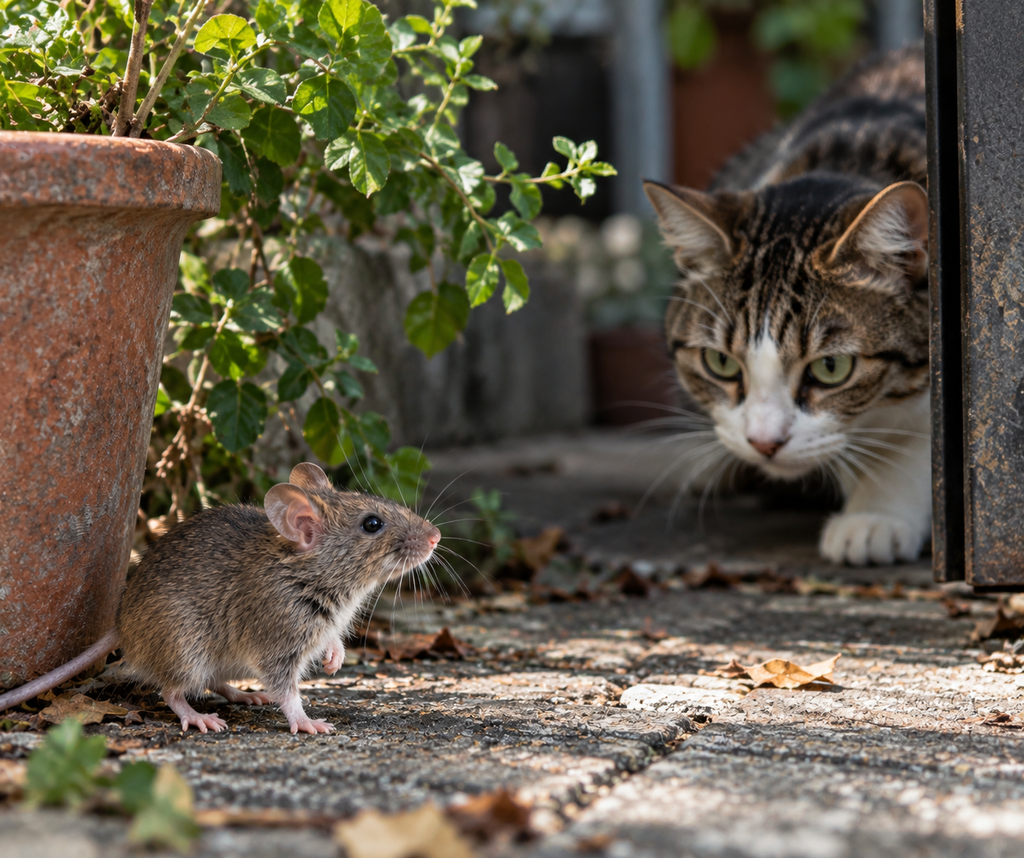
A rat encounters the scent of a cat. What happens next should be predictable.
For a small rodent, recognizing a predator is a matter of survival. The safest response is avoidance: stay away, hide, and certainly don’t investigate the source of the smell.
Yet under certain experimental conditions, some rats infected with a microscopic parasite behave differently. Their normal avoidance of cat-related odors becomes weaker, and studies have even reported animals spending more time investigating areas associated with those scents.
The organism responsible is Toxoplasma gondii.
What makes the story remarkable isn’t simply that an infection can influence behavior. It is where the parasite ultimately needs to go.
Back to a cat.
That connection has produced one of the most intriguing questions in behavioral biology: can a parasite alter its host in ways that increase its own chances of transmission?
The evidence is fascinating, although considerably more complicated than the popular claim that Toxoplasma simply makes rodents “fall in love with cats.”
A parasite with an unusual destination
Despite occasionally being described online as a virus, Toxoplasma gondii is neither a virus nor a bacterium. It is a single-celled parasite capable of infecting many warm-blooded animals, including humans.
Cats and other felids, however, occupy a unique position in its life cycle.
They are the parasite’s definitive hosts, meaning that the sexual stage of Toxoplasma reproduction occurs in felids.
An infected cat can shed oocysts in its feces. After these mature in the environment, they can contaminate soil, water or food and subsequently infect other animals.
Those animals become intermediate hosts. The parasite can persist in their tissues in microscopic cysts.
Now imagine that the intermediate host is a mouse or rat.
If a cat catches and eats that infected rodent, the parasite has found its way back into a feline.
From an evolutionary perspective, this creates an extraordinary possibility. Anything that makes an infected rodent slightly easier for a cat to catch could potentially benefit the parasite.
The experiments behind the “fatal attraction”
Rodents normally show defensive responses to signs that predators are nearby. Cat odor is therefore useful to researchers studying predator avoidance.
Experiments involving Toxoplasma-infected rodents produced an unexpected result.
Researchers found that infected animals could show a reduced aversion to cat odors. A well-known study reported that latent infection altered rats’ response to cat scent without simply destroying their ability to smell, learn or display fear in every situation.
The phenomenon became widely known as the fatal attraction effect.
That distinction matters.
A severely sick or disoriented animal behaving recklessly wouldn’t necessarily tell us much about parasite manipulation. But if an infection selectively changes responses relevant to a predator, the evolutionary implications become far more interesting.
It raises an obvious possibility: perhaps the parasite is making its intermediate host more likely to end up inside its definitive host.
But subsequent research has made the story less tidy.
Does Toxoplasma really make rats attracted to cats?
Not necessarily — at least not in the simple way the phrase suggests.
Studies have not always produced identical behavioral effects. Researchers have reported changes involving predator avoidance, anxiety-like behavior, exploration, activity and responses to unfamiliar environments.
Results can also depend on factors such as the rodent species, parasite strain, experimental design and stage of infection.
This has led scientists to consider a broader possibility.
Instead of precisely switching off a biological “fear of cats” circuit, infection may alter how an animal evaluates threats and risk more generally.
That would still potentially benefit the parasite.
A rodent doesn’t have to become attracted to a cat to become easier prey. It might only need to hesitate slightly longer before escaping, spend more time exploring an exposed area or respond less strongly to signs of a predator.
In nature, very small behavioral differences can have very large consequences.
What is happening inside the brain?
Toxoplasma gondii can establish a persistent infection and form tissue cysts, including within the nervous system.
This once encouraged a particularly appealing explanation: perhaps the parasite preferentially occupies the brain regions controlling fear and directly interferes with them.
Research suggests that reality is considerably more complex.
Cysts can occur across multiple regions of the brain rather than neatly concentrating in a single “fear center.” Scientists have therefore investigated several possible mechanisms, including changes involving immune responses, inflammation, neural circuits and chemical signaling within the brain.
One particularly interesting line of research examined how infected rats’ brains respond to cat odors. Scientists observed changes involving neural pathways associated with defensive and reproductive behavior, leading to the hypothesis that predator cues might acquire a different biological significance in infected animals.
That does not mean researchers have discovered a neurological switch that Toxoplasma flips to command a rat to approach a cat.
The precise mechanisms remain under investigation.
And this uncertainty is important: the behavioral phenomenon is compelling precisely because scientists are still trying to determine how specific it really is.
Why would reduced fear help the parasite?
Consider the problem from the parasite’s perspective.
A rodent provides a place to survive, but Toxoplasma’s sexual reproductive cycle requires a feline.
The ecological bridge between those two hosts already exists.
Cats eat rodents.
If infection makes a mouse or rat even modestly less cautious, the probability of predation could increase. Once the infected prey is eaten, tissue cysts enter the feline host and the parasite’s life cycle can continue.
Biologists have documented other parasites capable of changing the appearance, physiology or behavior of their hosts in ways that can promote transmission.
Toxoplasma has become an especially famous example because its hosts are mammals — and because humans can become infected too.
Which leads to a much more personal question.
Humans can carry Toxoplasma too
Human infection with Toxoplasma gondii is known as toxoplasmosis, and it occurs around the world.
This doesn’t mean people commonly become infected simply by encountering an infected mouse — or even by being near a cat.
According to the U.S. Centers for Disease Control and Prevention, important routes of exposure include eating raw or undercooked meat containing the parasite and accidentally ingesting infectious material originating from cat feces. Contaminated soil, water, produce, hands or objects can therefore play a role in transmission.
Good food hygiene, thoroughly cooking meat and appropriate precautions when handling cat litter or contaminated soil can reduce exposure.
Most people with healthy immune systems who become infected develop no obvious illness or experience relatively mild symptoms.
Toxoplasmosis becomes considerably more important in certain circumstances. Infection acquired during or shortly before pregnancy can sometimes be transmitted to the developing fetus, while people with severely weakened immune systems can develop serious disease.
But the fact that Toxoplasma can persist in humans inevitably raises another question.
If infection can alter rodent behavior, could it influence ours?
The controversial question of human behavior
Researchers have investigated possible relationships between latent Toxoplasma infection and human behavior for years.
Some observational studies have reported statistical associations involving behavioral characteristics or neuropsychiatric conditions. The possible relationship between Toxoplasma exposure and schizophrenia, for example, has generated substantial scientific interest, alongside research into immune responses, inflammation and neurotransmitter systems.
There is, however, an enormous difference between finding an association and demonstrating that one thing causes another.
People exposed to Toxoplasma may differ in many ways from people who aren’t. Lifestyle, environment, diet, socioeconomic circumstances and other variables can complicate observational research. Even when two characteristics repeatedly occur together, that alone does not establish which caused the other — or whether a third factor influenced both.
There is therefore no solid scientific basis for the sensational claim that Toxoplasma gondii “controls human minds.”
Nor should results obtained from rodents automatically be extrapolated to humans.
The responsible conclusion is simultaneously less dramatic and more interesting: scientists have legitimate reasons to investigate how persistent infection interacts with the nervous and immune systems, but major questions remain unanswered.
The real story is stranger than the “zombie parasite” headline
It is tempting to describe Toxoplasma gondii as a microscopic puppet master.
The image practically writes itself: a parasite enters a rat’s brain, removes its fear of cats and sends the doomed animal toward the predator that the parasite needs to reach.
Nature rarely provides stories that clean.
What researchers actually know is more nuanced.
Toxoplasma can establish persistent infections in nervous tissue. Infected rodents can display altered behavior, including changes in responses to predator-related cues. Cats are essential to the parasite’s sexual life cycle. And from an evolutionary perspective, any behavioral change that increases feline predation could potentially improve transmission.
What scientists have not established is that the parasite operates a precise behavioral control system that deliberately directs its host toward a cat.
Perhaps it doesn’t need one.
Evolution doesn’t require a parasite to “know” what it is doing. If an infection produces a behavioral change that improves transmission, natural selection can favor that relationship without intention, planning or conscious control of any kind.
And a rat doesn’t have to lose all fear of a predator for the outcome to change.
Sometimes it only has to become a little less afraid.
For the rat, that difference may last only seconds.
For the parasite, those seconds could be enough to complete an extraordinary journey from prey to predator.
Sources and further reading
Centers for Disease Control and Prevention (CDC), guidance on Toxoplasma gondii, toxoplasmosis, transmission and prevention.
Berdoy M., Webster J.P., Macdonald D.W., research on the “fatal attraction” phenomenon in Toxoplasma gondii-infected rats.
Vyas A. and colleagues, research examining predator odors and neural responses in infected rats.
Worth A.R., Lymbery A.J., Thompson R.C.A., critical review of evidence concerning Toxoplasma gondii-associated behavioral changes in rodents.
Peer-reviewed research examining latent toxoplasmosis, host behavior, neurobiology and immune responses.