
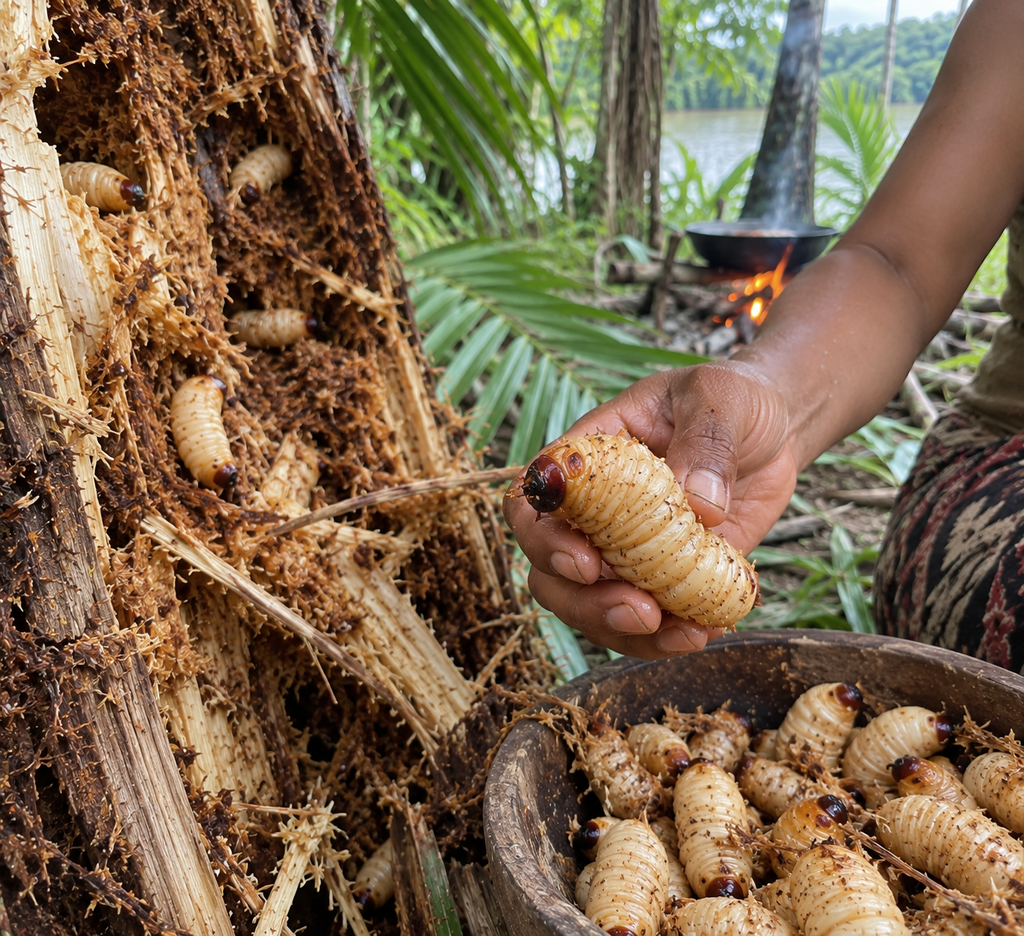
A palm trunk is split open in the middle of the rainforest. Inside, instead of ordinary decaying wood, dozens of plump, cream-colored larvae appear. They are collected by hand. Then one is picked up and eaten.
Seen without context, a video like this seems almost designed for social media. It has everything needed to stop someone mid-scroll: something unfamiliar, a visceral reaction and an obvious question.
Why would anyone eat that?
But the answer has little to do with internet challenges or desperate survival.
In parts of the Amazon, edible palm-weevil larvae have been part of local food traditions for generations. In some communities, people do more than simply stumble upon them in the forest. They understand the insects’ life cycle well enough to create favorable conditions for the larvae to develop and return later to harvest them.
One of the best-documented species is Rhynchophorus palmarum, the South American palm weevil. Its larvae are commonly known as suri in Peru and chontacuro in parts of Ecuador.
It is not possible to identify the exact species in a social-media video from appearance alone. Still, the large pale larvae collected from palm tissue closely resemble the edible palm-weevil larvae extensively described in scientific and ethnobiological research.
And their story is far more sophisticated than the shocking images suggest.
They Are Not Actually Worms
Calling them “worms” is convenient, but biologically incorrect.
They are beetle larvae.
Rhynchophorus palmarum belongs to the weevil family. During its larval stage, it develops within palm tissue, feeding and growing before eventually entering the pupal stage and emerging as an adult beetle.
The unusually plump body has a purpose. A developing larva needs substantial energy reserves before undergoing metamorphosis, and these reserves contribute to the high fat content that later makes the larvae nutritionally valuable to humans.
So the feature that can make the insect particularly unsettling to an unfamiliar observer — its large, soft, fleshy body — is also part of the reason it became a useful food resource.
Some Larvae Are Harvested by Design, Not by Chance
This may be the most unexpected part of the story.
It would be easy to imagine people simply walking through the rainforest until they happen upon a decaying palm full of insects. Opportunistic collection certainly occurs, but researchers have documented something much more deliberate.
Some Indigenous communities have developed practices often described by researchers as semi-cultivation.
Palm trees may be felled or already fallen trunks may be selected and left in conditions favorable to colonization by palm weevils. Adult insects arrive and lay eggs. Their larvae then develop inside the palm tissue.
People return later and open the trunk to harvest them.
The Food and Agriculture Organization of the United Nations has discussed palm-weevil larvae as an example of this kind of traditional semi-cultivation of edible insects. Research among the Awajún in the Peruvian Amazon has likewise documented the use of naturally fallen and deliberately felled palms in obtaining edible weevil larvae.
Similar knowledge has been recorded elsewhere in South America.
Among the Paiter Suruí in Brazil, researchers documented both opportunistic collection from decomposing palms and planned harvesting involving palms that had been cut and revisited later.
What initially looks like someone searching rotten wood for insects can therefore represent something very different: a food-production strategy built around an intimate understanding of another species’ biology.
Knowing When to Return Is Part of the Skill
The practice requires more knowledge than simply leaving a tree on the forest floor.
People need to recognize suitable palms, understand how decomposition and insect colonization progress and know approximately when the larvae will have reached the desired stage.
That knowledge matters because waiting too little means finding larvae that are still small. Waiting too long risks allowing them to progress further toward pupation and adulthood.
Scientific reviews of R. palmarum have described how the deliberate use of felled palms can give people a degree of control over where larvae develop, when they are harvested and even the size at which they are collected.
This is not insect farming in the modern industrial sense.
It is something older: ecological knowledge developed through observation, experience and transmission between generations.
Yes, People Really Eat Them
The consumption of R. palmarum larvae is well documented in the Peruvian Amazon and elsewhere in South America.
They may be eaten in different ways depending on local tradition. Scientific and ethnobiological literature describes raw consumption as well as roasting, frying and other forms of cooking. Suri are also sold in some local markets.
When heated, their considerable fat content affects both texture and flavor, producing something very different from what someone might imagine when hearing the word “larva.”
This matters when interpreting viral footage.
A person eating one directly from a palm is not necessarily performing an outrageous stunt for the camera. The behavior may simply belong to a food tradition unfamiliar to the people watching the video thousands of kilometers away.
At the same time, it would be inaccurate to turn that observation into the sweeping claim that “people in the Amazon eat larvae.”
The Amazon encompasses an enormous geographic area and hundreds of cultures. Palm-weevil consumption is associated with particular Indigenous and local communities, and traditions vary considerably between regions.
There Is a Nutritional Reason These Larvae Became Food
Cultural tradition explains why people recognize suri as food, but chemistry helps explain why the practice made sense in the first place.
A 2024 study published in the Journal of Food Composition and Analysis examined chontacuro larvae from the Ecuadorian Amazon and found an unusually energy-dense food.
The samples contained roughly 50 percent lipids and 20 percent protein, along with fiber. Researchers also characterized their fatty-acid composition, finding oleic acid among the prominent fatty acids.
Oleic acid is a monounsaturated fatty acid also found in many familiar foods, including olive oil.
The researchers additionally detected several micronutrients, including vitamins B6, B9, A and E, beta-carotene and minerals such as calcium, potassium, magnesium and phosphorus.
That does not make palm-weevil larvae some miraculous “superfood,” a label often attached too casually to unusual foods.
It does demonstrate something more interesting.
For communities living in forest environments and making sophisticated use of local resources, a large larva rich in fat and containing substantial protein represents a remarkably concentrated package of energy and nutrients.
They Are More Than Emergency Survival Food
There is an important distinction here.
Watching someone pull insects from a tree can encourage the assumption that this must be something people eat only when conventional food is unavailable.
Ethnobiological research paints a different picture.
In communities where edible palm larvae form part of traditional food culture, they can be actively sought, prepared, shared and sometimes sold. Their consumption therefore cannot be reduced to hunger or desperation.
They are food because the culture recognizes them as food.
That sounds obvious until we consider how strongly the same principle shapes our own diets.
A whole shrimp has an exoskeleton, antennae and numerous legs. A lobster can look almost prehistoric. Oysters are eaten alive in some culinary traditions. Yet none of these foods necessarily produces disgust in someone who grew up seeing them on restaurant menus and family tables.
A palm larva may provoke an entirely different reaction.
Biology alone does not explain that distinction.
Culture does much of the work.
What About Eating Them Raw?
Traditional consumption and modern food-safety advice are not the same thing.
The 2024 Ecuadorian study did not detect pathogenic microorganisms in the larvae it analyzed, and the researchers also evaluated potentially toxic elements without finding problematic levels in those particular samples.
The crucial words are those samples.
Such findings cannot establish that every wild larva collected from every palm is safe to eat raw.
Microbial contamination can depend on where an insect develops, environmental conditions, handling after collection, storage and preparation. Other research on R. palmarum has examined microbiological quality and the importance of hygienic processing.
So the existence of traditional raw consumption is an interesting ethnographic fact. It should not be interpreted as advice to pick an unidentified insect out of decomposing wood and eat it.
The Larvae Have Another Traditional Role
Food is not their only documented use.
Research involving Kukama-Kukamiria, Tikuna and Awajún communities in the Peruvian Amazon has recorded the use of R. palmarum larvae in traditional medicine as well. Fat or oil obtained from the larvae has been associated with various traditional remedies, including preparations used for respiratory complaints.
That distinction needs careful wording.
A traditional medicinal use tells us something valuable about cultural knowledge and practice. It does not by itself establish that the remedy has been clinically proven to treat a disease.
Traditional use and demonstrated medical efficacy are two different claims, and evidence for one should never automatically be presented as evidence for the other.
Food for Humans, Trouble for Palms
There is another twist to the relationship.
For humans, the larva can be a valuable source of food. From the perspective of a palm plantation, however, Rhynchophorus palmarum can be a serious pest.
The larvae develop within palm tissue, while adult weevils also have agricultural importance because they can act as vectors of Bursaphelenchus cocophilus, the nematode associated with red ring disease in palms.
The same insect can therefore occupy two completely different roles.
In one agricultural setting, it is something growers try to control.
In another cultural and ecological setting, its larva is something people intentionally harvest.
Neither description tells the whole story on its own.
The Viral Video Is New. The Knowledge Behind It Isn’t.
A split palm trunk filled with moving larvae is almost perfectly suited to the modern attention economy. It produces curiosity, discomfort and disbelief before the viewer has even had time to understand what is happening.
Yet the knowledge behind the scene predates social media by generations.
It involves insect biology, nutrition, traditional ecological knowledge and a remarkably practical understanding of how a forest resource can be encouraged, timed and harvested.
Once that context is restored, the question raised by the video begins to change.
At first, it is difficult not to wonder:
How could anyone possibly eat that?
But after learning what these larvae are, how nutritionally dense they can be and how deliberately some communities have harvested them, another question becomes more interesting.
Why does a shrimp seem perfectly ordinary to one person, a lobster luxurious, and a palm larva almost unimaginable?
Perhaps because long before we learn what something tastes like, our culture teaches us something even more fundamental:
whether we are supposed to think of it as food at all.