
By the time Anna Bågenholm reached the hospital, she wasn’t breathing and had no spontaneous circulation. Her body was so profoundly cold that, under almost any ordinary circumstances, the absence of vital signs would have left little reason for hope.
Her core temperature was eventually measured at just 13.7°C — 56.7°F.
Yet the medical team continued trying to save her.
What happened next would become one of the most remarkable cases in the history of accidental hypothermia. Bågenholm’s survival was later documented in The Lancet, where physicians described roughly nine hours of resuscitation and stabilization followed by an unexpectedly good physical and mental recovery.
Over the years, the story has often been condensed into an irresistible headline: a woman froze, her heart stopped, and the cold somehow saved her.
The real story is more complicated — and far more fascinating.
Trapped Beneath the Ice
On May 20, 1999, 29-year-old physician Anna Bågenholm was skiing with two colleagues in the mountains near Narvik in northern Norway.
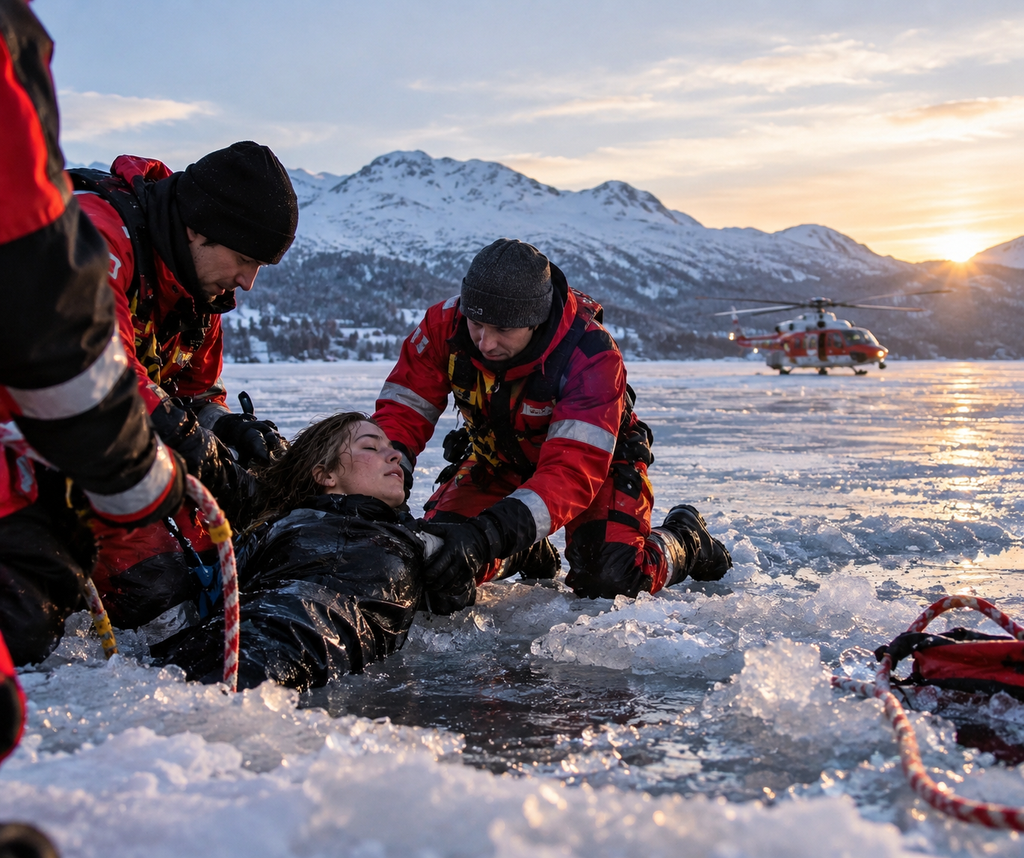
During the descent, she lost control and fell onto a frozen mountain stream. The ice gave way, and she was pulled beneath it, headfirst.
Her colleagues rushed toward her, but getting her out was extraordinarily difficult. The current had carried much of her body beneath the solid sheet of ice.
Then came the first circumstance that may have made her eventual survival possible.
Bågenholm found an air pocket beneath the ice.
With her face pressed into that small space, she was able to breathe while her colleagues desperately tried to free her. Around her, the near-freezing water was rapidly drawing heat from her body.
After roughly 40 minutes, she stopped responding.
She was still trapped.
Rescuers eventually managed to cut another opening through the ice and pull her from the water. By then, approximately 80 minutes had passed since the accident.
She had no detectable pulse and was not breathing.
For many patients, that combination would signal a devastating outcome.
But Bågenholm was not an ordinary cardiac-arrest patient.
Her body was profoundly hypothermic.
Why They Kept Going
Her colleagues were physicians and immediately began CPR. Resuscitation continued during the difficult evacuation and the helicopter journey to the University Hospital of North Norway in Tromsø.
That detail matters because it corrects one of the most misleading versions of the story.
Bågenholm did not simply remain for hours with absolutely no blood moving through her body before suddenly coming back to life. Once she was removed from the ice, chest compressions were used to provide some artificial circulation while rescuers and doctors worked to get her to definitive treatment.
The extraordinary duration of her cardiac arrest was still alarming.
But the extreme cold gave doctors a reason not to apply the expectations associated with a typical cardiac arrest at normal body temperature.
Deep hypothermia changes the physiology of the human body.
And in very unusual circumstances, it can also change the amount of time doctors have to save it.
A Core Temperature of Just 13.7°C
When Bågenholm reached the hospital, her core temperature was measured at 13.7°C.
To put that into perspective, hypothermia begins when core body temperature falls below 35°C. As the temperature continues to drop, consciousness deteriorates, the heart becomes increasingly vulnerable to dangerous arrhythmias, and eventually circulation can cease altogether.
Bågenholm was far beyond the threshold for severe hypothermia.
Her case was subsequently reported in The Lancet under the strikingly straightforward title Resuscitation from accidental hypothermia of 13.7°C with circulatory arrest.
At the time, the temperature was regarded as an extraordinary survival benchmark. Even lower core temperatures have since been documented in survivors, so Bågenholm should no longer be described as holding the current world record.
But the number alone was never what made her case medically important.
The crucial question was what had happened before her heart stopped.
The Timing of the Cold May Have Saved Her Brain
The human brain is extraordinarily dependent on a continuous supply of oxygen.
At normal body temperature, interruption of circulation can begin causing irreversible neurological injury within minutes. This is one reason cardiac arrest is such a race against time.
But metabolism is temperature-dependent.
As the brain cools, its demand for oxygen falls dramatically. Research involving deep hypothermia has demonstrated substantial reductions in cerebral metabolic activity and oxygen consumption at very low temperatures.
Bågenholm’s accident created a rare sequence of events.
For some time after becoming trapped, she could still breathe from the air pocket while the icy water steadily lowered her body temperature. Only later did she lose consciousness and progress to circulatory arrest.
In other words, her brain had already become extremely cold before normal circulation disappeared.
That distinction is critical.
It is very different from a person suffering a cardiac arrest at 37°C and only becoming cold afterward. Cooling cannot simply reverse brain damage that has already occurred.
In Bågenholm’s case, however, profound cooling appears to have reduced the brain’s metabolic requirements before the most dangerous period began.
The cold was not harmless.
It was killing her.
But at the same time, the physiological slowdown it produced may have extended the window in which successful resuscitation remained possible.
Her Blood Was Warmed Outside Her Body
At 13.7°C, ordinary warming measures alone were not enough.
The hospital team used cardiopulmonary bypass, an extracorporeal circulation technique that temporarily allows blood to circulate through machinery outside the body.
Blood can be oxygenated and warmed before being returned to the patient, effectively supporting essential functions while doctors gradually raise the body’s core temperature.
This was far more than placing a hypothermic patient under warm blankets.
The medical team was supporting Bågenholm’s circulation while warming her from within.
The original medical report describes cardiopulmonary bypass as a central part of her resuscitation and rewarming.
Modern treatment has evolved further. Extracorporeal life-support techniques, including ECLS and ECMO in appropriate cases, now play an important role in the management of selected patients suffering cardiac arrest from severe accidental hypothermia.
But in 1999, the case unfolding in Tromsø was exceptional.
Her Heart Came Back. The Bigger Question Was Her Brain
As Bågenholm’s blood was warmed and circulation supported, her body gradually moved away from the extreme physiological state produced by the cold.
Eventually, effective cardiac activity returned.
Her heart was working again.
That did not mean the crisis was over.
The next question was arguably even more frightening: Had her brain survived?
Restoring circulation after prolonged cardiac arrest is one thing. Recovering with meaningful neurological function is another.
Bågenholm had experienced an extraordinarily long period of cardiac arrest and resuscitation. Even if doctors could stabilize her heart and other organs, severe brain damage remained a major concern.
What followed surprised them.
Waking Up Was Only the Beginning
Bågenholm’s recovery was neither immediate nor effortless.
Her body had endured severe hypothermia, prolonged resuscitation and critical illness. She required intensive care and mechanical ventilation, and the extreme cold had damaged peripheral nerves.
When consciousness returned, she was profoundly weak and initially had major difficulties moving her body.
Recovery took months.
Some effects of the accident persisted considerably longer.
But the outcome doctors feared most had largely been avoided: her cognitive function was remarkably well preserved.
She could think. She could communicate. She understood what had happened.
The woman who had been pulled from beneath the ice without a detectable pulse had survived not merely biologically, but with her mind intact.
That is what transformed an astonishing rescue into an important medical case.
Eventually, She Became a Doctor Again
Over time, Bågenholm regained mobility and independence.
She returned to medicine and later worked in radiology.
Years after the accident, she would even discuss her own experience and the medical technologies involved in keeping her alive.
There is something particularly striking about that part of the story.
A woman who had once arrived at a hospital as one of its most extraordinary emergency patients eventually returned to the world of medicine from the other side of the relationship — as a physician again.
Her story became famous because of 13.7°C.
Her recovery is what made that number truly meaningful.
“No One Is Dead Until Warm and Dead”
Emergency medicine has a well-known saying associated with profound hypothermia:
“No one is dead until warm and dead.”
It is not meant as an absolute rule. Some injuries are incompatible with survival, and there are circumstances in which continued resuscitation is not medically appropriate.
The principle behind the phrase, however, is important.
Profound hypothermia can make signs of life extraordinarily difficult to detect, while the reduction in metabolism can sometimes allow successful resuscitation after periods that would normally be associated with an extremely poor prognosis.
That principle remains relevant today.
The European Resuscitation Council’s 2025 guidelines continue to classify accidental hypothermia among the special circumstances of cardiac arrest and recommend extracorporeal rewarming for appropriate patients, including transfer to centers capable of providing extracorporeal life support when indicated.
More than a quarter of a century after Bågenholm’s accident, the fundamental lesson remains: cardiac arrest caused by profound hypothermia cannot always be judged by the same timeline as cardiac arrest occurring at normal body temperature.
But Cold Is Not a Miracle Treatment
There is an important danger in telling this story too simply.
If extreme cooling helped protect Bågenholm’s brain, it might sound as though hypothermia itself is beneficial.
It isn’t.
Severe accidental hypothermia is life-threatening. It can slow the heart dramatically, trigger dangerous arrhythmias, interfere with blood clotting, damage organs and ultimately cause cardiac arrest.
Nor does becoming cold after a prolonged period without oxygen somehow erase the damage that has already occurred.
What made Bågenholm’s circumstances so unusual was the sequence.
She initially had access to air while the icy water cooled her body. Her metabolism slowed dramatically before circulatory arrest occurred. CPR began after she was extracted. She was transported to a hospital capable of extracorporeal rewarming, and the medical team continued treatment despite an extraordinarily prolonged resuscitation.
No single factor explains her survival.
Together, they created a possibility that would have been almost unimaginable under ordinary circumstances.
What Anna Bågenholm’s Case Taught Medicine
Medicine has since documented other remarkable recoveries from profound accidental hypothermia, including survival at core temperatures even lower than Bågenholm’s.
Her case nevertheless remains one of the classic examples demonstrating why hypothermic cardiac arrest deserves a different approach.
The lesson is not that time stops mattering.
It is that time means something different when the brain and body have been profoundly cooled before circulation stops.
Modern resuscitation guidelines reflect that distinction. Severe accidental hypothermia is treated as a special circumstance precisely because some patients who would appear unsalvageable under normal conditions may still have a chance.
And that brings us back to the question at the heart of Bågenholm’s story.
What actually saved her?
Not simply the cold.
The cold nearly killed her, but it also slowed her metabolism before her circulation failed.
The pocket of air bought time.
Her colleagues acted.
Rescuers got her out.
CPR provided artificial circulation.
A helicopter brought her to a hospital equipped for an exceptionally difficult resuscitation.
Cardiopulmonary bypass allowed doctors to support her circulation and warm her blood.
And the medical team kept going when the situation looked almost hopeless.
The result became one of the most extraordinary cases ever published in the medical literature on accidental hypothermia.
Anna Bågenholm’s story is sometimes described as that of a woman who “froze to death and came back to life.”
That makes a compelling headline, but it misses the most fascinating part.
She survived because an extraordinarily rare sequence of physiology, circumstance, rescue and medicine came together at exactly the right time — revealing that, in profound hypothermia, the boundary between a heart that has stopped and a life that can still be saved is not always where we expect it to be.