
What would you do if, overnight, everyone around you simply stopped engaging with you—no arguments, no threats, no dramatic confrontations, just a quiet, total withdrawal? No one would sell you food, no one would work your land, no one would respond when you asked for help. It sounds unreal, but this is exactly what happened in 1880 to Charles Boycott, the man whose name would unexpectedly become part of everyday language across the globe.
Ireland in the Late 19th Century: A System Under Pressure
To understand how this unfolded, you have to look at the bigger picture. Rural Ireland at the time was built on a fragile and deeply unequal system. Much of the land was owned by British landlords who didn’t even live there, leaving agents to manage estates and collect rent. The people actually working the land had little security, yet carried most of the risk when crops failed or prices dropped.
After several difficult agricultural seasons, frustration began to build. That tension didn’t stay private for long. It turned into organized resistance through groups like the Irish Land League, which pushed for fairer rents and basic protections for tenant farmers. This wasn’t just about money—it was about dignity, stability, and control over one’s own life.
The Decision That Changed Everything
As an estate manager in County Mayo, Charles Boycott was responsible for enforcing the landlord’s rules. When local tenants asked for rent reductions due to poor harvests, their request was denied. Evictions followed for those who couldn’t keep up with payments.
In many places, that kind of situation would have led to open conflict. But this time, something different happened. Influenced by figures like Charles Stewart Parnell, the community chose a strategy that avoided violence entirely—yet proved just as powerful.
A Protest Without Noise
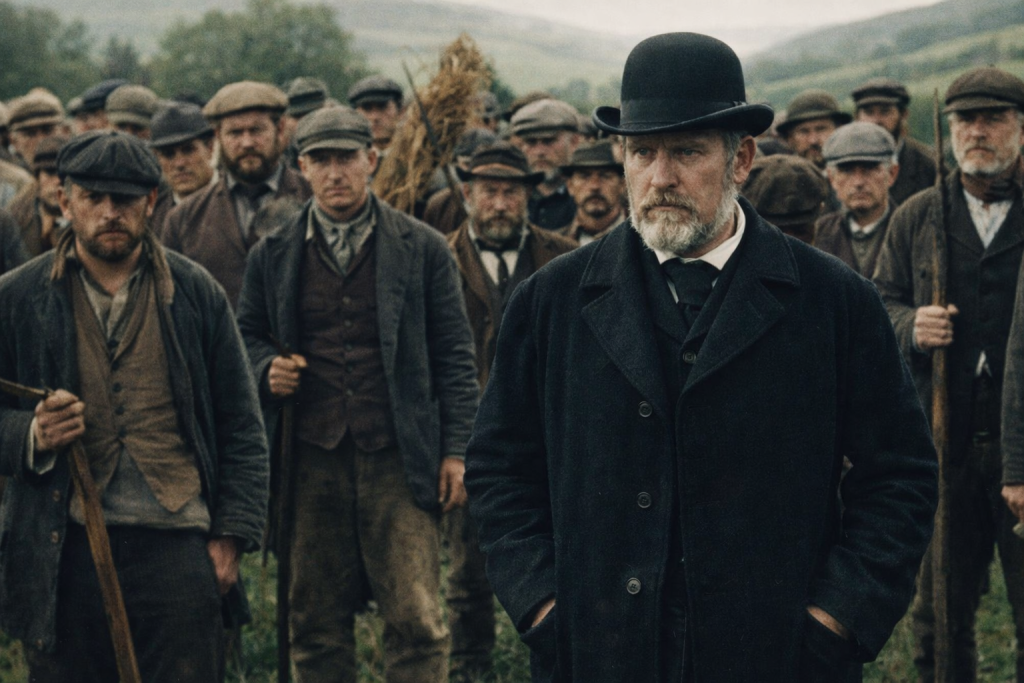
Instead of fighting back physically, people began to withdraw. Workers refused to harvest crops. Local shops stopped selling supplies. Services that had once been taken for granted simply disappeared. Day by day, Boycott found himself cut off from the basic network that made daily life possible.
This wasn’t about silence in a literal sense. It was about exclusion. In a tightly connected rural community, where everything depended on cooperation, that kind of isolation quickly became overwhelming.
When Isolation Becomes Unsustainable
Determined to salvage the situation, Boycott arranged for outside workers to come in and harvest the crops. But the effort required military protection to prevent unrest, turning a routine task into a costly operation. In the end, the expenses far exceeded the value of what was being harvested.
That moment revealed the real power of what had happened. No one had attacked him. No property had been destroyed. Yet the system around him had stopped working. Without cooperation, even the simplest processes became nearly impossible.
Eventually, Boycott left the area—not because he was forced out violently, but because staying was no longer viable.
From a Name to a Global Concept
The story quickly spread through newspapers in Britain and beyond. Journalists began using Boycott’s name to describe this kind of coordinated refusal to engage. Within a short time, “boycott” entered the English language and then spread internationally.
It’s a rare linguistic shift, where a person’s name transforms into a widely used term. And it happened because the idea behind it was simple, clear, and easy to replicate in other situations.
Why This Still Matters Today
More than a century later, the principle remains the same. Whether it’s consumers choosing not to support certain brands or communities withdrawing participation for ethical reasons, the underlying mechanism hasn’t changed. Power doesn’t always come from confrontation—it can also come from stepping back.
The story of Charles Boycott isn’t just a historical footnote. It’s a reminder of how interconnected systems really are, and how much influence people can have when they act together, even without raising their voices.
Beyond the Viral Version
Modern retellings often simplify the story, turning it into a dramatic anecdote about “total silence.” But the reality was more structured, more deliberate, and deeply tied to the political and economic struggles of the time.
And maybe that’s what makes it so compelling even now. Not the drama, but the strategy. Not the noise, but the shift in rules. Because sometimes, the most powerful response isn’t the loudest one—it’s the one that quietly changes everything.