
There are situations that don’t happen to you directly, yet stay with you longer than the ones that do.
Not because they are dramatic.
Not because they are shocking.
But because you don’t know what you’re supposed to do with them.
A friend of mine went through something like this, and it hasn’t left my mind since. Not because it was rare or extraordinary, but because it’s the kind of situation that, if it happened to you, would quietly shift the way you see everything.
She was part of one of those Facebook groups — the kind where women ask about men they’re talking to, trying to understand if what they’re being told matches reality. Some people see these groups as protective, even necessary. Others see them as dangerous, where truth, assumptions, and personal agendas sometimes blend in ways that are hard to untangle.
She wasn’t looking for anything. She was just scrolling.
Until she stopped.
Because she recognized a face.
Not an ex.
Not a distant acquaintance.
The husband of a woman she knew from another Facebook group.
A couple that, from the outside, seemed completely normal — even more than that, stable. The kind of relationship you see online and don’t question.
Family photos.
Smiles.
Anniversaries.
Trips.
Everything carefully aligned into that familiar image of a happy, grounded life.
And yet, he was there.
Posted in a space where women ask if it’s safe to meet a certain man, if he might be talking to others, if there’s something they should know before getting involved.
The shock wasn’t just seeing him there.
It was the contrast.
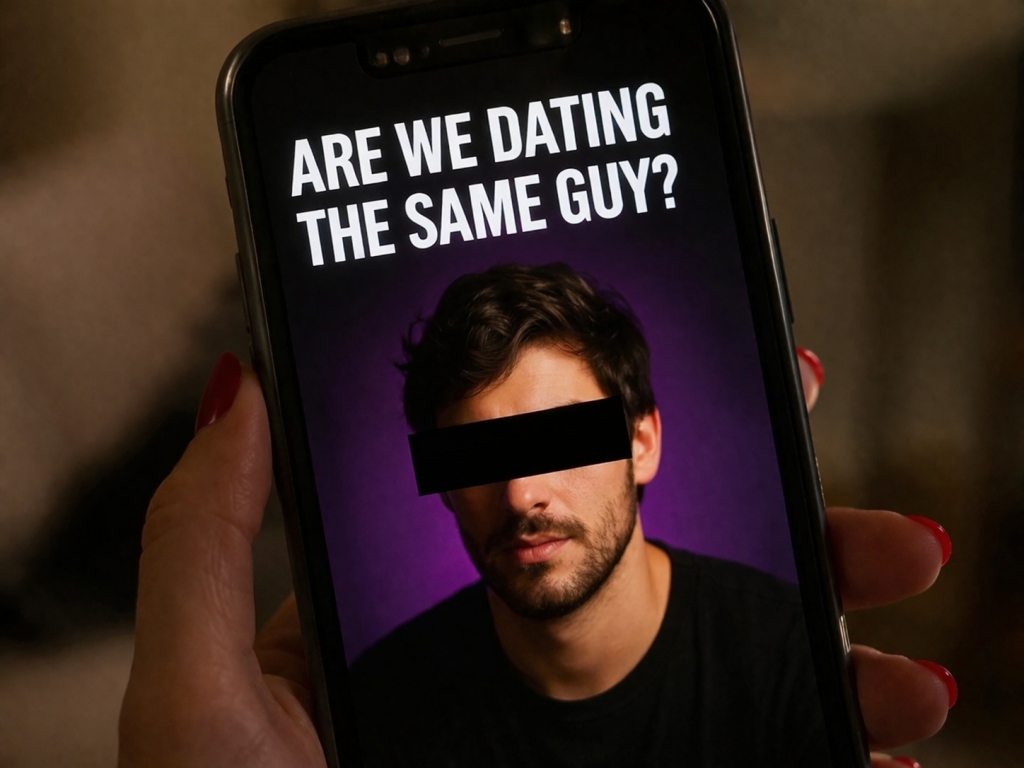
On Facebook, he was part of a peaceful family life.
In that group, he was a question.
And that’s where the real weight of the situation begins.
Because it stops being about him.
And becomes about you — the person who saw.
In that moment, every possible explanation rushes in at once.
Maybe she already knows.
Maybe they have an arrangement no one else sees.
Maybe it’s an old profile.
Maybe someone is using his photos.
Maybe it’s exactly what it looks like.
And none of these possibilities can be fully dismissed.
That’s the problem.
It’s not what you saw.
It’s that you don’t have enough certainty to know whether you have the right to step into someone else’s life and say: I think something is wrong.
Since these kinds of groups started gaining traction, there have been real stories that are hard to ignore. Women who found out that the man they were seeing was involved with multiple others at the same time. Women who were warned before getting into something unsafe. Women who supported each other in ways that didn’t really exist before.
And for that alone, it’s difficult to say these spaces have no value.
But there is another side.
Anonymous posts.
Outdated photos.
Stories taken out of context.
People exaggerating — or sometimes inventing.
There have been cases where innocent people were placed under suspicion based on incomplete or misleading information. There have also been situations where women inside these groups warned the men being discussed, complicating everything even further.
And suddenly, it’s no longer just about protection.
It becomes a space where truth is no longer entirely clear.
My friend didn’t tell her.
Not that day.
Not later.
Not because she didn’t care.
But because she found herself exactly where most people would — caught between two equally heavy outcomes.
If you speak and you’re wrong, you risk damaging something real.
If you stay silent and it was true, you might have said nothing when it mattered most.
And at that point, it’s no longer about a man on a dating app or a post in a group.
It’s about responsibility.
About boundaries.
About how far you’re allowed to step into someone else’s reality when you don’t see the full picture.
What stayed with me the most wasn’t even the possibility that he might be unfaithful.
It was how convincing a relationship can look from the outside, even when something inside it may no longer be what it seems.
We’ve become so used to believing what we see online.
Photos.
Smiles.
Milestones.
But none of these actually prove anything.
A picture doesn’t prove loyalty.
A vacation doesn’t prove peace.
A post doesn’t prove truth.
And maybe that’s exactly why these groups exist.
Because, at some point, people realized that what is shown isn’t always enough.
And still, even there, things are far from simple.
Because between the need to protect and the risk of accusing someone unfairly, there is a very thin line.
And sometimes, without meaning to, you find yourself standing right on it.
Unprepared.
Uncertain.
Left with a question that has no perfect answer:
If you saw something that could change someone’s life…
would you say something?
Or would you stay silent, hoping it isn’t what it looks like?