
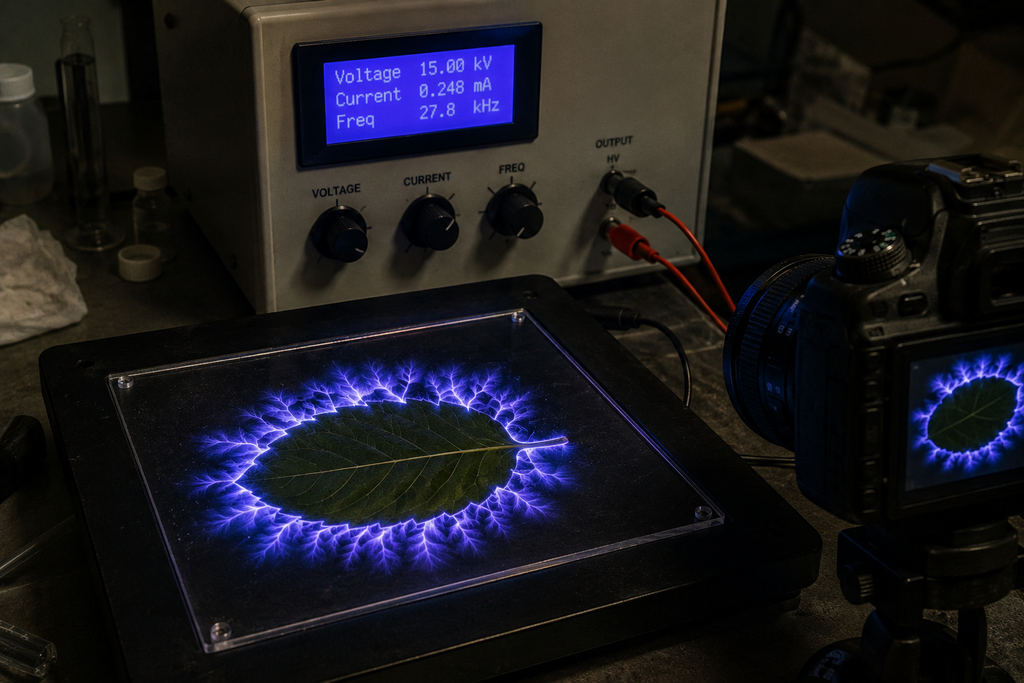
A green leaf is placed on a special surface and exposed to a powerful electrical field. In the resulting image, its edges seem to come alive, surrounded by an irregular blue-violet glow that looks remarkably similar to what many people imagine when they hear the word “aura.”
Then the experiment becomes stranger.
Part of the leaf is cut away and the image is taken again. In some photographs, a faint luminous trace still seems to appear where the missing piece used to be.
It looks as if the plant tissue is gone, but something of its original shape remains.
This phenomenon became known as the “phantom leaf effect,” and it played a major role in giving Kirlian photography its almost mystical reputation. Over the decades, images like these have been presented as possible photographs of the aura, of “life energy,” or of an invisible biological field surrounding living organisms.
Today, Kirlian experiments regularly resurface on social media, often alongside a familiar statement: energy cannot be created or destroyed, only transformed.
That statement is correct in physics. The problem begins when it is used to suggest something much more specific — that the glow in a Kirlian image must be the energy of life itself, somehow preserving the form of an organism even after part of it has been removed.
Physics does not actually say that.
At the same time, dismissing the whole subject with “it’s just electricity” is also too simplistic. The history of Kirlian photography includes unusual experiments, debated results and a phantom-leaf effect that remains scientifically interesting, even if it has never been proven to reveal a supernatural aura.
What Kirlian photography actually captures
The technique is named after Semyon Kirlian and his wife, Valentina, who began experimenting with this type of imaging in the Soviet Union during the 20th century.
Electrical discharge photography existed before their work, but the Kirlians helped popularize the striking images that later became famous around the world.
The process does not involve photographing an invisible light that is constantly surrounding the body.
Instead, an object such as a fingertip or a leaf is placed in a high-voltage electrical field. Under suitable conditions, the gas surrounding the object becomes ionized, creating what physicists call a corona discharge.
The glowing filaments visible in Kirlian images are produced by this electrical process.
This distinction matters because the photographs are not fake. The glow is not simply added afterward, and the phenomenon itself is real. The question is not whether the light exists.
The question is what the light tells us.
Why it looks so much like an “aura”
If you look at a Kirlian image of a fingertip without knowing how it was produced, the association is understandable. The skin can appear surrounded by dozens or hundreds of luminous filaments, unevenly distributed around the edge.
Leaves can look even more dramatic.
That visual resemblance helped fuel the belief that the technique might be revealing an invisible energy field around living things.
The problem is that corona discharge is not exclusive to life.
Nonliving materials can produce similar electrical patterns under the right conditions. Experiments using Kirlian-related techniques have also been performed on minerals and other inorganic materials, which can generate their own discharge patterns.
This is a crucial point.
If the glow were simply the visible signature of biological life, its appearance around lifeless materials would be difficult to explain. If it is an electrical discharge, however, the result makes perfect sense.
Why the same person can appear to have a different “aura”
Another reason Kirlian photography became associated with health and emotions is that the images are not always identical.
Two exposures of the same fingertip can look different. That variability has sometimes been interpreted as evidence that a person’s “energy” changes with mood, stress or physical condition.
There is a much more ordinary factor capable of altering the image dramatically: moisture.
A classic study published in Science in 1976 examined Kirlian photography and concluded that the images primarily recorded corona-discharge activity. The researchers found that much of the variation seen in biological subjects could be explained by moisture present on or near the surface.
Moisture changes the way electrical charge is distributed and therefore changes the local electrical field. That can alter the density, shape and extent of the visible discharge.
On human skin, perspiration matters.
In plants, water content matters.
Contact pressure, surface geometry, electrical resistance, applied voltage and other experimental conditions can also influence the final pattern.
So when the image changes, it does not automatically mean that something mysterious has happened to a person’s biological “energy.”
Then what is happening with the phantom leaf?
This is where the subject becomes genuinely interesting.
In the classic version of the experiment, a whole leaf is photographed first. A section is then removed and the remaining portion is photographed again.
Sometimes a faint glow appears in the area where the missing tissue had previously been.
Visually, the result can be striking. If you encounter the image without context, the interpretation almost writes itself: perhaps the physical leaf has been cut away, but its invisible energy field is still there.
One conventional explanation involves moisture and residue left on the contact surface.
If the entire leaf was originally resting on the photographic material before being cut, the removed portion may have left behind moisture or other substances that altered local conductivity. Since moisture is known to influence corona discharge, a later exposure could potentially produce a glow in that same region.
For many demonstrations, this is a reasonable explanation.
But one later experiment deliberately tried to remove that possibility.
The 137 leaves that made the story more complicated
In 2015, researcher John Hubacher published a study in the Journal of Alternative and Complementary Medicine specifically examining the phantom-leaf phenomenon.
The important detail was the timing.
The leaves were cut before they were placed on the film.
That meant the missing portion had never touched the photographic surface and could not have left behind the usual moisture trace invoked in simpler explanations.
The experiment involved 137 leaves from 14 plant species, with roughly 30 to 60 percent of each leaf removed. Hubacher reported a phantom-like effect in 96 of the 137 leaves, while 41 did not produce it.
He suggested that the result might be consistent with the existence of some form of “biological field.”
That is an intriguing hypothesis, but it is not the same thing as a scientific demonstration of an aura.
This distinction is essential.
A study can report an unusual result without proving the explanation proposed by its author. Moving from “an unexpected luminous structure appeared” to “we have detected a previously unknown biological field” requires much stronger evidence: independent replication, strict controls, careful elimination of conventional electromagnetic mechanisms and consistent results across different laboratories.
That standard has not been met.
Still, the 2015 experiment does make one point worth preserving: it is too simplistic to claim that every phantom-leaf image can always be dismissed as nothing more than moisture left behind by the missing piece. In that particular protocol, the removed tissue had never touched the film in the first place.
That makes the phenomenon interesting.
It does not make it paranormal.
Does a dying leaf lose its “life energy”?
Another visually impressive version of Kirlian photography follows a leaf as it dries and deteriorates.
The corona pattern changes over time. In some images, it appears weaker or more fragmented. Seen as a sequence, the photographs can look almost like the “energy of life” is fading away.
But a wilting leaf is undergoing major physical changes.
Most obviously, it is losing water.
And if we already know that moisture strongly influences corona discharge, we do not need to invoke an invisible vital force to explain why a fresh, hydrated leaf produces a different image from a dry one.
This is a useful example of the difference between correlation and explanation.
The image changes as the leaf dies, but that does not prove that the photograph is showing “life” leaving the plant.
“Energy cannot be destroyed” — true, but often misunderstood
The conservation of energy is one of the most frequently used arguments in viral discussions about Kirlian photography.
It is also one of the most misunderstood.
In physics, energy is a defined and measurable quantity. We speak about chemical energy, thermal energy, kinetic energy, electromagnetic energy and transformations between them.
Living organisms constantly use and transform energy. After death, that energy does not simply vanish in violation of physical law. Chemical energy changes form, heat is transferred to the surroundings and biological structures break down.
But conservation of energy does not imply that the organism’s shape, memories, personality, consciousness or a supposed aura must continue to exist as a separate energetic structure.
A simple analogy makes the distinction clear.
When a piece of wood burns, chemical energy is transformed into heat, light and other forms. Energy conservation remains perfectly valid.
But the released energy does not continue to preserve the shape of the tree.
For that reason, the statement “energy is conserved” cannot, by itself, be used as evidence that Kirlian photography captures a persistent life force.
That would be a separate claim, and it would require separate evidence.
Can Kirlian photography detect disease?
Once Kirlian images became associated with the body’s “energy,” another idea naturally followed: perhaps changes in that glow could reveal changes in health.
Later technologies, often grouped under the term Gas Discharge Visualization, or GDV, were developed using related principles.
This area has actually been studied, although the evidence is often presented online in a misleading way.
A systematic review published in 2023 examined research on GDV in health and disease. After applying its selection criteria, the review included 42 studies, including randomized controlled trials, non-randomized controlled studies, cross-sectional studies and other observational designs.
The authors considered the technique potentially interesting for research, screening or monitoring applications.
But they also emphasized the need for more methodologically robust studies before firm conclusions could be made and called for further clinical validation.
That distinction is critical.
“There are studies” does not mean “the method is clinically proven.”
At present, Kirlian photography or GDV should not be treated as substitutes for laboratory tests, medical imaging or standard clinical diagnosis.
Earlier scientific analyses of so-called aura photography have likewise argued that Kirlian and related images can be explained using known physical mechanisms and that the evidence is not strong enough to establish them as validated medical diagnostic tools.
Science does not have to say “impossible” to say “not demonstrated”
This is probably the most important part of the entire story.
When people encounter a strange phenomenon, they often feel pressured to choose between two extremes.
Either it must be paranormal, or it must already be completely understood.
Serious science is usually more cautious than that.
With Kirlian photography, we know a great deal. We know that the technique produces corona discharge. We know that moisture can strongly alter the image. We know that the effect is not exclusive to living matter, and we know that experimental conditions can dramatically influence what appears in the final photograph.
We also know that the phantom-leaf effect has been reported in an experiment where the leaves were cut before being placed on the film, making one simple explanation insufficient for that particular setup.
What we do not have is evidence that the remaining explanation must therefore be an aura, a soul or an unknown biological energy field.
There is a very large gap between “we have not fully explained every detail” and “we have demonstrated the paranormal.”
So what are we actually seeing?
At minimum, we are looking at a very real and visually spectacular electrical phenomenon.
A seemingly ordinary leaf is placed in a strong electrical field. Gas around it becomes ionized. Electrical charges move. Water inside the tissue affects conductivity. The shape of the leaf changes the local field, and processes normally invisible to the human eye become a glowing corona.
That does not need to be a photograph of the soul to be remarkable.
The phantom-leaf effect makes the story even more interesting because it also demonstrates how science should approach an unexpected result.
We do not declare something supernatural simply because it looks mysterious.
But we should not dismiss an unusual observation merely because it does not fit the simplest explanation either.
We improve the experiment. We control moisture, surfaces, voltage, geometry and environmental conditions. We repeat the result. We ask other laboratories to reproduce it. And if the effect survives those tests, we keep looking for the mechanism responsible.
Kirlian photography may not have given us a photograph of the aura.
What it has given us is something almost as fascinating: a perfect example of how quickly a real physical phenomenon can become a mystery when the image reaches the public long before the explanation does.