
“Saint Michael the Archangel, defend us in battle…” is one of the best-known Catholic prayers for spiritual protection. For generations of Catholics, it was also closely associated with the end of Mass, becoming part of a devotional practice that lasted for decades.
Its history, however, is surrounded by a dramatic story.
According to a long-standing Catholic tradition, Pope Leo XIII experienced something deeply disturbing during or after Mass. In later versions of the story, he is said to have perceived an attack by evil forces against the Church. Some accounts go even further, claiming that he heard a conversation between God and Satan in which Satan asked for a period of time to test or attempt to destroy the Church.
The pope, the story continues, then composed the Prayer to Saint Michael.
It is a compelling account, and it has been repeated for many years. But the historical record is more complex. Some parts of the story are well documented, while others belong to a tradition that developed and became more detailed over time.
Who Was Pope Leo XIII?
Born Vincenzo Gioacchino Pecci, Leo XIII became pope in 1878 and remained head of the Catholic Church until his death in 1903.
His pontificate came at a remarkable moment in European history. The Papal States had disappeared, Rome had become the capital of the Kingdom of Italy, and the relationship between the Church and modern political society was changing rapidly.
Leo XIII is remembered for many reasons. His 1891 encyclical Rerum Novarum became one of the foundational texts of modern Catholic social teaching. He also strongly promoted the Rosary and wrote extensively about spiritual life.
It was during his pontificate that the Prayer to Saint Michael became part of Catholic devotional practice on a worldwide scale.
The Prayer Became Part of the Leonine Prayers
The history of the prayer did not begin exactly as many viral posts suggest.
In 1884, Leo XIII ordered a series of prayers to be recited after Low Mass. These prayers eventually became known as the Leonine Prayers.
The Prayer to Saint Michael was added to them in 1886.
From that point onward, Catholics in many parts of the world became familiar with the invocation asking Saint Michael to defend them in spiritual battle.
This part of the story is historically well established. Leo XIII was closely connected with the prayer, and the Vatican itself has continued to refer to it as the prayer composed by Pope Leo XIII.
What About the Famous Vision?
The mysterious part of the story concerns an alleged supernatural experience of the pope.
According to accounts passed down in Catholic circles, Leo XIII was seen becoming unusually still or visibly shaken after Mass. He was then said to have withdrawn and composed a prayer calling on Saint Michael for protection against evil.
Later versions became increasingly detailed.
One popular account claims that Leo XIII heard Satan boast that he could destroy the Church if he were given greater power and sufficient time. God supposedly allowed him a limited period in which to try.
Depending on the version, that period is sometimes described as 75 years and sometimes as 100 years.
This is where historical caution becomes important.
There is no known contemporary document written by Leo XIII himself describing this exact conversation. Nor do the later accounts agree perfectly on when the event occurred, what the pope experienced or how long Satan supposedly requested.
That does not prove that Leo XIII had no unusual spiritual experience. It does mean, however, that the detailed dialogue frequently quoted online cannot be treated as securely documented history.
Tradition and Historical Evidence Are Not the Same Thing
Religious history often contains both documented events and traditions that were transmitted orally before being written down.
The story of Leo XIII is a good example.
We can say with confidence that he introduced the Prayer to Saint Michael into the Leonine Prayers in the 19th century.
We can also say that a Catholic tradition developed according to which the pope’s decision was connected with a frightening spiritual experience.
What historians cannot establish with the same level of certainty is the precise conversation between God and Satan that appears in many modern retellings.
There is an important difference between saying, “Catholic tradition holds that Leo XIII had a vision,” and saying, “Leo XIII definitely heard these exact words.”
The first accurately describes a tradition. The second goes beyond what surviving historical evidence can demonstrate.
Where Do the “75 Years” Come From?
The number 75 appears frequently in social-media versions of the story, but it is used in different ways.
In some retellings, Satan supposedly asked for 75 years in which to attack the Church. In others, people say the Prayer to Saint Michael was recited after Mass for roughly 75 years.
Only the second claim has an obvious historical basis.
The prayer was added to the Leonine Prayers in 1886, and the requirement to recite those prayers after Low Mass ended during the liturgical changes of the 1960s.
That means the practice lasted for close to eight decades.
Describing it loosely as “about 75 years” is therefore understandable. But the duration of the practice should not be used as proof that Leo XIII received a prophecy involving an exact 75-year period.
Those are two separate claims.
Was the Prayer Banned After Vatican II?
No.
This is another claim that often appears in dramatic retellings of the story.
The Prayer to Saint Michael was not forbidden by the Catholic Church.
What changed was the obligation to recite the Leonine Prayers after Mass. During the liturgical reforms of the 1960s, that practice was discontinued.
Removing a prayer from a required place in the liturgy is not the same as prohibiting Catholics from praying it.
The Prayer to Saint Michael continued to be used privately and in devotional settings, and some Catholic communities later restored the custom of praying it after Mass voluntarily.
Later popes also spoke positively about it.
John Paul II Asked Catholics Not to Forget It
One of the clearest examples came from Pope John Paul II.
In 1994, he spoke publicly about spiritual warfare and recalled the Prayer to Saint Michael associated with Leo XIII.
Although the prayer was no longer recited as part of the former post-Mass practice, John Paul II encouraged Catholics not to forget it.
That moment matters because it directly contradicts the idea that the Church had rejected or prohibited the prayer.
The liturgical requirement had disappeared, but the devotion itself remained very much alive.
Why Saint Michael?
The image of Saint Michael as a defender against evil did not begin with Leo XIII.
It comes from Scripture.
Michael appears in the Book of Daniel as a powerful heavenly protector. The Letter of Jude refers to him explicitly as the archangel.
His most famous biblical appearance, however, is found in the Book of Revelation.
Revelation 12 describes a war in heaven in which Michael and his angels fight against the dragon. The dragon is identified as the ancient serpent, the Devil and Satan.
This passage shaped centuries of Christian art and devotion.
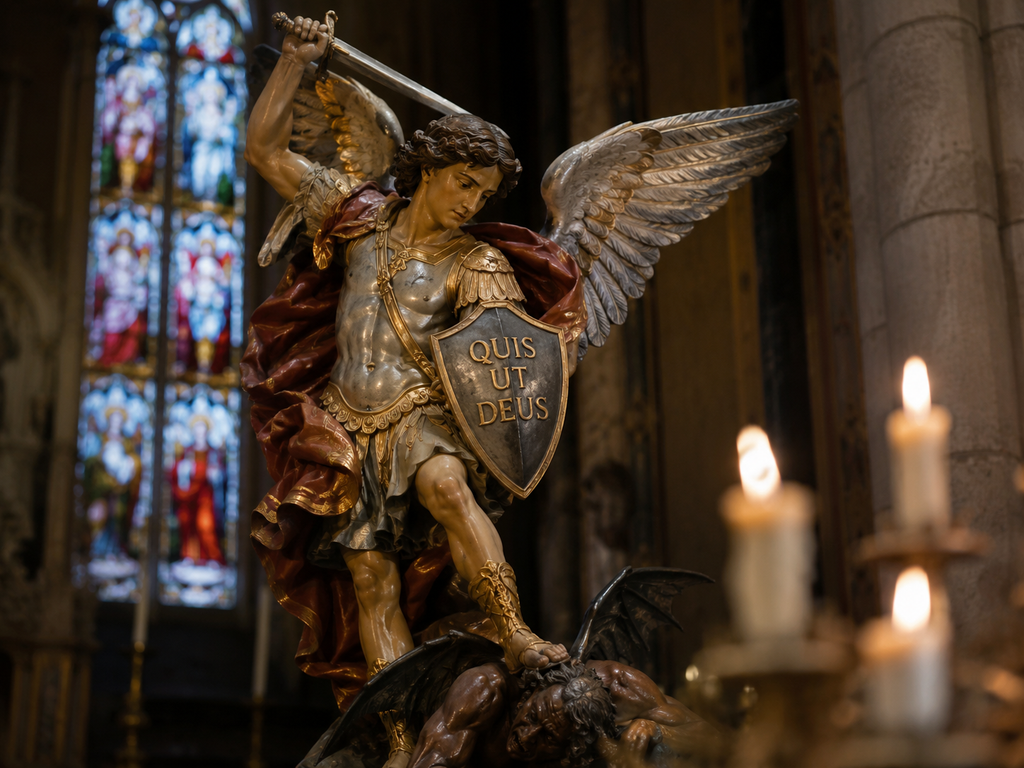
It explains why Saint Michael is so often depicted wearing armor, holding a sword or spear and defeating a dragon beneath his feet.
By the time Leo XIII composed his prayer, Saint Michael had already been associated with spiritual protection for many centuries.
What Does “Defend Us in Battle” Actually Mean?
The language of the prayer can sound almost military when read without context.
It speaks of battle, wickedness, snares, Satan and evil spirits.
Within Christianity, however, the battle is understood primarily as spiritual rather than physical.
The New Testament uses similar imagery. In the Letter to the Ephesians, Saint Paul explains that the Christian struggle is not fundamentally against other human beings but against spiritual forces of evil.
The Prayer to Saint Michael belongs to that theological tradition.
It is not a call to fight people. It is a request for protection against evil, temptation and spiritual harm.
Pope Francis Brought the Prayer Back Into the Spotlight
The prayer received renewed worldwide attention in 2018.
In September of that year, Pope Francis invited Catholics to pray the Rosary every day during the month of October. He also asked them to conclude it with two additional prayers, including the Prayer to Saint Michael.
The Vatican explained that the intention was to ask for protection for the Church against evil and division.
More than 130 years after Leo XIII introduced the prayer into the Leonine Prayers, another pope was therefore encouraging Catholics around the world to use it.
That alone shows how enduring the devotion has been.
So Is the Viral Story True?
Parts of it are.
Pope Leo XIII really is closely connected with the Prayer to Saint Michael.
The prayer became part of the Leonine Prayers during his pontificate.
Catholics recited it after Mass for many decades.
There is also a long-standing Catholic tradition that Leo XIII experienced something spiritually disturbing before composing or promoting the prayer.
What cannot be established with equal certainty is the dramatic dialogue between God and Satan frequently quoted online, the precise words supposedly spoken or the exact number of years Satan is said to have requested.
The claim that the prayer was later banned is also incorrect.
The obligation to recite the Leonine Prayers after Mass ended. The prayer itself did not disappear.
The Historical Story Is Powerful Enough Without Embellishment
Perhaps the most interesting thing about the Prayer to Saint Michael is that its documented history does not need exaggeration.
Here is a prayer associated with a 19th-century pope, built around one of Christianity’s oldest biblical images: Michael confronting the forces of evil.
It was recited by generations of Catholics and remained part of Church life through enormous changes in politics, society and liturgy.
After the old post-Mass practice ended, John Paul II encouraged Catholics not to forget the prayer.
Decades later, Pope Francis once again asked Catholics throughout the world to pray it.
The mysterious story of Leo XIII’s vision will probably continue to fascinate believers.
But even when we carefully separate tradition from what can be historically verified, the story of the prayer remains remarkable.
The Prayer to Saint Michael the Archangel
English versions of the prayer vary slightly in wording. One widely used Catholic form reads:
Saint Michael the Archangel, defend us in battle. Be our protection against the wickedness and snares of the devil. May God rebuke him, we humbly pray; and do thou, O Prince of the heavenly host, by the power of God, cast into hell Satan and all the evil spirits who prowl about the world seeking the ruin of souls. Amen.
More than a century after Leo XIII’s pontificate, those words continue to be prayed by Catholics around the world — not because every detail of the story surrounding their origin can be proven, but because the prayer itself has become one of the most enduring expressions of Catholic belief in spiritual protection.