
Before Clint Eastwood became one of the most recognizable faces in cinema, he was simply a young American serviceman trying to find his place in life. In the early 1950s, years before Hollywood fame, before the westerns, and long before the Oscar-winning films, Eastwood experienced a real-life survival story that could have ended everything before his career had even begun.
At the time, he was stationed at Fort Ord in California during the Korean War era. Although many people assume he served directly on the front lines overseas, Eastwood actually remained in the United States, where he worked in several roles connected to physical training and water safety. Because he was an exceptionally strong swimmer, he also spent time working as a military swimming instructor and lifeguard.
Ironically, those exact skills would soon become the reason he stayed alive.
America During the Korean War Era
The early 1950s were marked by uncertainty and military tension across the United States. Thousands of young men were being drafted, sent overseas, or assigned to military bases around the country. For many families, military service became a defining part of life during that period.
Eastwood was still far from becoming an actor. He had worked various jobs before entering the military and had not yet discovered the career that would later make him famous worldwide. By most accounts, he was quiet, physically imposing, and disciplined, but not someone anyone would have predicted would eventually become a Hollywood icon.
Military travel during that era was often informal compared to modern standards. Service members on leave sometimes managed to secure rides on available military aircraft if there was space. These flights were not always designed for passenger comfort or even regular transportation.
The Flight That Nearly Changed Film History
In September 1951, Eastwood was returning from leave in the Seattle area and trying to make it back to base before his leave expired. According to several biographies and interviews connected to the story, he missed his scheduled transport and searched for another way back to California.
Eventually, he boarded a smaller military aircraft. Over time, many versions of the story have circulated, some more dramatic than others. Certain retellings claim he was allowed aboard at the last moment after insisting on getting a ride back to base.
Not every detail has been fully verified decades later, but the central facts remain consistent: the aircraft encountered serious problems during the flight, and what began as a routine return trip quickly turned into a life-threatening emergency.
Trouble Over the Pacific
At some point during the flight above the Pacific Ocean, the aircraft began experiencing difficulties. Reports connected to the incident have mentioned navigation problems, low fuel, and deteriorating flight conditions.
Eventually, the pilot realized the plane would not safely reach its destination. With few options remaining, the aircraft was forced down into the Pacific waters off the California coast.
Movies often portray water landings as dramatic but survivable moments. In reality, crashing into water at high speed can be catastrophic. Darkness, cold temperatures, and strong ocean currents make survival far more difficult than most people imagine.
Eastwood and the pilot managed to escape the aircraft before it disappeared beneath the surface, but surviving the crash itself was only the beginning.
Hours in Freezing Water
Once in the ocean, the real danger started to unfold.
The Pacific waters near California are cold enough to become dangerous very quickly, especially at night. Human bodies lose heat rapidly in cold water, and even healthy individuals can begin suffering serious physical impairment within a relatively short period of time.
Hypothermia is considered one of the greatest threats in maritime and aviation survival situations. As body temperature drops, coordination weakens, breathing becomes more difficult, judgment declines, and exhaustion accelerates.
Eastwood’s background as a trained swimmer and military lifeguard likely gave him a critical advantage. He understood how to conserve energy, remain calm under pressure, and keep moving in hostile conditions.
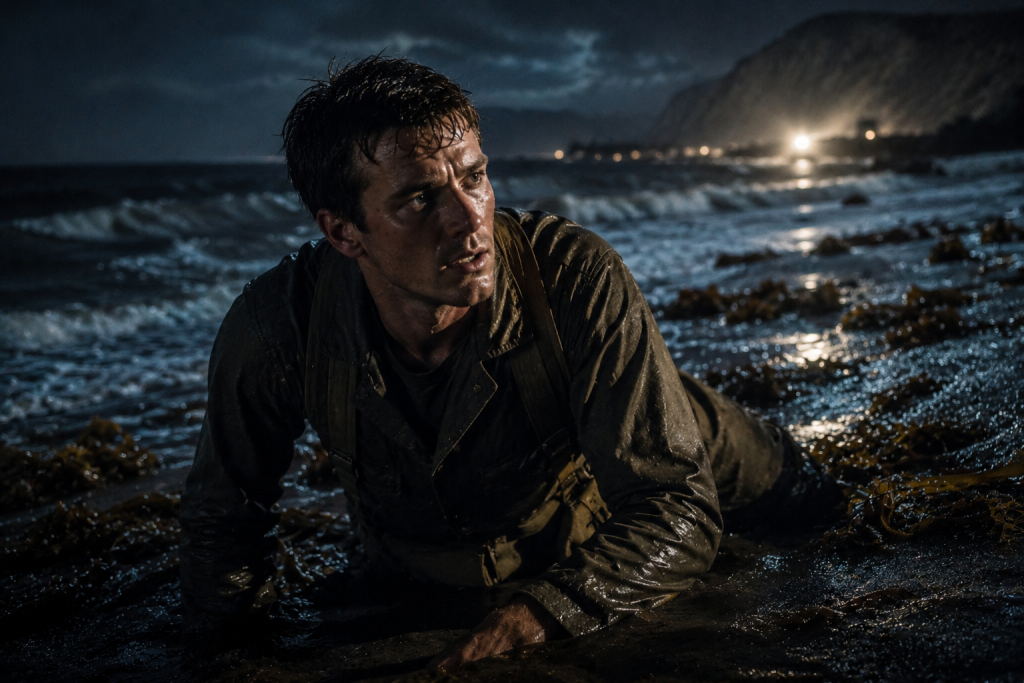
Years later, he described swimming through dark Pacific waters toward shore, trying to stay focused while battling cold temperatures and exhaustion. Some accounts mention the presence of heavy kelp in the water, adding another obstacle as he fought to reach land.
The Psychological Impact of Near-Death Experiences
Biographers and film historians have often pointed to this accident as one of the experiences that shaped Eastwood’s personality long before fame arrived. Surviving a situation where death feels genuinely possible can profoundly alter the way people respond to fear, stress, and risk later in life.
Psychologists sometimes refer to this phenomenon as Post-traumatic growth, a process in which certain individuals develop increased emotional resilience or a changed perspective after surviving traumatic experiences.
Looking back at Eastwood’s public image over the decades, many people have noted how naturally calm and controlled he appeared, both on-screen and off. While no single event defines a person completely, surviving the Pacific crash may have contributed to the quiet toughness that later became associated with his identity.
A Real Survival Story Before Hollywood
Today, the 1951 Pacific crash remains one of the most remarkable chapters in Clint Eastwood’s life story because it happened before any fame, wealth, or public recognition existed. At the time, he was simply another young serviceman trying to return to base after leave.
Had the aircraft gone down farther from shore, had the water been rougher, or had Eastwood lacked strong swimming skills, the outcome might have been very different.
The strange irony is difficult to ignore: decades before becoming famous for playing unshakable survivors and hardened heroes, Clint Eastwood first had to survive a very real ordeal of his own, alone in the cold Pacific Ocean, long before Hollywood ever learned his name.