
The signs appeared before the disappearance
In late August 2013, 19-year-old Bryce Laspisa was preparing to return to classes at Sierra College in Rocklin, California.
From the outside, his life appeared fairly typical for a college student. He had friends, a girlfriend, and a supportive family living in Southern California. But according to people close to him, something about his behavior had begun to change during the days leading up to his disappearance.
Friends later described him as emotionally unsettled and unusually distant. Some recalled conversations and decisions that felt strange in hindsight, including reports that he gave away personal belongings shortly before he vanished.
None of those details alone explained what would happen next.
But together, they created the sense that something inside Bryce’s life had begun shifting before anyone realized how serious the situation might become.
August 28, 2013 — the drive south begins
On August 28, Bryce visited his girlfriend in Chico, California. During that visit, the relationship reportedly ended.
After leaving Chico, the plan appeared straightforward:
he would drive south toward his parents’ home in Laguna Niguel.
Normally, the drive would have taken several hours.
Instead, the trip slowly transformed into a confusing sequence of delays, unexplained stops, phone calls, and hours of inactivity that alarmed his family more and more as the night progressed.
What makes Bryce’s case especially haunting is that he did not simply disappear without contact.
For many hours before vanishing, his family knew he was alive, speaking to him repeatedly while trying to guide him home.
Running out of gas in Buttonwillow
On August 29, Bryce’s parents learned that his vehicle—a 2003 Toyota Highlander—had required roadside assistance near Buttonwillow in Kern County after running out of fuel.
At first, the situation did not necessarily seem alarming. Long drives, exhaustion, and simple mistakes happen.
But after receiving gasoline, Bryce remained in the same general area for hours instead of continuing south.
His mother became concerned enough to ask the roadside assistance worker to return and check on him again.
When the worker returned, Bryce was reportedly still sitting in his car near the same location.
He assured both the worker and his mother that he was fine and that he would continue driving home soon.
But he still did not leave.
Hours of waiting with no clear explanation
As evening approached, Bryce’s parents became increasingly frightened.
His phone location suggested he remained near Buttonwillow despite supposedly being on his way home. At one point, a deputy from the Kern County Sheriff’s Office located Bryce and spoke with him directly.
According to public reports, the deputy did not observe signs that legally justified detaining him. Bryce appeared coherent and did not seem to present an immediate danger to himself or others.
This became one of the most difficult aspects of the case to process later.
From the family’s perspective, something clearly felt wrong.
But from a legal and investigative standpoint, Bryce was an adult who was speaking normally and refusing assistance.
Retrospectively, people often ask whether more could have been done.
In real time, however, the situation was far less clear.
The final phone call
At approximately 2:08 a.m. on August 30, Bryce spoke with his mother for what would become the final confirmed time.
He told her he was tired and had pulled over to rest before finishing the drive.
He sounded calm.
The conversation gave the impression that he simply needed sleep and would continue toward home afterward.
For his parents, the call likely offered temporary reassurance. He was still answering his phone. He was alive. He was supposedly only hours away from reaching them.
No one realized that this would be the last conversation.
The crash near Castaic Lake
A few hours later, authorities arrived at the Laspisa family home with devastating news.
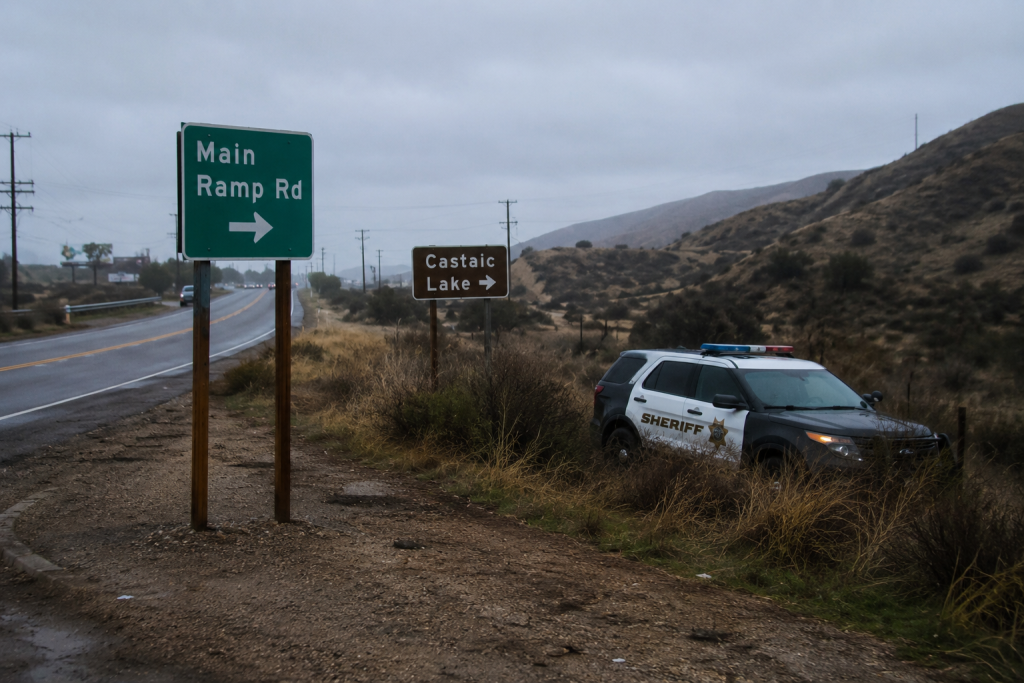
Bryce’s Toyota Highlander had been discovered overturned near Castaic Lake in Los Angeles County.
The SUV had gone down an embankment close to Main Ramp Road and was badly damaged.
But Bryce was gone.
Inside the vehicle, investigators found his phone, wallet, laptop, and other personal belongings.
Evidence suggested he had likely escaped the vehicle through the rear window after the crash.
Blood found inside appeared consistent with injuries caused by the collision, yet investigators did not find evidence at the scene proving fatal trauma.
That discovery transformed the case completely.
If Bryce survived the accident and exited the vehicle, where did he go afterward?
The search around the lake
Authorities launched extensive search efforts around Castaic Lake and the surrounding terrain.
Search teams used helicopters, dogs, divers, volunteers, and ground crews to examine nearby roads, hillsides, water areas, and remote terrain.
No confirmed trace of Bryce was found.
The geography around Castaic Lake complicated the investigation more than many people realize. The area includes steep slopes, brush, uneven terrain, isolated roads, and sections that become difficult to search thoroughly.
Without a confirmed direction of travel after the crash, investigators were left with multiple possibilities but no definitive path forward.
The behavior that still raises questions
One of the reasons Bryce Laspisa’s disappearance continues to fascinate people is the strange behavior leading up to it.
Why did he spend so many hours sitting near Buttonwillow without continuing his drive?
Why did he repeatedly reassure his family that he was fine while making almost no progress?
Why did he continue driving south only to crash near Castaic Lake hours later?
From a psychological perspective, severe emotional stress, exhaustion, prolonged driving, sleep deprivation, and mental overload can dramatically affect decision-making and behavior.
People under intense strain sometimes become indecisive, emotionally detached, disoriented, or unable to organize simple tasks effectively.
That does not explain Bryce’s disappearance directly.
But it helps explain why his actions may have appeared confusing even to people speaking with him in real time.
The abandoned belongings
Another detail that continues to disturb investigators and the public alike is the fact that Bryce left behind essential personal items.
His phone remained in the vehicle.
His wallet remained in the vehicle.
His laptop remained in the vehicle.
In many disappearance cases, abandoned belongings can suggest panic, confusion, injury, impulsive behavior, or deliberate separation from a previous identity.
But without knowing what happened after the crash, those objects remain open to interpretation.
False leads and reported sightings
Over the years, multiple reported sightings and online rumors have surfaced.
Some were investigated seriously, including a widely discussed image in 2022 of a man in Montana who resembled Bryce. Investigators later confirmed the individual was not him.
The California Department of Justice missing person listing for Bryce Laspisa continues to classify the case as active.
Why the case feels so unsettling
Many missing person cases remain mysterious because information is scarce.
Bryce Laspisa’s disappearance feels different.
There was contact.
There were phone calls.
There were witnesses.
There was roadside assistance.
There was a police encounter.
There was a crash scene.
The story appears to move steadily toward an explanation.
And then, suddenly, the final piece disappears.
That is what makes the case so difficult to forget.
Bryce was not lost in a remote wilderness from the beginning.
He was not completely cut off from communication.
For hours, he seemed close to home.
Close to help.
Close to safety.
And yet somewhere between Buttonwillow, Castaic Lake, and the final crash site, the trail ends completely.
More than a decade later, nobody has been able to explain what happened after Bryce Laspisa climbed out of that overturned SUV and vanished into the darkness.