
Some cases shock through violence, but others stay with you for a different reason, one that feels harder to process. Not because a stranger suddenly appeared out of nowhere, but because the danger came from someone already inside the circle, someone who seemed familiar, someone who didn’t immediately raise suspicion.
Katie Beers’ story belongs to that category.
In late December 1992, in Bay Shore, Long Island, New York, Katie was just days away from her tenth birthday. Her life was already far from stable. Public records and her own later account show that she had been growing up in a difficult environment marked by neglect and abuse, long before anyone reported her missing.
That context matters, because what happened next did not interrupt a protected childhood. It happened to a child who had already been living without the safety most people take for granted.
The man who abducted her, John Esposito, was not a stranger. He was a friend of the family, someone who had been around enough to be trusted, or at least not questioned. On December 28, 1992, he lured her into his home with the promise of birthday gifts. At first, everything seemed ordinary. She played video games in his room, a moment so normal that it didn’t signal danger.
That is what makes the shift so unsettling.
Because the danger did not announce itself.
At some point, that ordinary situation turned into something entirely different. Esposito forced her into a concealed underground space he had built beneath his property. This was not an improvised hiding place, but a deliberately constructed bunker, hidden under a heavy hatch and accessed through a disguised entrance.
The space was small, enclosed, and completely cut off from the outside world.
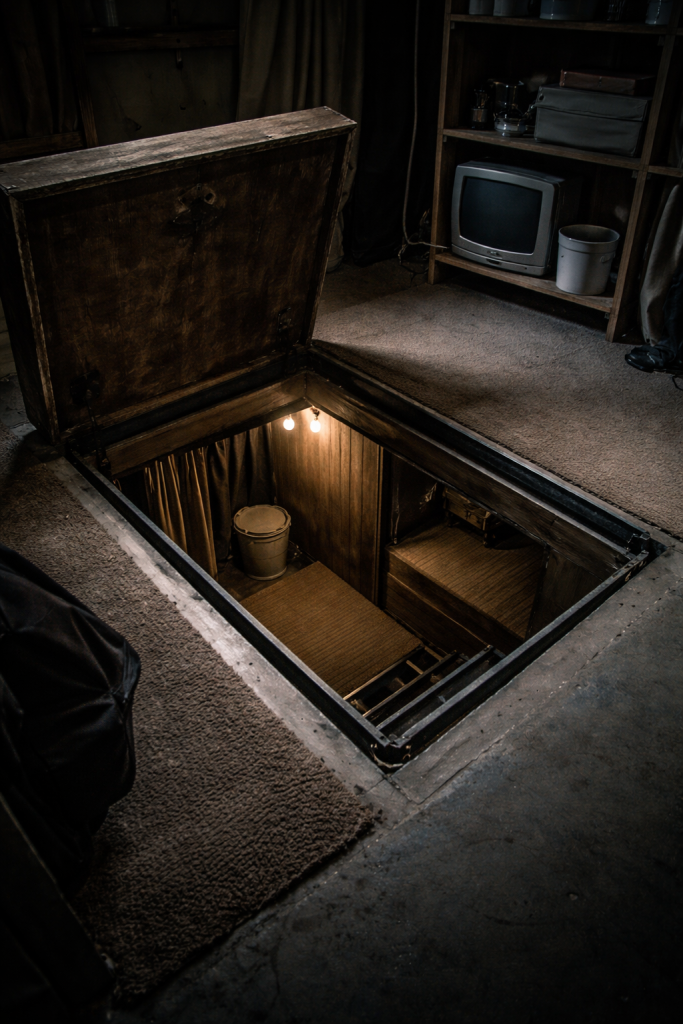
Inside, there were basic items—a small television, a bucket-style toilet, minimal bedding—but none of that changed the reality of the situation. Katie was isolated, controlled, and entirely dependent on the person who had taken her. Public accounts confirm that she was subjected to serious abuse during that time, though the details are not necessary to understand how extreme the situation was.
One of the most disturbing aspects of the case is the level of planning involved. Katie later recalled that she had played in the dirt that came from digging the hole, not knowing at the time what was being built. What looked like a simple project to a child was, in reality, preparation for her own confinement.
After hiding her, Esposito tried to mislead investigators by recording a message in which Katie claimed she had been taken by a man with a knife. The intention was to create the impression of an unknown attacker, distancing suspicion from himself. However, investigators quickly noticed inconsistencies, including the unnatural quiet in the recording, and began focusing on him early in the investigation.
During the roughly two weeks she was held there, Katie existed in a space where time became distorted and escape was not realistically possible. At one point, she managed to hide a key that allowed her to free herself from certain restraints and move within the bunker when he wasn’t there, but she still had no way out of the structure itself.
That detail is important, because it answers a question people often ask in hindsight: why didn’t she escape? The reality is that the environment had been designed specifically to prevent that, even in moments when direct supervision was reduced.
As the investigation intensified, pressure built around Esposito. His behavior raised suspicions, and contradictions in his statements became harder to ignore. Eventually, on January 13, 1993, more than two weeks after the abduction, he confessed and led authorities to the location.
Katie was found alive.
The moment of discovery was difficult to process even for those involved. Not only because she had survived, but because of where she had been found—inside a hidden underground bunker, physically close to everyday life, yet completely separated from it.
Her rescue did not mark a simple return to normal life. Shortly after being found, authorities removed her from her previous environment due to the abuse she had experienced before the abduction. She was placed in a safer setting and later adopted, growing up away from public exposure.
As an adult, she chose to speak about her experience and published her memoir, Buried Memories, explaining how deeply those events shaped her life. In a way that is difficult to accept, she also acknowledged that after being rescued, she finally experienced a level of safety that had been missing even before the abduction.
John Esposito later pleaded guilty and was sentenced to 15 years to life in prison. He died in custody in 2013. Another man connected to Katie’s earlier life was also convicted for abuse, reinforcing the reality that her story was not defined by a single act, but by a series of failures from adults who should have protected her.
What makes this case so difficult to forget is not just the existence of the bunker or the duration of her captivity, but the layers beneath it. It forces you to look at uncomfortable truths—how danger can come from within trusted circles, how warning signs can be overlooked, and how a child can be failed more than once before anyone truly steps in.
At its core, this is not just a story about a girl found underground.
It is the story of a child who survived repeated betrayals—and still found a way to move forward.