
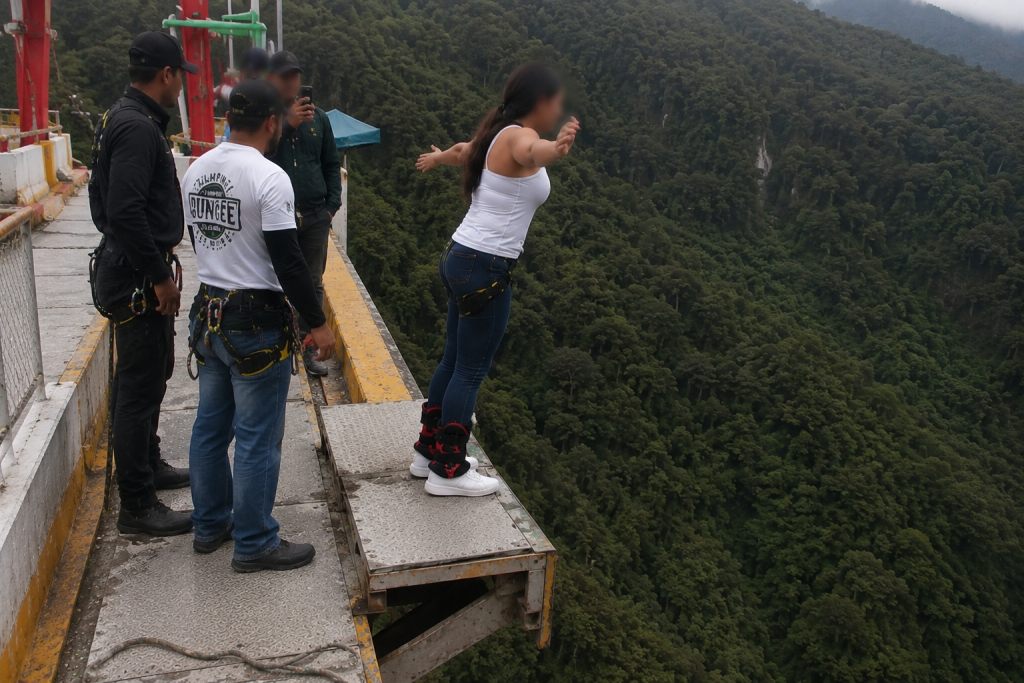
On the morning of July 18, 2021, a historic railway viaduct in Colombia’s Antioquia department was crowded with visitors looking for an adrenaline rush. Once part of the region’s rail network, the towering bridge had become a popular destination for commercial bungee jumping, drawing thrill-seekers from across the country every weekend.
Among them was 25-year-old attorney Yecenia Morales Gómez from Medellín.
It was her first bungee jump.
She had arrived with her boyfriend expecting an unforgettable adventure. Instead, within seconds, a chain of preventable failures turned an ordinary weekend outing into one of the most widely reported bungee jumping tragedies in recent years.
Unlike many accidents associated with extreme sports, this one was not caused by a snapped cord or a catastrophic equipment failure. According to publicly available information, the tragedy resulted from human error and a breakdown in safety procedures before the jump had even begun.
A Young Lawyer with Her Future Ahead of Her
Before her name appeared in headlines around the world, Yecenia Morales Gómez was simply a young professional building her future.
Family members described her as cheerful, generous, and full of energy. Her brother later told Colombian media that she loved reading, dancing, and helping those around her. Friends remembered her as someone who embraced life and enjoyed trying new experiences.
She was not an experienced extreme sports enthusiast. Like most first-time participants, she relied entirely on the instructors and organizers to ensure every safety procedure had been completed correctly.
That trust would prove fatal.
A Popular Adventure Destination
The accident occurred on a viaduct located between the municipalities of Amagá and Fredonia in western Colombia. After the railway line was abandoned decades ago, the bridge found a new purpose as a site for adventure tourism.
With a drop of roughly 45 to 50 meters (150–165 feet), it became an ideal location for commercial bungee jumping. Several operators offered jumps from the structure, attracting visitors eager to experience the sensation of free fall.
When conducted according to established safety standards, bungee jumping is considered relatively safe. Serious accidents are rare and are far more likely to result from procedural failures than from defects in the equipment itself.
That distinction makes Yecenia’s case particularly significant.
A Misunderstood Command
According to statements from local authorities and reports published after the investigation began, Yecenia’s boyfriend was scheduled to jump first.
He had already been secured to the bungee cord.
Yecenia was wearing part of her safety equipment, but the cord had not yet been attached to her harness.
At some point during the preparation process, an instructor gave the signal for the person who was already connected to jump.
For reasons that have never been fully clarified, Yecenia believed the instruction was directed at her.
She stepped forward.
She jumped.
She was not attached to the cord.
She fell approximately 45 to 50 meters.
Her boyfriend immediately rushed down the hillside and attempted CPR until emergency responders arrived, but she could not be revived.
The tragedy shocked both the local community and the international adventure sports industry because it was not caused by a hidden mechanical defect. Instead, it appeared to stem from a breakdown in procedures that should have prevented an unsecured participant from ever reaching the jump point.
Did She Die Before Impact?
One detail has been repeated countless times since the accident: the claim that Yecenia suffered cardiac arrest during the fall and died before hitting the ground.
Numerous international news outlets reported this conclusion, but it deserves careful context.
The complete forensic report has never been publicly released, meaning independent experts cannot verify the precise moment of death. While several publications cited medical findings suggesting cardiac arrest occurred during the fall, those claims cannot be independently confirmed through publicly available official documents.
Medical experts also note that news reports frequently confuse a heart attack with cardiac arrest, even though they are different medical events.
Cardiac arrest occurs when the heart suddenly stops pumping blood effectively. It can have multiple causes, including severe trauma or certain electrical disturbances of the heart. A heart attack, by contrast, involves a blockage of blood flow to the heart muscle.
Without access to the full forensic findings, the most accurate conclusion is that reports of cardiac arrest before impact remain unverified outside the information released through the media.
The Investigation
Following the accident, Colombian authorities launched an investigation into both the incident itself and the operator responsible for the jump.
Local media also reported that questions were raised regarding the company’s operating licenses and regulatory compliance.
Beyond the legal investigation, however, one question stood above all others:
How was it possible for someone who had not yet been connected to the bungee cord to reach the edge of the platform and jump?
In a properly designed safety system, a single misunderstanding should never be enough to produce a fatal outcome.
Participants should only approach the jump point after every connection has been physically completed and independently verified. Commands should be unmistakable. Critical steps should never rely on assumptions.
When any one of those safeguards is missing, the entire system begins to depend on luck rather than procedure.
Why Aviation Offers an Important Lesson
At first glance, commercial aviation and bungee jumping seem to have little in common.
One transports hundreds of passengers across continents. The other lasts only a few seconds.
Yet both involve moments when a single mistake can have catastrophic consequences.
That is why aviation relies on standardized checklists rather than memory alone. Even highly experienced pilots read and verify the same procedures before every takeoff and landing. They do not use checklists because they lack experience—they use them because human beings are capable of making mistakes.
The same philosophy exists in modern surgery, nuclear power operations, and professional climbing.
Critical actions are verified repeatedly, often by more than one person.
The goal is simple: ensure that one human error cannot immediately become a fatal accident.
Adventure sports involving significant risk are increasingly expected to follow the same principles. Not because every jump is as complex as flying an aircraft, but because the consequences of failure can be equally irreversible.
The “Swiss Cheese” Model of Safety
Safety specialists often explain major accidents using the “Swiss Cheese Model,” developed by British psychologist James Reason.
The concept suggests that every safety system contains multiple layers of protection. Each layer has small weaknesses—like holes in slices of Swiss cheese—but an accident occurs only when those weaknesses temporarily align.
A participant may misunderstand an instruction.
An instructor may assume another colleague has completed a safety check.
A verification step may be skipped.
A communication may be unclear.
Normally, one of the remaining safeguards catches the error before it reaches the participant.
In Yecenia Morales Gómez’s case, the tragedy appears to have resulted from several safety barriers failing at the same time rather than from one isolated mistake.
A Similar Question Raised Again
Several years later, another fatal accident involving a commercial rope jumping activity in Brazil once again focused public attention on safety procedures in adventure sports.
Although the circumstances were different, both tragedies raised the same fundamental question: should activities involving potentially fatal risks adopt standardized safety systems similar to those used in aviation, medicine, and other high-risk industries?
If you’ve already read our article about Maria Eduarda Rodrigues de Freitas and the fatal rope jumping accident in Brazil, you’ll notice that the details differ, but the underlying issue is remarkably similar. In both cases, investigators examined whether a series of preventable procedural failures allowed a participant to enter an irreversible situation.
The comparison is not about equating two separate investigations.
It is about recognizing a shared lesson.
More Than an Isolated Accident
Yecenia Morales Gómez did not set out that morning believing she was accepting a fatal risk.
Like thousands of people who participate in commercial adventure activities every year, she believed she was taking part in a carefully managed experience where every critical safety measure had already been addressed.
That distinction matters.
Extreme sports involve controlled risk.
Negligence removes the control.
Years after her death, Yecenia’s story continues to be discussed not because of its shock value, but because it illustrates a universal principle of safety management: procedures exist precisely because even experienced people can make mistakes.
When lives depend on equipment, communication, and human decisions, safety cannot rely on assumptions.
It must rely on systems designed to catch human error before it becomes irreversible.
For participants, a bungee jump lasts only a few seconds.
For the people responsible for their safety, the real work begins long before anyone leaves the platform.