
There are some medical mistakes that seem almost impossible in a modern operating room.
Before major surgery begins, the patient’s identity is checked. The planned procedure is confirmed. When the operation involves one side of the body, the correct site is identified and marked. Before the first incision, the surgical team pauses again to make sure everyone agrees on the patient, the procedure and the location.
These safeguards exist because medicine does not assume that human beings are incapable of making mistakes.
Yet in September 2025, a woman in Ohio entered an operating room expecting surgeons to amputate her right leg below the knee.
When the operation was over, her left leg was gone.
The case of Sharon Jacks is disturbing for an obvious reason. But the deeper question is even more unsettling: How can a catastrophic mistake survive several layers of safety checks designed specifically to catch it?
The surgery was supposed to involve her right leg
Sharon Jacks, who was reported to be 74, was scheduled for a below-the-knee amputation of her right leg at Selby General Hospital in Marietta, Ohio.
According to reporting on the lawsuit, the operation was medically necessary in connection with squamous cell carcinoma and a chronic wound affecting that limb.
On September 19, 2025, Jacks underwent surgery.
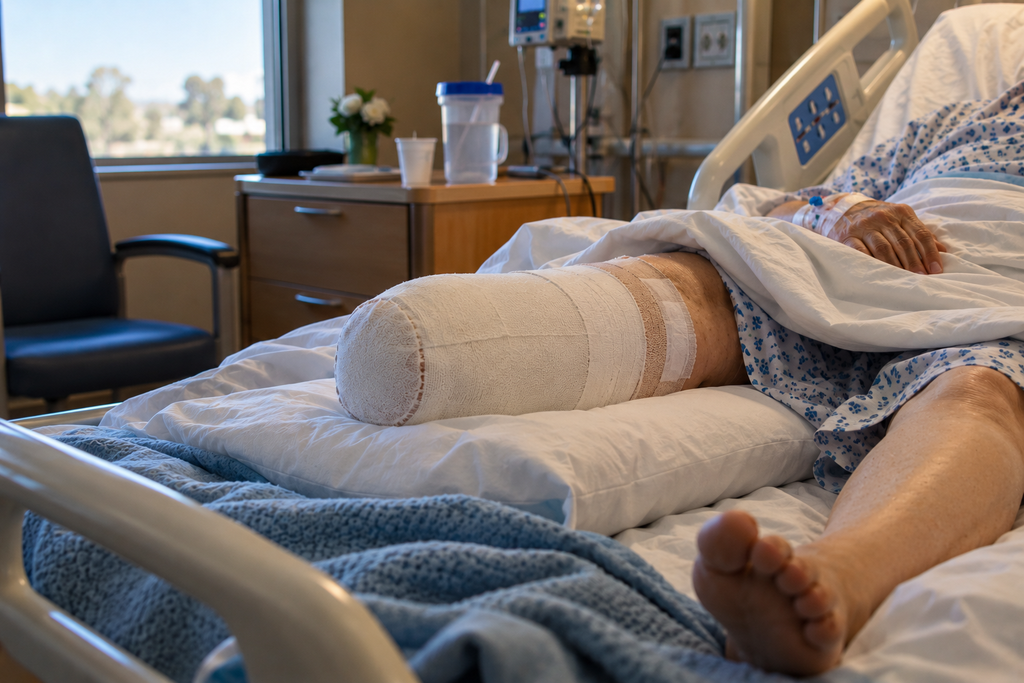
But surgeons amputated her left leg instead.
Her original medical problem remained. Roughly four months later, her right leg also had to be amputated below the knee, leaving Jacks without either lower leg.
That alone would make this an extraordinary medical error.
But one allegation in the lawsuit makes what happened even harder to comprehend.
The correct leg had reportedly been marked
According to the family’s attorney, Brad Layne, Jacks’ right leg — the one that was actually supposed to be removed — had been marked before surgery.
After the wrong leg had been amputated, that marking was reportedly still visible on her right leg.
If established as described in the lawsuit, this changes the nature of the safety failure.
It would mean that the correct information was not simply absent. A visible indication of the intended surgical site may have been present on the patient’s body while the operation proceeded on the opposite side.
Reporting on the complaint also says records documented two surgical “time-outs” associated with the procedure.
Those details remain allegations being litigated, and the precise sequence of events will ultimately have to be established through the legal and investigative process.
The hospital, however, has acknowledged something significant.
The hospital says the event was preventable
Selby General Hospital publicly acknowledged the surgical error and said its investigation concluded that the event was preventable and that expected operating-room procedures had not been followed.
The hospital said those involved had been held accountable and were no longer in their positions.
It also said safety procedures were reviewed, surgical staff underwent mandatory additional training, and the hospital worked with the Ohio Department of Health. According to the hospital’s statement, its procedures were also reviewed with Mayo Clinic, and Ohio health authorities subsequently found its current surgical protocols safe and effective.
That distinction matters.
A hospital can have the right safety protocol on paper while still experiencing a devastating failure in how that protocol is carried out.
Medicine has a category for mistakes like this
Operating on the wrong part or side of a patient’s body is known as wrong-site surgery.
It belongs to a broader group of serious medical errors commonly described as “never events.”
The term does not literally mean these incidents never happen.
It reflects something more important: they are considered so serious, identifiable and generally preventable that they should not occur when appropriate safety systems are functioning.
The U.S. Centers for Medicare & Medicaid Services has specifically identified surgery performed on the wrong body part among these serious preventable events.
The existence of such cases is one reason modern operating rooms rely on several safeguards rather than a single final check.
Why surgeons mark the patient’s body
Imagine an operation involving a left hand, a right eye or one particular leg.
The consequences of a side being confused are obvious, which is why surgical-site marking became an important layer of protection.
Joint Commission guidance requires an unambiguous method of identifying the correct site when confusion is possible. The mark should remain visible after the patient’s skin has been prepared and covered for surgery, and patients should be involved in the marking process whenever possible.
But the mark is not supposed to carry the entire burden of preventing an error.
It is one checkpoint among several.
Then comes the moment when everyone stops
The World Health Organization’s Surgical Safety Checklist divides safety checks into three crucial phases: before anesthesia, before the skin incision, and before the patient leaves the operating room.
The pause before incision is particularly important.
This is the point at which the team stops and confirms essential information before proceeding.
It sounds almost too simple to matter.
But that simplicity is precisely its strength.
A surgeon may have misunderstood something. A document may contain an inconsistency. A nurse may have noticed something others missed. A previous assumption may simply be wrong.
The pause creates one final opportunity for those discrepancies to surface before an irreversible action is taken.
But there is a crucial difference between performing a safety check and recording that a safety check was performed.
A checklist cannot protect anyone merely because a box has been ticked.
The danger of treating safety as routine
Most surgical checks reveal nothing unusual.
Day after day, the patient’s name is correct. The procedure is correct. The site is correct.
And that creates an interesting human-factors problem.
When people repeat a check hundreds or thousands of times and almost always receive the expected answer, there is a risk that verification gradually becomes confirmation.
Instead of asking, “Is this actually correct?” the brain can begin asking, without realizing it, “This is correct, isn’t it?”
The difference appears tiny.
In safety-critical environments, it can be enormous.
This is why preventing medical errors requires more than written protocols. It requires people to remain willing to challenge what everyone else in the room appears to believe.
What if someone notices something is wrong?
Operating rooms have hierarchies.
Surgeons, anesthesiologists, nurses, technicians and other professionals work together, but they do not necessarily carry the same authority.
That matters when something seems wrong.
WHO surgical-safety guidance has emphasized communication and teamwork because a safety system only works when members of the team can raise concerns and those concerns are taken seriously.
A person noticing a discrepancy is useful only if that person feels able to speak.
A person speaking is useful only if someone listens.
A checklist therefore cannot be separated from the culture surrounding it.
The safest operating room is not necessarily the one in which nobody questions the surgeon.
It may be the one in which anyone can say, “Stop. Something doesn’t match.”
Why one mistake should not be enough to cause a catastrophe
Modern safety systems are built around a seemingly pessimistic assumption: eventually, somebody will make a mistake.
A tired person may misread something.
Two similar pieces of information may be confused.
Someone may assume another team member already performed a verification.
A routine action may be completed automatically.
The goal is therefore not to construct a world populated by flawless professionals.
It is to prevent one person’s error from reaching the patient.
If the first safeguard fails, the next one should catch the problem.
If that fails, another should remain.
This principle is often illustrated through psychologist James Reason’s famous Swiss cheese model of accident causation.
Imagine several slices of Swiss cheese
Each slice represents a defensive layer.
Each has holes representing weaknesses or opportunities for failure.
Normally, a mistake passing through a weakness in one layer encounters solid protection in the next.
A catastrophe becomes possible when the weaknesses in several layers temporarily line up, allowing the hazard to pass all the way through.
The model cannot tell us exactly what happened during Sharon Jacks’ surgery. That requires evidence from the investigation and litigation.
But it explains why investigators examining a catastrophic medical error need to ask more than:
Who made the mistake?
They also need to ask:
Why didn’t the next safeguard stop it?
And then:
Why didn’t the safeguard after that stop it either?
Wrong-site surgery is rare, but it has not disappeared
These events are unusual.
One historical study highlighted by the Agency for Healthcare Research and Quality’s Patient Safety Network examined nearly three million operations performed between 1985 and 2004 and estimated an incidence of approximately one wrong-site surgery per 112,994 operations.
Those figures are old and should not be treated as an estimate of today’s incidence.
But they illustrate something important about extremely rare safety events.
Rare does not mean impossible.
And because the consequences can be permanent, rarity does not make prevention unimportant.
Five checks are useless if they are really the same assumption five times
There is another lesson hidden inside safety systems.
Redundancy only works when the individual safeguards retain some independence.
Imagine that one person makes an incorrect assumption and four other people simply accept it because they trust that the first person already checked.
Technically, five people may have been involved.
Functionally, there was only one verification.
The same can happen with paperwork and checklists.
Multiple signatures do not necessarily represent multiple independent judgments.
A resilient system requires each checkpoint to retain the ability to contradict what came before it.
Otherwise, several layers of protection can quietly become one assumption repeated several times.
Sharon Jacks and her husband are now seeking damages
Jacks and her husband have filed a lawsuit against the hospital and members of the medical team.
The complaint seeks compensatory and punitive damages and describes consequences including permanent disability, medical expenses, humiliation and emotional suffering.
The courts will ultimately determine legal responsibility and the disputed details surrounding the operation.
But one fundamental fact is already acknowledged by the hospital itself: a preventable surgical event occurred, and expected operating-room procedures were not followed.
The most important question may not be who made the first mistake
A case like this naturally produces anger.
Someone entered a hospital with two legs and underwent an operation intended to remove one of them. The wrong one was amputated. Months later, the leg that had originally required surgery also had to be removed.
It is difficult to imagine a more irreversible medical error.
But focusing exclusively on the individual who made the first mistake can obscure the larger lesson.
Modern surgical safety is specifically designed around the knowledge that individuals are fallible.
Someone can confuse right and left.
Another person should catch it.
A document can be wrong.
The patient’s body and medical records should expose the discrepancy.
An incorrect assumption can enter the operating room.
The surgical pause should challenge it.
That is why Sharon Jacks’ case raises a question far more consequential than simply asking how someone could amputate the wrong leg:
How did the error make it through the next safeguard, and then the next, until there was no longer any way to undo it?
Medicine cannot guarantee that a human being will never make a mistake.
What it can do — and what every serious safety system is designed to do — is make sure that one person’s mistake does not automatically become a patient’s catastrophe.