
A painful patch of red bumps appears on one side of the body and a familiar question immediately follows: could this be shingles?
Sometimes it is. Often, it is not.
Contact dermatitis, insect bites, folliculitis, herpes simplex and several other skin conditions can resemble the early stages of shingles. At the same time, some people dismiss the possibility entirely because they are certain they never had chickenpox.
That raises a surprisingly complicated question: Can someone develop shingles if they have no memory of ever having chickenpox?
Understanding the answer requires looking at an unusual feature of the virus responsible for both diseases. An infection that appears to have ended in childhood may, biologically speaking, never completely leave the body.
Chickenpox and shingles are two chapters of the same infection
Chickenpox and shingles are caused by the same pathogen: varicella-zoster virus (VZV).
When someone encounters VZV for the first time, the infection typically causes chickenpox. Once the illness resolves, however, the virus is not necessarily eliminated.
Instead, VZV can remain dormant within sensory nerve ganglia. It may stay there silently for years or even decades.
If it later becomes active again, the result is usually not another episode of chickenpox. It is herpes zoster, better known as shingles.
Anyone who has previously been infected with VZV can potentially develop shingles. The risk rises substantially with age, particularly after 50, and is also higher among people whose immune systems are weakened by certain illnesses or medications.
What if you are certain you never had chickenpox?
This is where personal memory can be misleading.
There is an important difference between saying “I have never been infected with chickenpox” and “I don’t remember ever having chickenpox.”
Ordinary shingles requires VZV to already be present in the body in a latent state. Someone who has genuinely never been infected with VZV and has never received a varicella vaccine would not have latent virus available to reactivate.
But not every childhood case of chickenpox was memorable.
Some infections were mild enough to go unrecognized or were attributed to another childhood rash. This is particularly relevant for generations that grew up before routine varicella vaccination became widespread.
For perspective, the U.S. Centers for Disease Control and Prevention estimates that more than 99% of Americans born before 1980 have been infected with VZV, even though some do not remember having chickenpox. That figure describes the U.S. population and should not automatically be applied to other countries, but it illustrates why personal recollection alone cannot always establish whether someone has previously encountered the virus.
So an adult saying, “I never had chickenpox,” does not by itself rule out shingles.
Can vaccinated people develop shingles?
They can, although there is an important distinction.
Varicella vaccines contain a weakened form of the virus. The vaccine virus can establish latency, which means shingles following vaccination is possible.
However, CDC data indicate that shingles occurs less frequently among children vaccinated against chickenpox than among children who experienced natural varicella infection.
The chickenpox vaccine should also not be confused with the recombinant vaccine used specifically to prevent shingles in adults.
Shingles may begin before there is anything obvious to see
The first warning sign is not always a rash.
Pain, burning, tingling, itching or unusual skin sensitivity can develop in a localized area several days before the characteristic lesions appear. Some people also experience headache or a general feeling of being unwell.
Then the skin changes begin.
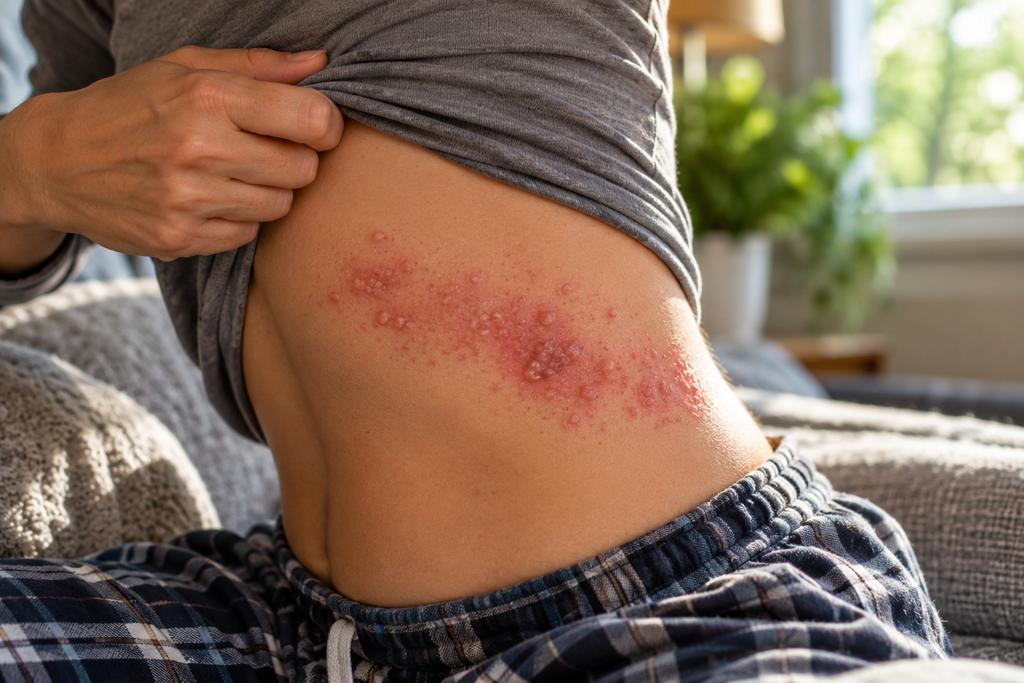
Classic shingles typically progresses to clusters of small, fluid-filled blisters. Their distribution is one of the most useful clues.
The rash generally follows one or two neighboring dermatomes, areas of skin supplied by particular sensory nerves. This is why shingles can form a band across one side of the chest, abdomen or back. The face can also be affected.
A classic shingles rash is usually one-sided and does not cross the body’s midline.
New blisters may continue appearing for several days. They subsequently dry, crust over and gradually heal, with the entire rash commonly resolving over roughly two to four weeks.
A few red bumps do not automatically mean shingles
The appearance of an unexplained rash can understandably cause concern, particularly when photographs of shingles are readily available online. But appearance alone can be deceptive.
The CDC lists several conditions that can resemble herpes zoster, including herpes simplex, contact dermatitis, impetigo, folliculitis, scabies, insect bites and papular urticaria.
The circumstances surrounding the rash therefore matter.
Consider someone renovating a house who is repeatedly exposed to cement dust, mortar, plaster, cleaning chemicals or solvents. Irritant or allergic contact dermatitis becomes a plausible explanation for red, itchy bumps developing on exposed skin.
That situation is quite different from the more characteristic combination of localized nerve-like pain or burning, a one-sided distribution and clusters of developing blisters.
Even those clues cannot replace a medical examination. Diagnosing shingles solely from a photograph can be unreliable, particularly during its earliest stages.
Can shingles be confirmed with a laboratory test?
Often, the clinical pattern is distinctive enough for a healthcare professional to make the diagnosis without laboratory testing.
When the presentation is unusual or the diagnosis remains uncertain, testing can help.
According to the CDC, polymerase chain reaction (PCR) testing for VZV DNA is the preferred laboratory method for confirming suspected varicella-zoster infection. Material collected from skin lesions, including vesicles or scabs, can be used for testing.
This can be particularly useful when the rash does not have the textbook appearance.
Shingles without a rash is possible — but uncommon and difficult to diagnose
There is an intriguing condition known as zoster sine herpete, in which VZV reactivation occurs without the familiar skin eruption.
A person may develop pain or neurological symptoms along an affected nerve without ever producing the characteristic shingles rash.
That does not mean unexplained burning, tingling or nerve pain should routinely be assumed to be shingles. Many other conditions can cause similar symptoms, and without the characteristic lesions the diagnosis becomes considerably more challenging.
Can you catch shingles from another person?
This question is often answered incorrectly.
You do not develop shingles simply because you have been around somebody who has shingles.
However, a person with active shingles can transmit varicella-zoster virus to someone who is susceptible to it.
If that person has never had chickenpox and has not been vaccinated against it, the initial infection causes chickenpox — not shingles.
Once that infection resolves, VZV can remain dormant in the newly infected person’s nervous system. Years or decades later, it could potentially reactivate as shingles.
Do you have to touch the blisters to become infected?
Direct contact with fluid from shingles blisters is an important route of VZV transmission. CDC guidance also recognizes transmission through virus-containing particles originating from the blisters.
Localized shingles is generally less contagious than chickenpox, and keeping the affected area covered reduces the risk further.
Once all the lesions have dried and crusted over, the person is no longer considered contagious. Until then, covering the rash when possible, avoiding touching or scratching it and washing the hands frequently are sensible precautions.
What if someone without chickenpox immunity is exposed?
Exposure does not cause shingles in that person. If transmission occurs, the result is chickenpox.
Certain exposures deserve particular attention, however. People who are pregnant and lack evidence of immunity to varicella, those with substantially weakened immune systems, and some newborn or premature infants can face greater risks from VZV infection.
Someone in a vulnerable group who has had significant exposure should seek medical advice promptly, because management depends on immune status, the nature of the exposure and individual medical circumstances.
Can someone with shingles go to work?
There is no single answer that applies to every occupation.
If the lesions are still weeping and cannot be completely covered, avoiding work or school may be necessary until the rash has dried. When a localized rash can remain securely covered, transmission risk is lower.
Healthcare workers and people whose jobs involve close contact with highly vulnerable individuals may need to follow additional infection-control requirements.
Is showering safe with shingles?
Yes. Having shingles does not mean the affected skin should be left unwashed.
The area can be kept clean while avoiding aggressive rubbing and products that irritate the lesions. Cool or wet compresses may provide some relief from discomfort.
Towels or other objects that directly contact active lesions should not be shared with other people.
Why can shingles hurt so much?
The answer lies beneath the skin.
Shingles involves reactivation of a virus associated with sensory nerves, so the pain is not simply caused by irritated skin. People may describe burning, stabbing, shooting or electric-like sensations. In some cases, even clothing brushing against the affected area can become painful.
For some patients, the pain outlasts the rash.
This complication is called postherpetic neuralgia (PHN). The affected nerves continue producing pain after the skin lesions have healed, sometimes for months or longer. The likelihood of developing PHN increases with age.
Shingles near the eye deserves urgent attention
Not every case of shingles is an emergency, but location can dramatically change its significance.
A shingles eruption involving the face, particularly the region around an eye, requires prompt medical assessment. When VZV affects the ophthalmic branch of the trigeminal nerve, eye structures can become involved and vision can potentially be threatened.
Prompt assessment is also particularly important for people with severely weakened immune systems, those with extensive rashes or those experiencing severe symptoms.
Why does everyone talk about the first 72 hours?
Antiviral medicines used for shingles include acyclovir, valacyclovir and famciclovir.
These medications can accelerate lesion healing, limit the formation of new lesions and reduce the severity of acute pain. They work best when treatment begins early.
The World Health Organization notes that antiviral treatment is most effective when started within approximately 72 hours after the rash appears.
But this has generated a persistent misconception.
Seventy-two hours is not a deadline after which seeking medical care becomes pointless.
Someone who presents later may still require assessment and, depending on the circumstances, treatment. This is particularly important when new lesions continue to appear, symptoms are severe, the immune system is compromised, or the face or eye may be involved.
Treatment decisions should be individualized by a healthcare professional.
Can shingles happen more than once?
Yes.
Having shingles does not create guaranteed lifelong protection against another episode. Recurrences are possible, even though many people experience the disease only once.
A previous episode therefore does not automatically eliminate the potential benefit of shingles vaccination when a person otherwise meets vaccination recommendations.
There is a vaccine specifically designed to prevent shingles
The shingles vaccine is different from the childhood varicella vaccine.
The recombinant zoster vaccine Shingrix is designed to reduce the risk of shingles and its complications, including postherpetic neuralgia.
Vaccination recommendations vary by country. In the United States, the CDC currently recommends two doses for adults aged 50 and older and for adults aged 19 and older who are or will become immunodeficient or immunosuppressed because of disease or therapy.
Eligible adults are generally advised to receive the vaccine even if they have previously experienced shingles.
Those are U.S. recommendations, however. National vaccination policies, eligibility criteria and access differ between countries, so individual decisions should be discussed with an appropriate healthcare professional.
Is there a way to find out whether you ever had chickenpox?
Blood tests can detect IgG antibodies against VZV and may provide evidence of immunity.
The answer is not always as straightforward as a positive-or-negative result, particularly in vaccinated individuals. The CDC notes that commercially available antibody tests may not be sensitive enough to detect every case of vaccine-induced immunity.
When determining immunity has important medical consequences — for example, in pregnancy or before certain immunosuppressive treatments — results should therefore be interpreted within the person’s broader medical and vaccination history.
The childhood infection may end. The virus may not.
That is what makes shingles so unusual.
A child develops chickenpox, recovers, and the illness appears to be finished. Yet the virus responsible for that infection can remain quietly embedded within the nervous system long after the spots have disappeared.
Decades later, the same virus can return in a completely different form.
But awareness of shingles should not turn every unexplained rash into a suspected case. A handful of red bumps, itching or irritated skin is not, by itself, evidence of shingles. Contact dermatitis, insect bites, folliculitis and many other skin problems can initially look similar.
The pattern of the eruption, its progression into clusters of blisters, its tendency to remain on one side of the body and the presence of localized burning or nerve-like pain provide much more meaningful clues.
And when someone insists that shingles is impossible because they have never had chickenpox, there is one distinction worth remembering:
Do we know they were never infected with varicella-zoster virus — or do they simply have no memory of the infection?
Those are not necessarily the same thing.
Medical sources
This article was developed using current medical information from the U.S. Centers for Disease Control and Prevention – Shingles, the World Health Organization – Shingles (herpes zoster) and NHS – Shingles.
This article is intended for general educational purposes and does not replace medical diagnosis, examination or individualized advice from a healthcare professional.