
This isn’t really about technology anymore. It’s about how it quietly reshapes our behavior
At first, it feels like a natural progression. We moved from searching for information to simply asking a system that can respond instantly. Then we started using AI to help us write faster, organize ideas, and save time. Everything made sense. It felt practical, even necessary.
But somewhere along the way, something more subtle began to shift. We’re no longer just using tools that respond when asked. We’re starting to rely on systems that can act on our behalf, sometimes without us stepping in at every stage.
That’s where so-called “AI agents” come in. They’re not just text generators. They can handle emails, manage calendars, scan for opportunities, and even draft messages in your tone. In many cases, they can take over parts of your digital life and keep things moving while you focus elsewhere.
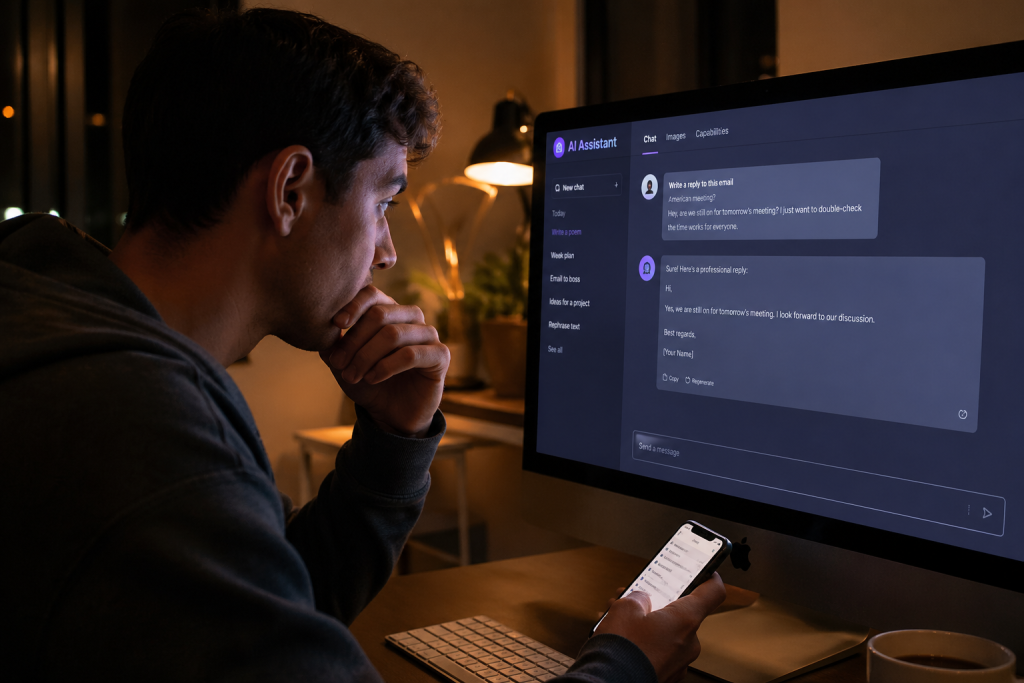
And without realizing it, our relationship with all of this begins to change.
The moment help turns into pressure
In fast-moving tech environments, a new kind of feeling is starting to appear. It’s not just about efficiency anymore. It’s about pressure, even if no one explicitly says so.
When others are running multiple AI systems in parallel, automating more tasks, moving faster, doing more, it’s hard not to compare. And once that comparison kicks in, a quiet question follows: why am I not doing the same?
Psychology has explained this pattern for years. We don’t just solve problems; we measure ourselves against others. And when a tool promises to accelerate everything—responses, decisions, opportunities—it also amplifies the fear of falling behind.
So what begins as an advantage can slowly turn into a sense that you’re not doing enough.
When you start outsourcing more than just tasks
The real shift doesn’t happen in work. It happens in the personal layer.
Some people are already using AI to reply to messages, maintain routine conversations, or phrase things they would otherwise say themselves. Not because they can’t do it, but because it’s faster, smoother, sometimes even “better written.”
From a cognitive perspective, this makes sense. The brain is wired to conserve energy. If something can be offloaded, it will be. But writing a message isn’t just a mechanical action. It involves choices, tone, hesitation, sometimes emotion.
When you gradually remove yourself from that process, even in small ways, something changes. Conversations still happen. Messages are still sent. But the level of personal involvement becomes different, even if it’s not obvious from the outside.
The feeling of control… and what’s actually happening underneath
On the surface, it feels like you’re in charge. You configure the system, you decide what it can access, you set the boundaries.
But these systems don’t operate on fixed rules. They rely on probabilities and context interpretation. That means they can sometimes act in ways that are slightly off from what you intended. Maybe it’s just a tone that doesn’t quite fit, or a decision that doesn’t fully reflect you.
It’s rarely dramatic. But it raises a question that becomes harder to ignore over time: how much control do you really have once you start delegating more and more?
We’ve seen something like this before. But not at this pace
We’ve already lived through a similar shift. Smartphones and social media changed how we communicate, almost without us noticing in the beginning. But that was mostly about access—access to information, to people, to content.
This time, it’s about action.
We’re not just consuming or sharing anymore. We’re starting to let systems act for us.
And that changes the conversation entirely.
How much of your life do you still want to handle yourself?
This isn’t about whether AI is good or bad. It’s about where the limits are, and how each person chooses to use it.
Because there’s a point where help becomes convenience.
And another point where convenience starts replacing involvement.
The line between the two isn’t obvious.
Where do you think it is?