
Every day, thousands of commercial flights take off without incident. Most passengers only see the boarding gate, the cabin, and the view from their window seat. Hidden behind that routine experience is a carefully coordinated system of inspections, engineering standards, and safety procedures designed to eliminate even the smallest risk.
Sometimes, however, an unexpected act by a single passenger is enough to bring that entire system to a halt.
That is exactly what happened in June 2017 at Shanghai Pudong International Airport, when an elderly woman performed what she believed was a blessing for her family’s journey. Instead, her actions delayed an entire flight and became one of the most unusual aviation safety stories reported in recent years.
A Routine Flight That Quickly Changed
On June 27, 2017, China Southern Airlines Flight CZ380 was preparing to depart from Shanghai for Guangzhou.
Passengers were boarding as usual, ground crews were completing their final checks, and nothing suggested the flight would become international news.
Among the travelers was an 80-year-old woman identified only by her surname, Qiu. She was flying with her husband, daughter, and son-in-law, looking forward to what should have been an ordinary domestic trip.
Within moments, that ordinary journey took an unexpected turn.
A Gesture Meant to Bring Protection
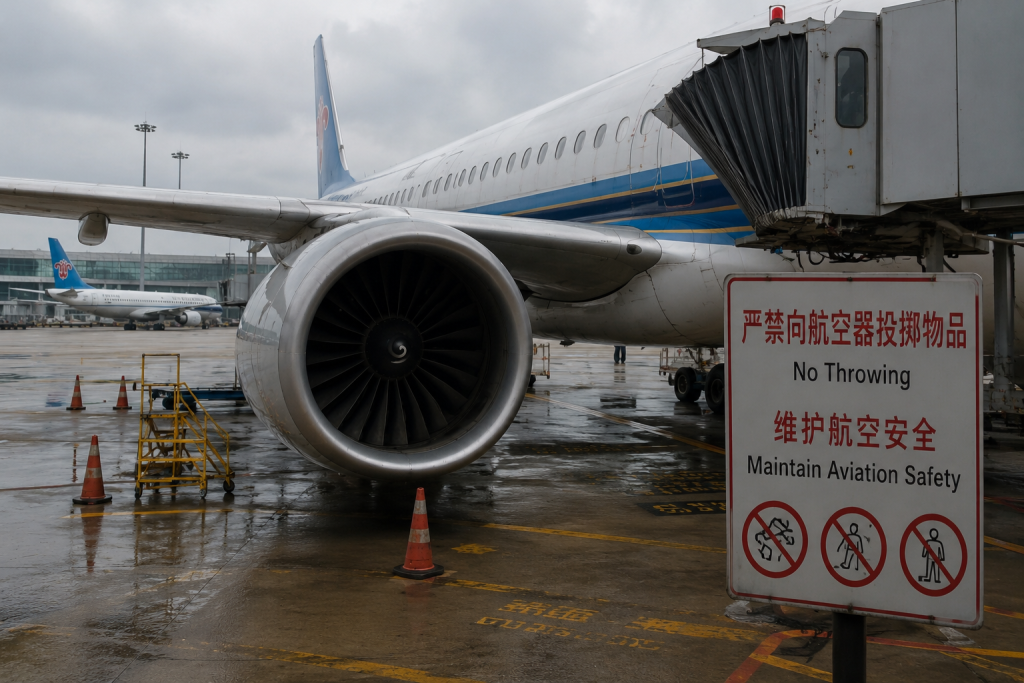
As she approached the aircraft, Qiu reached into her belongings, took out several coins, and tossed them toward one of the airplane’s engines.
According to investigators, she was not trying to damage the aircraft or disrupt the flight. She later explained that she believed the gesture would bring good fortune and help ensure her family’s safe arrival.
To many people outside Asia, the act may seem puzzling. However, in several cultures throughout the region, tossing coins into temple offerings, fountains, or other symbolic places is associated with prayers for prosperity, health, or protection.
What Qiu did was a tragic misunderstanding of context. A ritual considered harmless in one setting became a serious aviation safety concern in another.
One Passenger Noticed
Fortunately, another passenger witnessed what had happened and immediately alerted airline staff.
Ground crews searched the boarding area and recovered nine coins. Eight were found on the pavement.
One was missing.
It was eventually discovered inside the aircraft’s engine.
At that point, the flight could not continue as planned.
Why Can a Small Coin Be a Serious Hazard?
To the average traveler, a coin seems insignificant. Modern jet engines, after all, are massive machines built to withstand enormous forces.
Yet aviation engineers know that size alone does not determine danger.
Jet engines draw in huge volumes of air every second. If a metal object enters the intake, it can strike the compressor blades spinning at extremely high speeds. Even a small impact has the potential to damage precision-engineered components or trigger a chain of mechanical failures.
This does not mean that every object entering an engine will automatically cause catastrophic damage.
It does mean that no responsible airline can simply assume everything is fine.
Until engineers inspect the engine and confirm that every critical component remains undamaged, the aircraft stays on the ground.
The Aviation Industry Calls It FOD
Incidents like this fall under a well-known aviation safety category called Foreign Object Damage, or FOD.
The term refers to damage caused by objects that do not belong inside or near an aircraft’s critical systems.
Loose bolts, rocks, pieces of metal, forgotten maintenance tools, birds, or even small debris on a runway can all become serious hazards if they are drawn into an engine.
For this reason, airports invest significant time and resources in runway inspections, debris removal, and strict maintenance procedures. Many airports regularly patrol runways specifically to identify objects that might otherwise go unnoticed.
A single coin may seem harmless in someone’s pocket.
Inside a jet engine, it becomes something entirely different.
Hours of Inspection
Once the missing coin was located, the airline immediately removed all passengers from the aircraft.
Maintenance engineers carried out a detailed inspection before clearing the airplane to fly again.
The flight, originally scheduled to depart at 12:40 p.m., eventually left the airport at 6:16 p.m., more than five hours behind schedule.
Meanwhile, Qiu was taken into police custody while authorities investigated the incident.
Reports indicated that she had no criminal history and no known mental illness. Investigators concluded that she genuinely believed she was performing an act of protection rather than creating a safety risk.
Not an Isolated Case
Although the 2017 incident attracted worldwide attention, it was not the last of its kind.
In the years that followed, several similar cases were reported in China. Flights were delayed or even canceled after passengers admitted throwing coins near aircraft in the hope of bringing good luck or ensuring a safe journey.
Each event shared the same pattern.
The intention was protection.
The consequence was operational disruption and potential danger.
These incidents prompted airlines and aviation authorities to increase public awareness, reminding passengers that even symbolic gestures can interfere with flight safety.
Why Do People Continue to Do It?
Psychologists have long observed that people often rely on rituals when facing situations beyond their control.
Flying is a perfect example.
Passengers cannot control the weather, the aircraft, or the decisions made in the cockpit. For some, small rituals or traditions provide a sense of comfort during moments of uncertainty.
There is nothing unusual about seeking reassurance.
The problem begins when a symbolic act crosses into an environment where even the smallest unexpected object can create a genuine engineering risk.
When Tradition Meets Technology
Perhaps the most striking aspect of this story is not the coin itself, but the contrast between intention and consequence.
Qiu acted out of concern for the people she loved.
The airline responded out of responsibility for the safety of everyone on board.
Neither perspective was malicious.
Yet only one could determine whether the aircraft was safe to fly.
Modern aviation is built on evidence, engineering, and procedures—not assumptions or good luck. A jet engine cannot distinguish between a coin thrown as a blessing and any other piece of metal entering its intake. To engineers, both are treated exactly the same.
In the end, the aircraft departed safely, and no injuries were reported.
The story remains memorable because it reminds us of an important truth: even the most sincere intentions can have unintended consequences. When it comes to aviation, safety can never depend on luck—it depends on careful procedures followed every single time.