
Apples are so common today that most of us rarely stop to think about where they came from. They fill supermarket shelves, grow in backyard gardens, and appear in countless recipes across the globe. Yet behind this familiar fruit lies a remarkable story that stretches back thousands of years and spans entire continents.
Long before European orchards existed, before the Roman Empire expanded across the continent, and long before scientists understood genetics, vast forests of wild apple trees were growing in the mountains of Central Asia. Hidden among those forests was the ancestor of one of the world’s most successful fruits.
The journey that transformed a wild tree into a global agricultural staple is a story of evolution, trade, human ingenuity, and scientific discovery.
The Wild Apple Forests of Central Asia
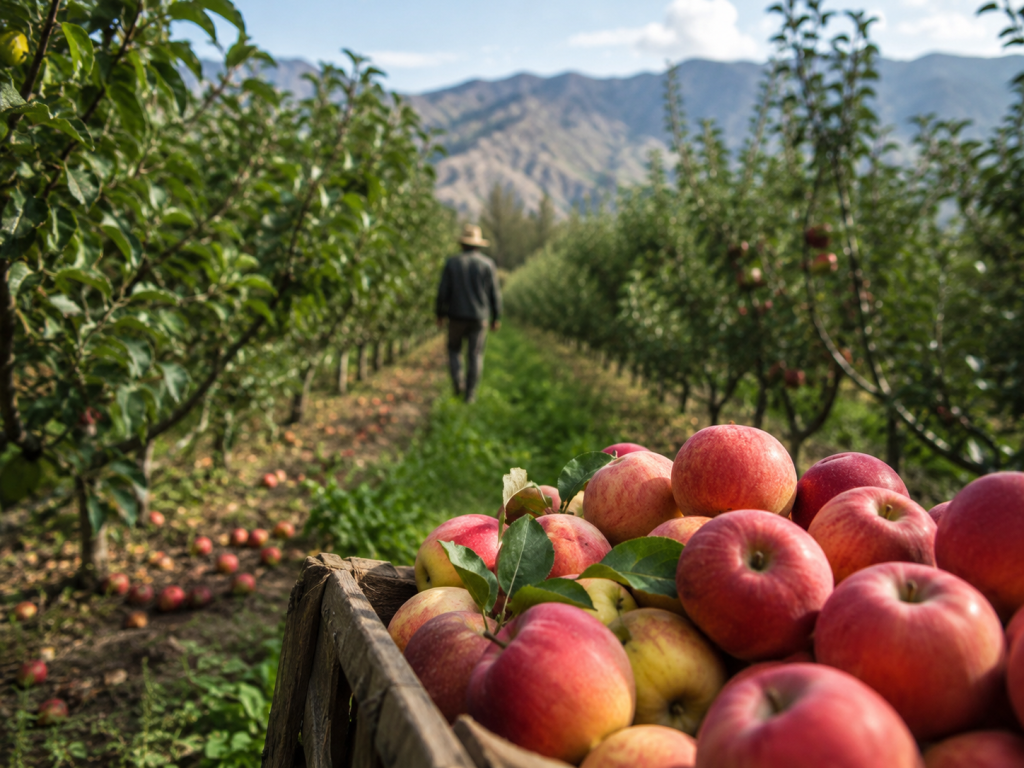
In southeastern Kazakhstan, near the modern city of Almaty, wild apple forests still survive today. During spring, the hillsides burst into shades of white and pink as millions of blossoms cover the landscape. By late summer and autumn, the trees produce an astonishing variety of fruit.
Some apples are small and sharply tart. Others are surprisingly large, sweet, and visually similar to modern cultivated varieties.
For decades, these forests attracted the attention of botanists and geneticists. The dominant species found there, Malus sieversii, is now widely recognized as the primary ancestor of the modern domesticated apple.
What makes these trees especially remarkable is their genetic diversity. Unlike many wild fruit species that produce relatively uniform fruit, neighboring Malus sieversii trees can bear apples that differ dramatically in size, color, flavor, and texture. Researchers have documented fruits ranging from tiny crabapple-like specimens to apples nearly as large as commercial varieties.
This natural diversity would prove critical to the apple’s future success.
The Scientist Who Saw the Connection
For centuries, the true origin of the domestic apple remained unclear.
One of the first scientists to suspect the answer was Russian botanist and geneticist Nikolai Vavilov. During expeditions across Central Asia in the early twentieth century, Vavilov observed the region’s extraordinary plant diversity and proposed that it was one of the world’s major centers of crop domestication.
At the time, his theory could not be fully proven. Modern genetic tools had not yet been developed.
Decades later, advances in DNA analysis finally allowed scientists to compare wild apple species with cultivated varieties grown around the world. The results strongly supported Vavilov’s original hypothesis.
Genetic studies revealed that Malus sieversii contributed the majority of the genetic material found in today’s domesticated apples.
What had once been an educated scientific guess became one of the most important discoveries in the study of agricultural history.
Nature Prepared the Apple for Success
The apple’s story did not begin with farmers.
Long before humans cultivated orchards, the species had already evolved characteristics that helped it spread across large areas. Its fleshy, nutritious fruit was designed to attract animals capable of carrying seeds far from the parent tree.
Large mammals likely played an important role in dispersing wild apples throughout ancient landscapes. After consuming the fruit, they transported seeds over considerable distances, helping establish new populations.
This natural distribution system laid the foundation for what would happen later when humans began traveling and trading across vast regions.
The Silk Road Changed Everything
The next chapter in the apple’s history began with the development of long-distance trade routes connecting Asia, the Middle East, and Europe.
What we now call the Silk Road was not a single road but a complex network of routes that linked distant civilizations. Merchants spent months traveling through deserts, mountain passes, and open steppes, transporting silk, spices, metals, textiles, and food.
Among their provisions were apples.
As travelers ate the fruit during their journeys, seeds were discarded along the way. Some found fertile ground near settlements. Others were carried by animals or spread unintentionally through trade activities.
No one set out to introduce apples across Eurasia.
Yet over generations, that is exactly what happened.
Little by little, wild and cultivated apples expanded westward, following the same routes that connected ancient societies.
A Genetic Exchange Across Continents
As apples spread into Europe, they encountered local wild relatives.
One of the most significant was Malus sylvestris, the European crab apple.
Modern research suggests that repeated crossbreeding occurred between Central Asian apples and native European populations. These genetic exchanges enriched the species and contributed to the development of traits that would eventually appear in cultivated varieties.
For this reason, scientists no longer describe the modern apple as the product of a single ancestor alone. Instead, it emerged through a long and complex process involving multiple wild populations interacting over thousands of years.
The Agricultural Puzzle of the Ancient World
As apple cultivation became more common, growers noticed something puzzling.
Planting seeds from an exceptional apple tree rarely produced identical offspring. A tree with sweet, flavorful fruit could generate seedlings that produced small, sour, or otherwise disappointing apples.
Today we understand why.
Every seed contains a unique genetic combination. Each apple tree grown from seed is essentially a new individual with its own characteristics.
For ancient farmers, this posed a major challenge. How could they preserve the qualities of their best trees?
The Innovation That Preserved Great Apples
The solution came through grafting, a technique that remains essential to apple production today.
Grafting involves attaching a branch from a desirable tree onto the root system of another tree. The resulting plant retains the genetic identity of the original variety.
This breakthrough transformed fruit cultivation.
Instead of relying on unpredictable seeds, growers could reproduce successful varieties with remarkable consistency. Many modern apple cultivars still trace their existence to this practice.
In a sense, some of the apples eaten today are descendants of trees selected by growers centuries ago.
How Greece and Rome Helped Spread the Apple
Apples held cultural and agricultural importance throughout the ancient Mediterranean.
The Greeks incorporated apples into mythology, literature, and farming practices. The Romans later expanded apple cultivation on a much larger scale.
Roman agricultural writers documented orchard management, grafting techniques, storage methods, and the characteristics of different apple varieties. As Roman influence spread across Europe, so did apple-growing knowledge.
By the end of the Roman era, orchards had become a familiar feature across large parts of the continent.
Crossing the Atlantic
Cultivated apples did not exist in North America before European arrival.
That changed during the sixteenth and seventeenth centuries, when settlers brought seeds and young trees across the Atlantic Ocean.
Apple cultivation expanded rapidly in the colonies. In many communities, apples were used not only as food but also for producing cider, which became an important part of daily life.
A fruit whose story began in the mountains of Central Asia had successfully established itself on an entirely new continent.
Why Ancient Wild Apples Still Matter Today
The importance of Central Asia’s wild apple forests extends far beyond historical curiosity.
Modern agriculture faces challenges that include climate change, emerging diseases, pests, and shifting environmental conditions. To address these threats, researchers often look for useful genetic traits hidden within wild plant populations.
The forests of Malus sieversii represent one of the most valuable genetic resources available to apple breeders. Traits linked to disease resistance, drought tolerance, and environmental adaptability may help shape the future of apple cultivation.
Protecting these forests is therefore not only about preserving the past. It is also about safeguarding future food security.
A Fruit With a Surprisingly Epic History
The next time you pick up an apple, consider the journey behind it.
Its story begins in ancient mountain forests, continues along the trade routes of Eurasia, passes through Roman orchards and colonial settlements, and eventually reaches modern laboratories where scientists study its DNA.
Few everyday foods carry such a rich and far-reaching history.
What seems like a simple piece of fruit is actually the result of thousands of years of natural evolution, human movement, agricultural innovation, and scientific discovery. The apple’s journey is still unfolding, but its roots remain firmly planted in the wild forests of Central Asia where the story first began.