
An Ordinary Summer Morning in Brooklyn
On the morning of July 7, 1967, Brooklyn was already settling into its daily rhythm. Commuters filled the roads, businesses were opening for the day, and thousands of people were making their way to work under the growing heat of a New York summer.
Among them was 17-year-old Nancy McEwen.
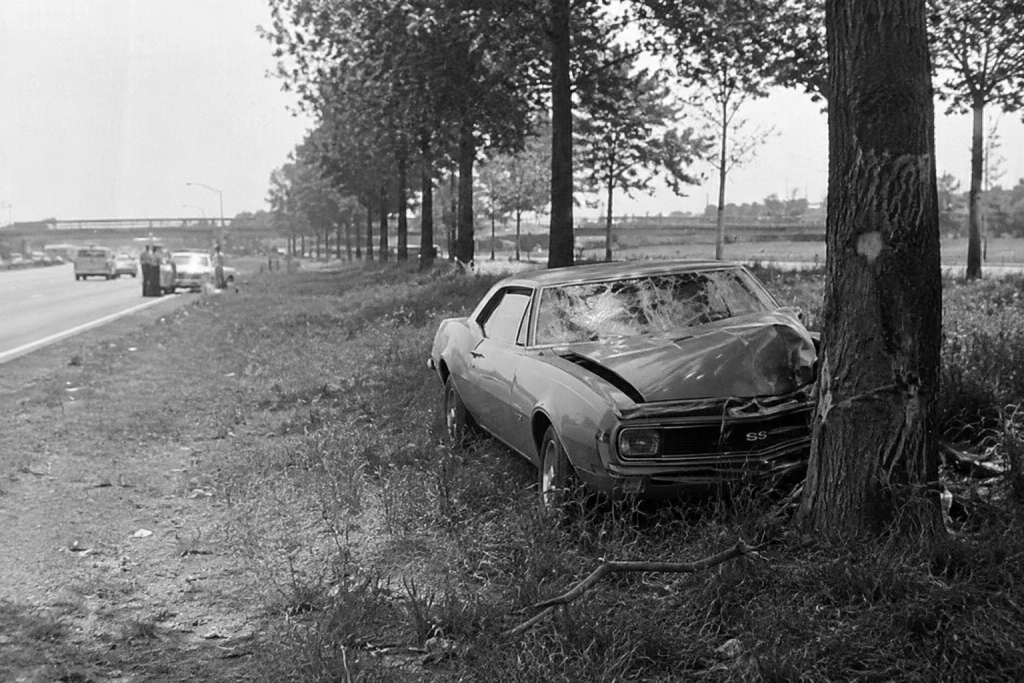
Like countless other drivers that morning, she was traveling along Belt Parkway, a major roadway that runs along Brooklyn’s southern shoreline. Behind the wheel of her yellow Chevrolet Camaro, Nancy appeared to be beginning what should have been an entirely routine day.
Nothing about the moment suggested that her name would soon become associated with one of the strangest cases in American criminal history.
Within minutes, a chain of events would unfold that investigators, legal experts, and ballistics specialists would continue discussing for decades.
A Crash That Didn’t Make Sense
Shortly after 8:40 a.m., witnesses noticed something unusual.
Nancy’s vehicle did not suddenly swerve. There was no indication she was attempting to avoid another car or obstacle. There were no reports of reckless driving, excessive speed, or dangerous road conditions.
Instead, the Camaro slowly drifted out of its lane.
To those watching, it looked as though the driver had simply stopped responding.
The car left the roadway and collided with a tree.
A police lieutenant who witnessed the incident arrived at the scene quickly. Nancy was still alive, but her condition raised immediate questions. Although she was conscious enough to make sounds, she was unable to explain what had happened.
More importantly, the crash itself did not appear severe enough to explain her condition.
At first, investigators suspected a medical emergency. Perhaps she had suffered a sudden illness, lost consciousness, or experienced some other health-related event before the collision.
It was a logical conclusion.
As it turned out, it was also completely wrong.
The Tiny Clue That Changed Everything
Nancy was transported to a hospital, where doctors worked to determine why she had been so badly injured.
Roughly two and a half hours after the crash, she died.
The autopsy revealed something nobody had expected.
Behind her left ear, medical examiners found an extremely small wound. It was so subtle that it had gone unnoticed during the initial emergency response. There was little visible bleeding, and nothing about the injury immediately suggested a gunshot wound.
A closer examination changed the entire direction of the investigation.
Nancy McEwen had been struck by a bullet.
The automobile accident had not caused her fatal injury. Instead, investigators concluded that she had been shot moments before losing control of her vehicle.
What had begun as a traffic collision instantly became a ballistics investigation.
The problem was that there was no obvious shooter.
No one nearby reported hearing gunfire. No witnesses described an attack. There was no evidence that Nancy had been targeted or involved in any conflict that might explain the shooting.
The mystery only deepened.
Following a Bullet Across Brooklyn
The case eventually came under the attention of Albert Seedman, a highly respected NYPD detective who would later become one of the most recognizable figures in the department’s history.
Seedman and his team began examining every available piece of evidence. They studied the bullet’s trajectory, analyzed the wound, reviewed the location of the crash, and searched for any possible source of gunfire.
What they discovered seemed almost impossible.
The shot had not come from nearby.
According to the investigation, the bullet’s origin could be traced to Gerritsen Inlet, a coastal area located roughly one mile away from where Nancy was driving.
There, a 47-year-old man named Theodore DeLisi had reportedly been firing a high-powered rifle at floating objects in the water.
At first glance, the connection appeared absurd.
How could a bullet fired so far away possibly reach a moving vehicle traveling along a busy roadway?
Yet the evidence repeatedly pointed investigators in the same direction.
The Science Behind an Unlikely Trajectory
The most controversial aspect of the case was not identifying the source of the shot. It was explaining how the bullet had traveled the distance required to reach Nancy.
Investigators concluded that the projectile had first struck the surface of the water.
For many people, that explanation sounded implausible. Common sense suggests that water should absorb a bullet and bring it to a stop.
Ballistics experts, however, knew the situation was more complicated.
When a projectile traveling at high speed strikes water at a shallow angle, the surface can behave very differently than most people expect. Under certain conditions, the bullet may ricochet rather than penetrate directly into the water.
The principle is somewhat similar to skipping a flat stone across a lake, although the physics involved are considerably more complex.
In most situations, a ricocheting bullet quickly loses energy and becomes harmless. What made this case extraordinary was the sequence of conditions that investigators believed occurred that day.
The projectile would have needed to strike the water at precisely the right angle, retain enough velocity after the ricochet, avoid obstacles along its path, and ultimately intersect with the exact location of Nancy’s vehicle at precisely the right moment.
Each step was possible on its own.
Combined together, they created a scenario so unlikely that many people struggled to believe it had actually happened.
Why the Case Still Sparks Debate
More than half a century later, the general conclusions of the investigation remain widely accepted.
Most researchers agree that Nancy was struck by a bullet linked to the shooting activity taking place at Gerritsen Inlet that morning.
Even so, discussions continue among historians and ballistics enthusiasts.
Some experts point out that investigative technology in 1967 was far less advanced than what is available today. Modern forensic analysts can rely on computer modeling, digital reconstruction, and sophisticated trajectory simulations that did not exist at the time.
Others note that not all original investigative materials have survived, making it impossible to recreate every aspect of the case with complete precision.
Still, no alternative explanation has emerged with stronger supporting evidence.
For historians, the case is less about unresolved mystery and more about the extraordinary ways in which rare events can occur in the real world.
The Legal Question That Divided Opinion
If the ballistics findings were unusual, the legal outcome proved equally controversial.
Investigators identified the rifle and the individual who had fired it. To many observers, that seemed sufficient to establish responsibility.
The law viewed the matter differently.
A grand jury reviewed the evidence and ultimately declined to indict Theodore DeLisi for Nancy McEwen’s death. The central issue was foreseeability: could a reasonable person have anticipated that a bullet would ricochet, travel nearly a mile, and fatally strike a teenager driving on a distant highway?
Legal experts disagreed.
Some argued that firing a high-powered rifle in proximity to populated areas demonstrated serious negligence. Others believed the chain of events was so extraordinary that the resulting death could not reasonably have been predicted.
In the end, DeLisi was not criminally convicted in connection with Nancy’s death. He received a $100 fine for a firearms-related violation.
For many people, the outcome felt unsatisfying. The tragedy had claimed a young life, yet no one was held directly accountable for the death itself.
The debate over whether justice was served continues to surface whenever the case is revisited.
A Tragedy That Became a Lesson in Probability
Many famous criminal cases are remembered because of violence, mystery, or the people involved.
The death of Nancy McEwen stands apart.
There was no elaborate plot, no personal motive, and no ongoing mystery about a hidden suspect. Instead, the case became remarkable because it appeared to challenge the limits of probability itself.
Two strangers, separated by nearly a mile and connected by nothing in their lives, became linked through a sequence of events that investigators described as extraordinarily rare.
For forensic specialists, the case remains a fascinating example of how complex projectile behavior can be. For legal scholars, it raises enduring questions about responsibility and negligence. For historians, it serves as a reminder that reality can sometimes produce circumstances far more unbelievable than fiction.
Nearly sixty years later, the story continues to be studied not because investigators failed to solve it, but because they did.
What still captures public attention is the same question that first stunned those who heard about the case in 1967: how could so many unlikely events align perfectly in a single moment and change a life forever?