
In recent years, countless true crime stories have gone viral across social media, often reduced to dramatic headlines and short video clips designed to capture attention within seconds. One such case is that of Ashley Fish, a young Louisiana mother whose death became the subject of millions of views after Ring camera footage showed police arriving at her home while her children unknowingly led officers inside.
Many online posts describe the case with sensational claims such as “Her daughters exposed their mother’s killer.” While those headlines generate clicks, they tell only a small part of a far more complicated story. The truth was not uncovered through a viral video or a single witness. It emerged over months of investigation, forensic analysis, courtroom testimony, and years of legal proceedings.
Ashley Fish’s case serves as a reminder that in the justice system, evidence—not internet speculation—is what ultimately determines the truth.
Who Was Ashley Fish?
Ashley Fish was a 28-year-old mother of four living near DeRidder in Beauregard Parish, Louisiana. Friends and family described her as someone devoted to her children, and much of her daily life revolved around raising them.
At the time of her death, she was in a relationship with Tyler Neil Derochowski. The couple lived together, and Ashley’s children were present at the home on the day everything changed.
According to court records presented during the trial, their relationship had experienced difficulties before the incident, although the full extent of those issues was never publicly documented in detail.
The 911 Call That Started the Investigation
On the evening of April 7, 2022, emergency dispatchers received an unusual phone call.
The caller was Tyler Derochowski.
According to evidence later presented in court, he told the 911 operator that he had shot his girlfriend and wanted to surrender. He remained on the line long enough to provide his location and waited for deputies to arrive.
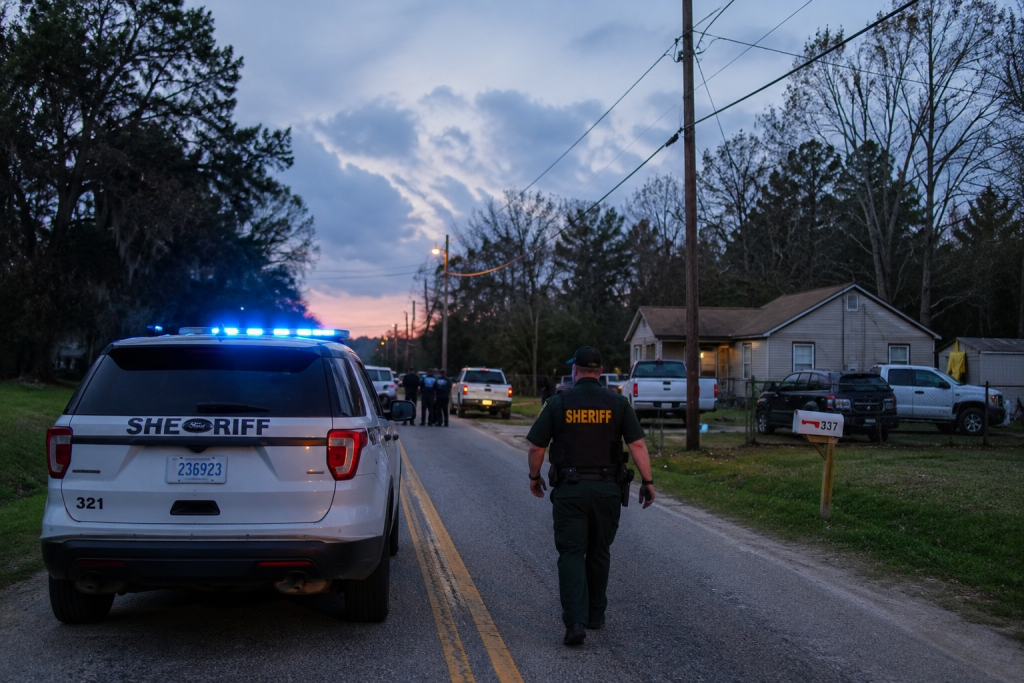
For emergency responders, calls like these are treated as high-risk situations. Deputies from the Beauregard Parish Sheriff’s Office were immediately dispatched to the residence, unaware of exactly what they would encounter inside.
What Officers Found
When deputies arrived, they encountered an unexpectedly quiet scene.
Ashley Fish’s children were outside the residence.
Security cameras installed around the property captured the moments that would later circulate widely online. One of Ashley’s young daughters approached the responding officers and led them toward the house.
Social media users frequently describe this moment as the instant the children “identified the killer.” That description, however, oversimplifies what actually happened. The children did not solve the case or accuse anyone. They simply guided officers to where their mother was, unaware of the tragedy that had already occurred.
The emotional impact of those images came not from revealing the crime, but from showing children caught in circumstances they could not possibly understand.
Inside the Home
Once inside, deputies discovered Ashley Fish in the bathroom.
She had suffered a fatal gunshot wound.
Court records indicate that investigators found a semi-automatic handgun near her body, while Ashley was still holding her cellphone when officers located her.
Emergency medical personnel were unable to save her.
From that moment forward, what began as an emergency response became a homicide investigation.
Tyler Derochowski’s Explanation
From the beginning, Tyler Derochowski acknowledged that he had fired the fatal shot.
The dispute centered on how it happened.
He told investigators that he and Ashley had been arguing when she allegedly grabbed the handgun. According to his account, the two struggled over the weapon, and it discharged accidentally during the confrontation.
This version of events remained the foundation of the defense throughout the trial.
Investigators, however, did not rely solely on his statements. Every part of his account was compared against the physical evidence recovered from the scene.
How Forensic Experts Reconstruct a Shooting
Modern forensic science allows investigators to reconstruct many aspects of a shooting with remarkable accuracy.
Crime scene analysts examine bloodstain patterns, bullet trajectories, firearm residue, the location of physical evidence, injuries sustained by everyone involved, and the overall condition of the scene.
Medical examiners analyze wound characteristics to estimate the distance between the firearm and the victim at the moment the shot was fired. Ballistics experts evaluate how the bullet traveled, while forensic specialists search for signs of a struggle, including defensive injuries, DNA transfer, fingerprints, and displaced objects.
Rather than depending on assumptions, investigators rely on evidence that can be tested, documented, and independently reviewed.
What the Evidence Revealed
The autopsy became one of the most significant pieces of evidence presented during the trial.
According to the medical examiner, Ashley’s fatal wound was consistent with a contact or near-contact gunshot wound, meaning the firearm was pressed against or extremely close to her head when it discharged.
This type of injury leaves distinctive characteristics that differ substantially from wounds inflicted at greater distances.
Investigators also reported finding no compelling physical evidence supporting the violent struggle described by the defendant.
Together, these findings became central to the prosecution’s argument that the shooting was not an accident.
The Trial
The case went to trial in 2024.
Prosecutors argued that the forensic evidence, combined with Tyler Derochowski’s own statements and the physical evidence recovered from the home, demonstrated that Ashley Fish had been intentionally killed.
The defense maintained that the shooting occurred accidentally during a struggle over the handgun.
As in every criminal trial, it was ultimately the jury’s responsibility to evaluate witness credibility, weigh the scientific evidence, and determine whether the prosecution had proven guilt beyond a reasonable doubt.
After reviewing the evidence, jurors rejected the defense’s explanation.
Tyler Derochowski was convicted of second-degree murder.
He received a mandatory sentence of life imprisonment without the possibility of parole.
The Appeal
Following his conviction, Derochowski appealed the verdict.
His attorneys challenged the sufficiency of the evidence and argued that the prosecution had failed to prove intent beyond a reasonable doubt.
In 2025, Louisiana’s Third Circuit Court of Appeal reviewed the case in detail.
After examining the trial record, the appellate judges concluded that the evidence presented to the jury was legally sufficient to support the conviction.
The life sentence was therefore upheld.
Why the Ring Camera Footage Captured So Much Attention
Long after the trial concluded, the Ring camera footage continued circulating across YouTube, TikTok, Facebook, and other social media platforms.
The video does not capture the shooting itself, nor does it identify the person responsible.
Instead, it documents something far more heartbreaking: police officers arriving at a home while a young child unknowingly leads them toward her mother’s body.
That brief moment became symbolic of the entire tragedy.
Unfortunately, many online posts transformed those images into misleading headlines suggesting that the children solved the case themselves. In reality, investigators reached their conclusions through forensic analysis, crime scene reconstruction, witness testimony, and extensive legal proceedings—not through a single viral video.
The Role of Forensic Science
Ashley Fish’s case highlights the crucial role that forensic science plays in modern criminal investigations.
Witnesses may remember events differently, suspects may provide conflicting accounts, and emotions can influence testimony. Physical evidence, however, tells its own story.
Bloodstain patterns, gunshot residue, wound characteristics, firearm examinations, and crime scene reconstruction allow investigators to evaluate competing versions of events using objective scientific methods.
These techniques have become indispensable in today’s justice system because they help establish facts that are often impossible to determine through eyewitness testimony alone.
A Tragedy Beyond the Headlines
Beyond the courtroom proceedings and the millions of online views lies the true human cost of this case.
Four children lost their mother in a single evening, and their lives were changed forever.
Although social media frequently reduces the story to a few dramatic seconds of surveillance footage, the official record tells a very different story—one built through meticulous investigative work, forensic expertise, and years of judicial review.
The Ashley Fish case reminds us that while viral videos may shape public opinion, they rarely tell the entire story. In the end, it was not internet speculation that determined what happened inside that Louisiana home, but the careful examination of evidence presented before a court of law.