
On the day he sat for his final medical school exam, David Fajgenbaum was focused on something far more serious than passing a test.
His body was failing.
While many of his classmates were thinking about residency programs and future careers, David was struggling with persistent fevers, overwhelming fatigue, and a mysterious illness that doctors had not yet been able to explain. Simply getting through a normal day required enormous effort. His lymph nodes were enlarged, his energy was disappearing, and his health seemed to be deteriorating with every passing week.
When the exam ended, he did not celebrate with friends.
He went straight to the hospital.
At the time, he had no idea that the battle ahead would nearly cost him his life several times, nor that it would eventually lead him to a discovery that would influence research into rare diseases around the world.
His story is not only about survival. It is about determination, scientific curiosity, and the extraordinary impact that one unanswered question can have on medicine.
A Healthy Young Athlete With an Unexpected Future
Before becoming a patient, David Fajgenbaum was known for his energy and drive.
He attended Georgetown University, where he served as captain of the university football team. He was active, disciplined, and physically fit. Few people would have imagined that he would one day find himself fighting a rare immune disorder that many physicians never encounter during their entire careers.
A major turning point came when his mother was diagnosed with pancreatic cancer.
Watching her battle the disease profoundly affected him. After her death, he became even more committed to pursuing medicine and understanding the illnesses that devastate patients and families. The experience strengthened his belief that medical research could make a difference where existing treatments fell short.
Not long afterward, his own health began to unravel.
A Medical Mystery That Took Weeks to Solve
The symptoms appeared gradually.
Extreme fatigue, night sweats, recurrent fevers, and swollen lymph nodes began interfering with daily life. At first, doctors considered several possibilities, including severe infections and blood cancers such as lymphoma.
The search for answers became increasingly urgent as his condition worsened.
Weeks of testing followed. Imaging studies, laboratory work, biopsies, and consultations with specialists produced more questions than answers.
Finally, after roughly eleven weeks, doctors identified the cause.
David had idiopathic multicentric Castleman disease, often abbreviated as iMCD.
The diagnosis explained the symptoms, but it did not provide much reassurance.
Understanding Castleman Disease
Castleman disease is a rare group of disorders that affect the lymphatic system and the immune system.
In multicentric forms of the disease, multiple groups of lymph nodes become enlarged and inflamed. More importantly, the immune system can become dangerously overactive, releasing inflammatory signals that affect organs throughout the body.
Patients may develop kidney dysfunction, liver problems, fluid accumulation around the lungs, severe anemia, clotting abnormalities, and, in some cases, life-threatening organ failure.
The term “idiopathic” means that the underlying cause remains unknown.
That uncertainty has made the disease particularly difficult to study and treat.
For years, researchers struggled to understand why some patients developed such devastating symptoms and why conventional therapies often failed.
The Moment Doctors Feared the Worst
Shortly after his diagnosis, David’s condition became critical.
The inflammatory storm inside his body intensified. Organs began to malfunction. Fluid accumulated throughout his body. Laboratory results grew increasingly alarming.
Medical teams worked around the clock to keep him alive.
At one point, his condition became so serious that family members were called to the hospital. A priest administered last rites because there was genuine concern that he would not survive.
For many patients, that would have been the end of the story.
Remarkably, emergency chemotherapy triggered a response that temporarily reversed the crisis.
Against the odds, he survived.
But survival was only the beginning.
Living Through Relapse After Relapse
Over the following years, the disease repeatedly returned.
Each relapse brought another cycle of severe inflammation, organ dysfunction, hospitalization, and uncertainty. Temporary recoveries were followed by new medical emergencies.
One of the most serious episodes required a lengthy stay in intensive care.
His kidneys, liver, and lungs were all affected. Massive fluid retention caused dramatic fluctuations in body weight, not because of fat gain, but because his body was struggling to regulate fluid balance.
Doctors managed to save him multiple times.
What they could not do was stop the disease from coming back.
The treatments available at the time could suppress symptoms temporarily, but none offered a reliable long-term solution.
As relapses continued, options became increasingly limited.
Looking at the Disease Through a Researcher’s Eyes
Faced with a future that seemed increasingly uncertain, David decided to approach the problem from a different perspective.
He was not only a patient.
He was also a physician and scientist.
Rather than accepting that there were no remaining answers, he began studying every piece of information he could find. He reviewed scientific publications, examined laboratory data, analyzed biological samples, and worked with experts from multiple disciplines.
He wanted to understand what was happening at a molecular level.
What exactly was driving the immune system to attack his body with such destructive force?
The search for that answer would eventually change everything.
A Critical Clue Hidden Inside the Immune System
As researchers analyzed data from his disease episodes, they identified evidence pointing toward a biological pathway known as mTOR.
This pathway plays a crucial role in regulating cell growth, metabolism, and immune activity.
Under normal circumstances, mTOR helps cells respond to changing conditions and maintain balance. When the pathway becomes abnormally active, however, it can contribute to excessive immune responses and chronic inflammation.
The finding offered something that had been missing for years.
A potential target.
For the first time, researchers had a plausible explanation for one of the mechanisms driving his disease.
An Existing Drug With Unexpected Potential
There was already a medication known to inhibit mTOR.
It was called sirolimus.
The drug had been used primarily to prevent organ transplant rejection and to treat certain other medical conditions. It was not originally developed for Castleman disease, nor was it considered a standard therapy for patients like David.
Still, the scientific rationale was compelling.
If abnormal mTOR activity was contributing to the disease, suppressing that pathway might reduce the destructive immune response.
After careful consideration and discussion with his medical team, treatment began.
A Turning Point No One Could Have Predicted
The results were remarkable.
Inflammatory markers began to decline.
Organ function improved.
Symptoms that had repeatedly threatened his life started to disappear.
Most importantly, the disease remained under control.
Months turned into years.
Years turned into more than a decade.
What began as a bold scientific hypothesis became one of the most significant advances in understanding and treating difficult cases of Castleman disease.
Turning Personal Experience Into a Mission
David’s recovery inspired a broader goal.
He became deeply involved in efforts to improve research into rare diseases and accelerate the discovery of treatments for patients who often have few options.
He helped build the Castleman Disease Collaborative Network, an international initiative focused on advancing research, improving collaboration, and connecting physicians, scientists, and patients.
He later co-founded Every Cure, an organization dedicated to identifying new uses for existing medications.
The idea behind the project is straightforward but powerful.
Thousands of approved drugs already exist. Some may have the potential to treat diseases for which they were never originally intended. Finding those opportunities could dramatically shorten the time required to bring treatments to patients.
For people living with rare diseases, that approach may represent one of the most promising paths forward.
A Story Larger Than One Patient
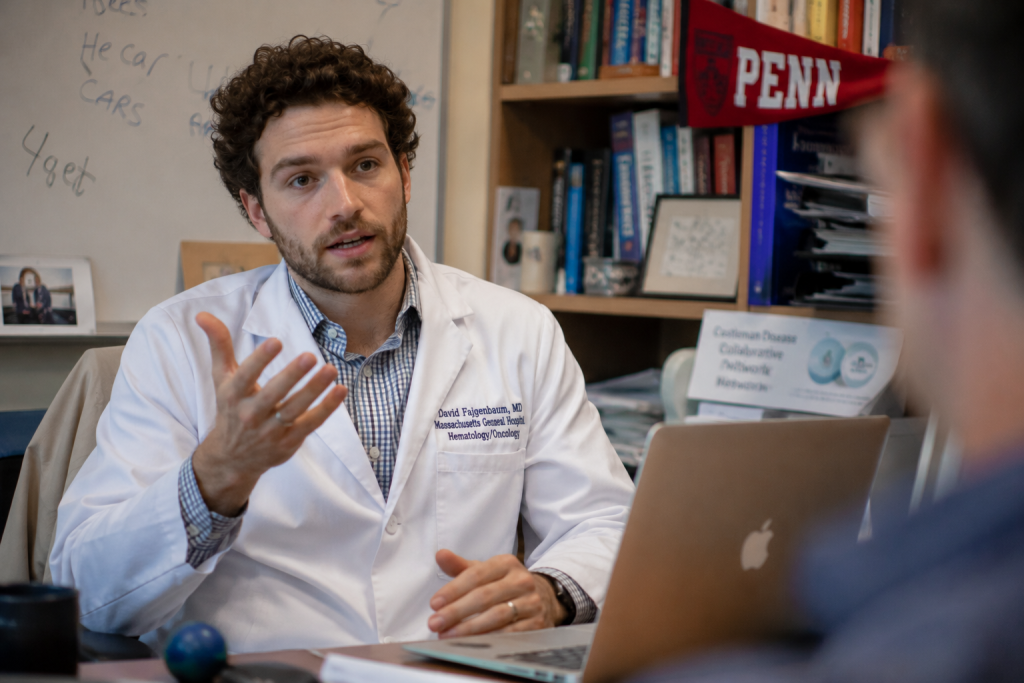
Today, David Fajgenbaum is known as a physician, researcher, author, and advocate for rare disease patients.
Yet his story extends beyond a single individual.
Worldwide, more than 7,000 rare diseases have been identified, and most still lack effective treatments. Many patients spend years searching for a diagnosis, while others face conditions that receive little research attention due to limited funding and small patient populations.
His experience highlights a growing reality in modern medicine: important breakthroughs do not always come from entirely new drugs. Sometimes they emerge from understanding disease biology well enough to recognize that an existing treatment can be used in a new way.
Years ago, David walked out of a medical school exam and into an emergency room, uncertain whether he would live long enough to build the future he had imagined.
Today, he continues working to ensure that other patients facing seemingly impossible diagnoses have a better chance than he once did.
For someone who was once not expected to survive, that may be the most remarkable outcome of all.