
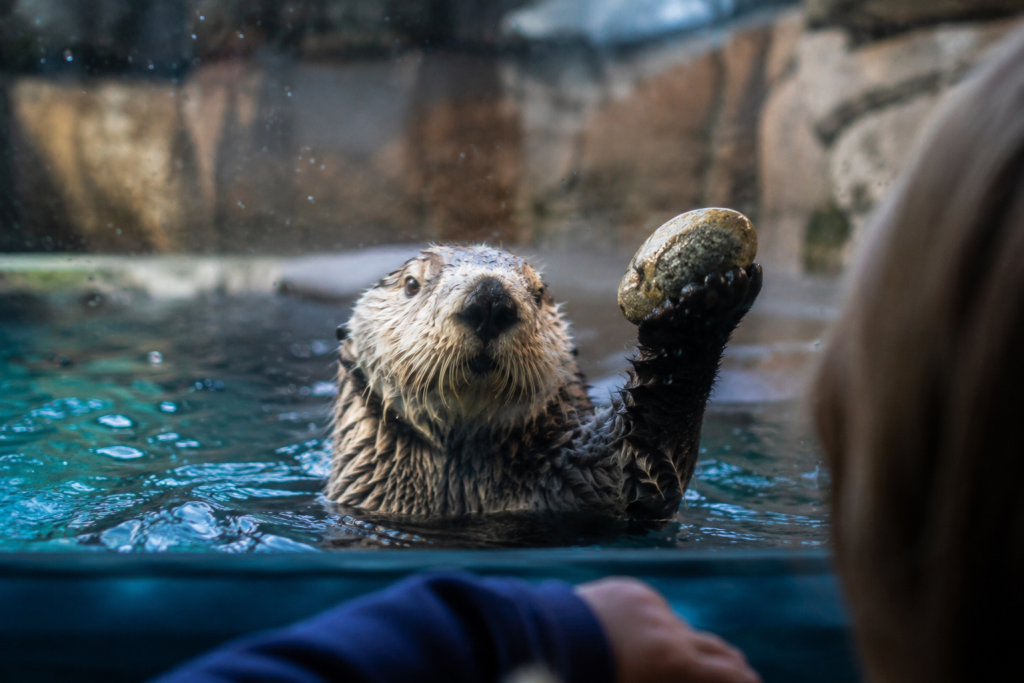
Every now and then, a simple animal video captures the attention of millions. One such story spread rapidly across social media after people shared images of a sea otter appearing to show off her newborn pup near an aquarium window, while another otter seemed equally eager to display something entirely different: a small stone.
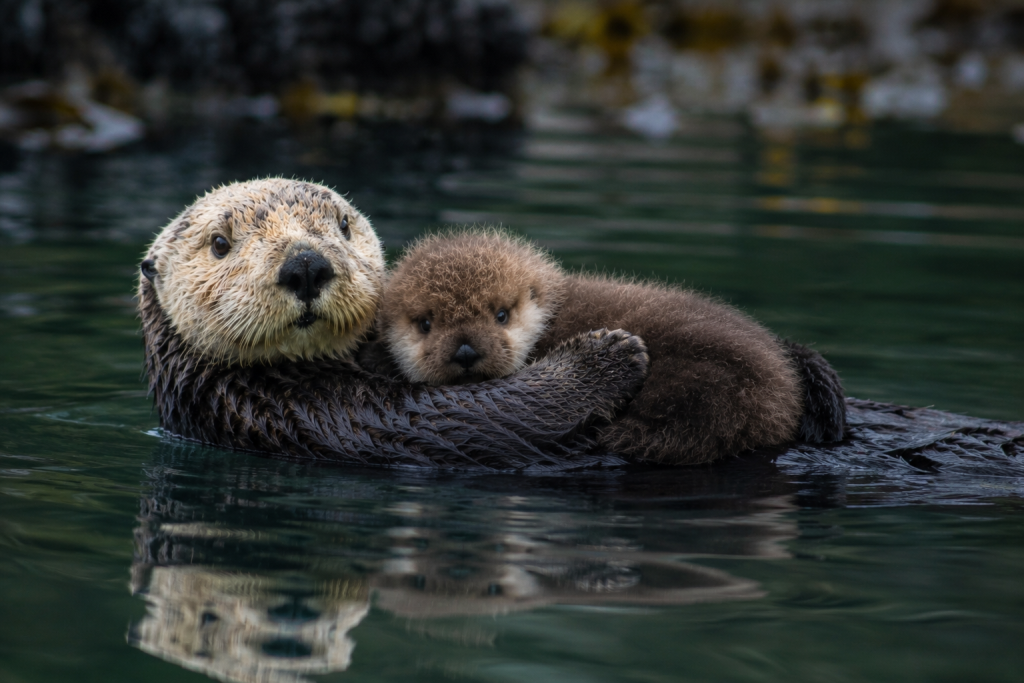
The internet quickly turned the contrast into a joke. The mother proudly introduced her baby to the world, while the supposed father proudly presented his favorite rock.
Whether those images actually featured members of the same family remains unverified. There is no evidence that the otter holding the stone was the pup’s father, nor that the two moments were connected. Yet the story resonated with people for an unexpected reason.
For a sea otter, a carefully chosen stone can be every bit as important as the internet imagines.
Behind the viral joke lies a fascinating scientific story involving intelligence, adaptation, tool use, and one of the most extraordinary marine mammals on Earth.
A Marine Mammal That Uses Tools
Sea otters, known scientifically as Enhydra lutris, inhabit coastal waters along the northern Pacific Ocean, from California and Alaska to parts of Russia and Japan.
Although they are often portrayed as playful and carefree animals, sea otters possess abilities that place them among a surprisingly small group of species known to use tools regularly.
For many years, scientists believed tool use was largely unique to humans. Later discoveries revealed that chimpanzees, crows, dolphins, and several other animals also use objects to solve problems. Sea otters joined that exclusive list because of the way they access food hidden inside hard shells.
Their diet includes clams, mussels, crabs, sea snails, and sea urchins. Many of these prey species are protected by shells or exoskeletons that are difficult to break open.
Rather than relying solely on jaw strength, sea otters frequently turn to stones.
Floating on their backs, they place a rock on their chest and repeatedly strike shellfish against it until the shell breaks. In other situations, they use the stone itself as a hammer.
The behavior may look simple, but it represents a highly effective survival strategy refined through countless generations.
Why Some Otters Keep Returning to the Same Rock
One of the most intriguing discoveries made by marine biologists is that sea otters often show preferences for specific tools.
These animals have loose folds of skin beneath their forelimbs that function like built-in pockets. They use these pouches to carry food, but they can also store stones and other useful objects.
Researchers have documented individuals repeatedly using the same rock over extended periods. Some otters carry favored stones between feeding sessions, retrieving them whenever they encounter prey with particularly tough shells.
This behavior demonstrates more than simple tool use. It suggests that the animal recognizes the future value of an object and chooses to keep it available.
Among wild mammals, that level of behavioral flexibility is relatively uncommon and continues to fascinate scientists studying animal cognition.
The Densest Fur in the Animal Kingdom
The sea otter’s survival strategy depends on far more than intelligence.
Unlike whales, seals, and sea lions, sea otters lack a thick insulating layer of blubber. Instead, they rely almost entirely on their fur to stay warm in cold ocean waters.
That fur is extraordinary.
Sea otters possess the densest fur of any animal known to science. In some areas of the body, a single square inch can contain hundreds of thousands of hairs.
This dense coat traps air close to the skin, creating an insulating barrier that helps maintain body temperature even in frigid environments.
To preserve this protection, sea otters spend a significant portion of each day grooming. Their survival depends on keeping the fur clean and capable of retaining trapped air.
If that insulation is compromised, the consequences can be life-threatening.
A Metabolism Built for Constant Activity
Maintaining warmth without a thick layer of fat requires enormous amounts of energy.
As a result, sea otters have one of the highest metabolic rates among marine mammals. An adult may consume roughly 20 to 30 percent of its body weight in food every day.
This constant demand for calories explains why feeding occupies such a large part of their daily routine.
Efficient tool use helps reduce the energy needed to access food, making those carefully selected stones even more valuable.
What appears to be a simple rock is often an essential piece of survival equipment.
The Remarkable Bond Between Mother and Pup
The viral images that inspired so much attention focused primarily on an otter and her pup, and for good reason.
Sea otter mothers invest an extraordinary amount of care in raising their young.
Newborn pups are covered in fluffy fur that makes them naturally buoyant. During the first weeks of life, they are almost entirely dependent on their mothers for protection, transportation, and nourishment.
When a mother dives to search for food, she may leave her pup floating safely at the surface. In some locations, she wraps the youngster in giant kelp fronds to prevent it from drifting away with currents.
As the pup grows, it learns by watching.
Young otters observe how their mothers forage, manipulate objects, and use tools. Many scientists believe this learning process plays a significant role in passing behavioral traditions from one generation to the next.
The Animals That Leave Archaeological Clues Behind
One of the more surprising areas of modern sea otter research involves what scientists sometimes call animal archaeology.
In coastal regions where sea otters regularly feed, researchers have discovered accumulations of broken shells and repeatedly used stones. These sites can reveal valuable information about feeding habits and tool-use patterns.
Marks left on shells often allow scientists to identify how prey was opened and what techniques were used.
In a sense, sea otters unintentionally create historical records of their behavior, providing researchers with rare opportunities to study long-term patterns in wild populations.
A Species Once Driven to the Brink
Today, sea otters are among the most beloved animals featured in wildlife documentaries and viral videos. Their history, however, tells a much darker story.
During the eighteenth and nineteenth centuries, sea otters were hunted extensively for their exceptionally valuable fur. Commercial fur trading devastated populations across the North Pacific.
By the early twentieth century, only small, scattered groups remained. Estimates suggested that perhaps just one or two thousand individuals had survived.
Many feared the species might disappear entirely.
International protection measures, hunting restrictions, and conservation efforts eventually helped populations recover. Although sea otters remain vulnerable to threats such as oil spills, disease, pollution, and environmental change, their comeback is often cited as one of marine conservation’s notable successes.
Guardians of Underwater Forests
Sea otters play a role that extends far beyond their own survival.
They are considered a keystone species because their presence helps maintain the balance of coastal ecosystems.
By feeding on sea urchins, otters prevent those populations from growing unchecked. Without predators, sea urchins can devastate kelp forests by consuming vast amounts of vegetation.
Kelp forests support countless marine species and are among the most productive ecosystems on the planet.
Where sea otter populations recover, healthier kelp forests often follow, creating benefits that ripple throughout the entire ecosystem.
More Than a Funny Internet Story
The famous image of an otter proudly displaying a stone may not tell the exact story social media imagined. The animal was probably not introducing its treasured possession to an audience in the human sense.
Yet the joke accidentally highlighted something genuinely remarkable.
For a sea otter, a stone is far more than an ordinary object. It is a tool, a resource, and sometimes a trusted companion in the daily challenge of finding food.
The viral story endured because it combined humor with a deeper truth. Behind every adorable sea otter photo lies an animal that has evolved extraordinary solutions to survive in one of the planet’s most demanding environments.
And sometimes, the simplest object in the picture turns out to be the most important one.