
Dustin “Dusty” Turner was 20 years old and training for the Navy SEALs when he crossed paths with 21-year-old Jennifer Evans during her vacation in Virginia Beach.
Within a year, Turner would be sentenced to 82 years in prison for her abduction and murder.
Years later, the case took a remarkable turn. The other man convicted in connection with Jennifer’s death said that he—and he alone—had killed her. A judge subsequently found that account credible and concluded that Turner had not participated in killing or restraining Jennifer. In 2009, a panel of the Virginia Court of Appeals even granted Turner a writ of actual innocence and vacated his convictions.
It seemed like the kind of development that should have ended his imprisonment.
It didn’t.
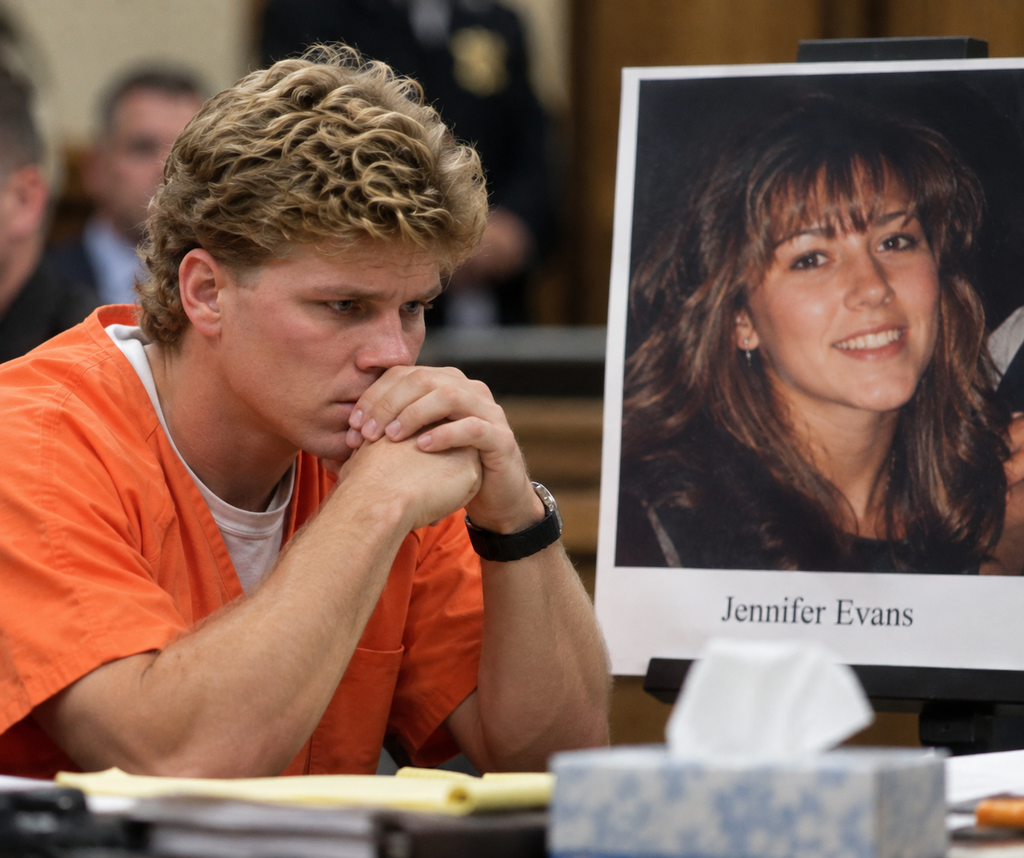
That decision was later reversed. Turner remained behind bars for decades, eventually walking out of prison on parole in March 2026.
But parole and exoneration are not the same thing.
Turner’s story is therefore considerably more complicated than the version often shared online: that an innocent man spent roughly three decades imprisoned for another man’s crime. The court record contains powerful evidence behind the challenge to his convictions, but it also explains why Virginia’s courts ultimately declined to declare him legally innocent.
Understanding that distinction requires returning to one night in the summer of 1995.
A Vacation Night That Ended in Murder
Jennifer Evans was 21 and vacationing in Virginia Beach with two friends in June 1995.
On the evening of June 18, the women went to a nightclub called The Bayou. Jennifer met Turner there. Turner and Billy Joe Brown were both servicemen involved in Navy SEAL training.
Jennifer and Turner spent time together that evening, and court records describe her writing her telephone number for him on a napkin.
Jennifer never returned to her friends that night.
Her body was discovered on June 27. She had been strangled.
Turner and Brown soon became central to the investigation.
One fact is particularly important because it complicates any simplified account of Turner as an uninvolved bystander: after Jennifer died, Turner participated with Brown in moving and concealing her body.
Turner maintained that he had not participated in the killing itself. His conduct afterward, however, became part of the evidence surrounding the case.
Two Defendants, Tried Separately
Brown and Turner faced separate trials.
Brown was convicted of first-degree murder, abduction and attempted rape. Turner was convicted of murder and abduction with intent to defile, an offense involving abduction accompanied by the intent required under Virginia law.
Turner received an 82-year prison sentence.
Brown received 72 years.
For several years, the verdicts appeared to have settled the question of responsibility.
Then Brown changed his story.
The Other Convicted Man Says He Acted Alone
In 2002, Brown gave a recorded interview in which he offered a dramatically different account of Jennifer’s death.
He said he alone had strangled her.
Brown also claimed that he had falsely implicated Turner because he felt betrayed after Turner told investigators what had happened and revealed where Jennifer’s body had been concealed.
In 2003, Brown formalized his new account in an affidavit.
This was not simply a peripheral witness reconsidering a detail years after a trial. One of the two men imprisoned in connection with Jennifer’s death was now saying that the other had not participated in killing her.
For Turner, the statement opened a possible legal path toward overturning his convictions.
He sought a writ of actual innocence based on newly discovered evidence.
A Judge Finds Brown’s New Account Credible
The Virginia Court of Appeals ordered an evidentiary hearing so that Brown’s new statements could be examined.
The findings were significant.
After considering the evidence, the judge found Brown credible when he said that he had acted independently in killing Jennifer. The court also found that Turner had played no role in killing or restraining her.
At first glance, that might seem to resolve everything.
If Brown acted alone and Turner did not participate in physically restraining or killing Jennifer, why would Turner remain convicted of her murder?
The answer lies in a distinction that would eventually determine the outcome of his case: proving that Turner was not the person who strangled Jennifer was not necessarily the same thing as proving that he was legally innocent of the crimes for which the jury had convicted him.
In 2009, Turner Won
In August 2009, a three-judge panel of the Virginia Court of Appeals considered Turner’s petition.
A majority ruled in his favor.
In light of the newly developed evidence, the panel granted him a writ of actual innocence and vacated his convictions for murder and abduction with intent to defile. The court concluded that the evidence instead supported liability as an accessory after the fact, reflecting his involvement after Jennifer’s death rather than participation in the underlying crimes.
For Turner, the distinction could hardly have been more consequential.
There is an enormous difference between participating in the abduction and murder of a young woman and becoming involved after her death by helping the killer conceal her body.
Yet the 2009 ruling was not the end of the case.
Virginia sought rehearing before the full Court of Appeals.
And the outcome changed.
Why Brown’s Confession Wasn’t Enough
When the Virginia Court of Appeals reconsidered the case en banc, the legal question was narrower—and more difficult—than simply determining who had placed their hands around Jennifer’s neck.
Turner faced an exceptionally demanding standard for obtaining a writ of actual innocence.
The court had to consider whether the new evidence established that no rational factfinder, considering the evidence as a whole, could have found him guilty beyond a reasonable doubt.
The majority concluded that Turner had not met that threshold.
Even if Brown’s later account were accepted regarding the killing itself, the court reasoned that the evidence did not necessarily eliminate Turner’s possible participation in Jennifer’s abduction. Under the legal theory involved in the case, that distinction mattered to the murder conviction as well.
That produces the apparent contradiction at the center of Turner’s story:
Not being the person who physically killed Jennifer and being legally innocent of the murder conviction were not necessarily the same proposition.
It is also why the viral version of this case loses so much of what makes it remarkable.
The Case Reaches Virginia’s Highest Court
Turner continued fighting the convictions.
In 2011, the Supreme Court of Virginia reviewed his actual-innocence claim.
The court ultimately upheld the rejection of his petition. It concluded that Turner had failed to satisfy the statutory standard requiring him to demonstrate that, considering all the evidence, no rational trier of fact could have found proof of guilt beyond a reasonable doubt.
His convictions therefore remained intact.
And Turner remained incarcerated.
The result created an extraordinary legal situation.
There was a judicial finding crediting Brown’s claim that he had acted independently in killing Jennifer and that Turner had not helped kill or restrain her.
Yet the later appellate decisions concluded that this was not enough to establish Turner’s legal innocence of the offenses for which he had been convicted.
Those are different questions, even though outside a courtroom they can sound almost impossible to separate.
Decades Passed
Turner entered custody when he was barely into adulthood.
Years became decades as his family and supporters continued arguing that he had suffered a wrongful conviction.
Then, in early 2026, the Virginia Parole Board approved his release.
On March 5, 2026, Dustin Turner walked out of prison after spending more than 30 years incarcerated.
He was 50 years old.
His release, however, came with a crucial qualification.
Turner had been paroled. He had not been exonerated.
His convictions had not simply disappeared because he was allowed to leave prison.
And within weeks, his newfound freedom encountered another complication.
Back Behind Bars
On April 21, 2026, Turner was arrested over an alleged parole violation.
The issue involved requirements attached to his legal status following the abduction with intent to defile conviction. Turner’s attorney disputed the allegation and the circumstances surrounding the claimed violation.
Turner was returned to custody.
Once again, however, his incarceration was temporary.
The Virginia Parole Board approved his release again, and on May 20, 2026, Turner left the Middle River Regional Jail. His parole supervision was subsequently set to transfer to Indiana.
More than three decades after Jennifer Evans was killed, Turner’s legal story was therefore still unfolding.
What the Record Actually Allows Us to Say
Social-media accounts of this case often make an unequivocal claim: Dusty Turner spent more than 30 years imprisoned for crimes he did not commit.
The documented history requires more careful language.
Brown did later say that he alone killed Jennifer.
A judge did find Brown’s revised account credible and found that Turner had not participated in killing or restraining her.
A three-judge appellate panel did grant Turner a writ of actual innocence in 2009 and vacate the relevant convictions.
That decision, however, did not survive rehearing.
Turner also acknowledged conduct after Jennifer’s death, including helping Brown move and conceal her body.
And most importantly when discussing his current legal status, Turner has not been formally exonerated of the convictions at the center of the case.
His supporters continue to characterize those convictions as a miscarriage of justice. The final appellate rulings on his actual-innocence petition reached a different legal conclusion: the new evidence did not satisfy the demanding statutory standard necessary to overturn them.
That distinction is not a technical footnote.
It is the heart of the case.
Jennifer Evans Should Not Disappear From Her Own Story
Wrongful-conviction cases naturally focus attention on the person who may have spent years imprisoned unjustly. But that focus can have an unintended consequence: the victim gradually becomes little more than the event that begins someone else’s story.
Jennifer Evans was 21 years old.
She had traveled to Virginia Beach with friends. On a June evening in 1995, she went to a nightclub and met Dusty Turner.
She never returned to her friends.
Billy Joe Brown was convicted in connection with her murder and later said that he alone had killed her. Turner spent more than three decades incarcerated in a case where the true extent of his responsibility remains fiercely disputed, even after Brown’s later confession and the extraordinary sequence of judicial decisions that followed it.
That is why the Dusty Turner case is more unsettling than its viral summary suggests.
The question is not merely who killed Jennifer Evans?
It also asks what should happen when newly developed evidence fundamentally changes our understanding of a crime but, under the legal standard governing an innocence claim, still does not erase a conviction.
More than 30 years after Jennifer’s death, Brown remains convicted, Turner is out on parole rather than formally exonerated, and the effort to clear Turner’s name continues.
Between the confession, an actual-innocence ruling that was later reversed, and decades spent behind bars lies a story too complicated—and too consequential—to reduce to a single viral sentence.