
At first, your eyes follow the bow.
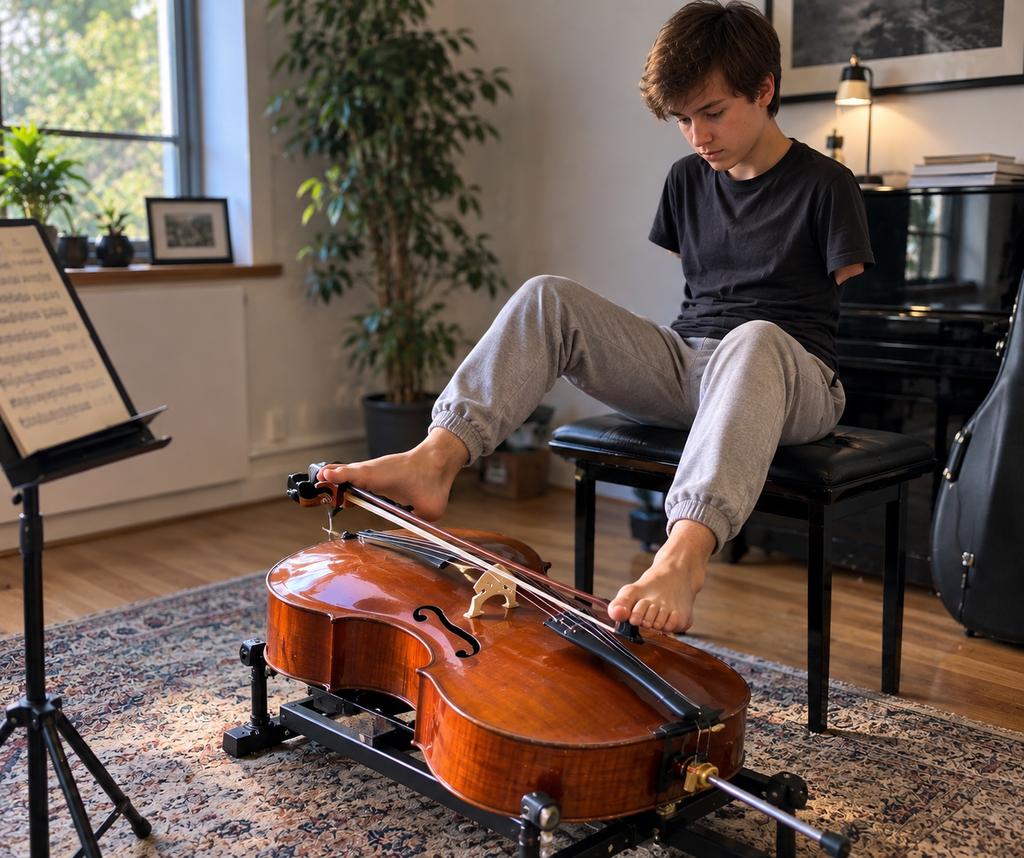
A young man sits in front of a cello, but the instrument is positioned very differently from the way most of us have seen it played. Instead of standing upright between the musician’s knees, it rests low on a specially adapted support.
One foot guides the bow across the strings. The toes of the other move along the fingerboard, finding the notes.
The melody is instantly recognizable: Schubert’s “Ave Maria.”
For a few moments, it is difficult to concentrate on the music itself. You find yourself watching his feet, trying to understand the mechanics of what you are seeing.
Yet this is far more interesting than a remarkable display of dexterity.
Behind performances like this lies a fascinating intersection of musical training, adaptive design and neuroscience — including evidence that the human brain can develop unusually detailed representations of toes when they are used for highly skilled tasks.
Who is the musician in the video?
There is an important distinction to make before telling this story.
The widely shared video is labeled “Ave Maria, Schubert,” but the footage alone does not provide enough reliable information to establish the musician’s identity. Assigning a name to him based only on his appearance or similarities to other performers would therefore be misleading.
What can be verified is the broader phenomenon.
There are well-documented musicians born without arms who have learned to play string instruments with their feet, sometimes with specially designed equipment that changes the position and stability of the instrument.
One notable example is George Dennehy, who was born in Romania without arms and later adopted by a family in the United States.
His early experience with the cello was documented by the Suzuki Association of the Americas. His teacher, Jennifer Petry, described the unusual process of figuring out how a child without arms could learn an instrument whose traditional technique assumes the use of two hands.
Dennehy would eventually learn several instruments and build a professional career in music.
That does not establish that he is the person in this particular video. His story matters for a different reason: it demonstrates that the technique itself is real, teachable and capable of reaching a sophisticated musical level.
A cello designed for hands presents an engineering problem
To understand how unusual this is, consider what happens during ordinary cello playing.
One hand moves along the fingerboard, pressing the strings at precise locations to determine pitch. The other controls the bow, adjusting its speed, pressure and position.
Meanwhile, the musician’s body helps stabilize the instrument.
Remove the use of both arms and the challenge is not solved simply by putting the bow between the toes.
The entire physical relationship between musician and instrument has to change.
In performances by musicians who play with their feet, the cello may be placed much lower and secured by an adapted support. This gives the feet access to both the bow and the fingerboard while preventing the instrument from moving uncontrollably.
What looks like a simple change of position is actually fundamental.
The instrument has been redesigned around the musician.
Other musicians have faced the same challenge
The Petry family provides another documented example of how conventional string instruments can be adapted.
Inga Petry, who was born without arms, learned to play using her feet from an exceptionally young age. She and her sister Elena have appeared in demonstrations of adaptive string playing, including material published by The Strad showing young musicians using alternative techniques to play string instruments.
Their experiences illustrate an important distinction.
A physical disability does not necessarily prevent someone from understanding rhythm, pitch, phrasing or musical expression. Sometimes the immediate obstacle is far more mechanical: the instrument was simply designed around a different body.
Change the way the instrument is supported, positioned or operated, and part of that barrier can change as well.
But this raises an even more intriguing question.
How can toes ever acquire the precision normally associated with fingers?
Your toes may be capable of more than you think
Most people have relatively poor independent control of their toes.
Try moving one toe without moving the others and the limitation becomes obvious.
That makes the movements required for an instrument such as the cello particularly striking. A musician must reach precise positions on a string while coordinating those movements with the bow. Rhythm, dynamics and musical phrasing have to happen at the same time.
For someone who has used their feet for highly skilled tasks throughout life, however, the relationship between foot and brain can be very different.
A 2019 study published in Cell Reports examined two professional foot artists who had been born without arms. Both had spent their lives using their feet for everyday activities as well as highly precise tasks such as painting.
Researchers used ultra-high-field functional MRI to investigate how individual toes were represented in their brains.
What they found was remarkable.
The researchers identified organized representations of individual toes in the artists’ somatosensory cortex. Those representations were substantially more differentiated than what was observed in control participants.
The organization even showed characteristics resembling the way individual fingers are represented in the brain.
This did not mean that the artists’ feet had literally become hands.
Something subtler — and scientifically more interesting — had happened.
Their lifelong sensory and motor experience was associated with a different pattern of brain organization.
The brain’s body map is not completely fixed
The study also produced another intriguing observation.
Features associated with the artists’ highly skilled feet appeared not only in brain territory normally associated with the feet, but also within cortical territory that would ordinarily be associated with their absent hands.
That finding fits into a larger field of research examining neuroplasticity — the nervous system’s ability to change its organization and function in response to development and experience.
Other research involving people born without hands has likewise found evidence that body parts frequently used to perform compensatory tasks can recruit cortical territory normally associated with the missing hand.
The implication is not that the brain is infinitely malleable.
Modern neuroscience presents a more complicated picture.
Brain organization is influenced by experience, but also by anatomy, existing neural connections and developmental constraints. Different regions do not simply reorganize in whatever way is most convenient.
That distinction matters because stories about neuroplasticity are frequently exaggerated into claims that the brain can “rewire itself to do anything.”
The science does not support such a sweeping conclusion.
There is another important limitation
The 2019 study involved only two foot artists.
That makes it fascinating evidence, but not a universal rule about what will happen to anyone who trains their toes intensively.
These individuals were also unusual in another crucial respect: they had been using their feet for sophisticated tasks throughout much of their lives.
Their brains had not undergone a few months of musical training. Their sensory and motor systems had developed alongside years of extraordinarily intensive foot use.
So when we watch a musician manipulate cello strings with their toes, it would be misleading to describe the performance simply as the triumph of determination.
Practice undoubtedly matters.
But so do development, anatomy, individual experience, adaptive technology and the remarkable — yet not unlimited — plasticity of the human nervous system.
The real story is more compelling precisely because it does not require a miracle.
Sometimes accessibility means changing the object
Musical instruments carry assumptions about the bodies that will use them.
A piano normally assumes access to hands. A violin traditionally requires one hand for the bow and another for the strings. Standard cello technique was developed around a musician using both arms.
For someone born with a limb difference, the barrier may therefore exist partly in the design of the object itself.
This is why an adapted cello support should not be dismissed as a minor accessory.
It changes what is mechanically possible.
Instead of asking the musician’s body to conform to an instrument designed centuries ago, adaptive design asks a different question:
Can the instrument be changed to work with the musician?
That principle extends far beyond music. Accessibility is not always about teaching a person to overcome an environment that excludes them. Sometimes the environment itself can be redesigned.
There is even a twist in the music itself
The melody heard in the video is widely known as Schubert’s “Ave Maria,” but the piece has its own history of transformation.
Franz Schubert composed it in 1825 as “Ellens dritter Gesang” (“Ellen’s Third Song”), D. 839, setting a German translation of a passage from Walter Scott’s The Lady of the Lake.
The opening words include an invocation of “Ave Maria,” but Schubert did not originally compose the work as a setting of the traditional Latin Ave Maria prayer.
Over time, the famous melody became associated with the Latin text and was arranged for numerous voices and instruments, including cello.
So even the music we hear has a history of adaptation.
In this performance, however, adaptation goes far beyond the score.
The relationship between musician and instrument itself has been reimagined.
More than an inspirational video
Videos like this are often shared with captions declaring that “nothing is impossible.”
That message sounds uplifting, but it misses something important.
Some things really are impossible in their original configuration.
A conventionally positioned cello was designed around a player using two arms. Pretending that physical constraint does not exist tells us very little about how the musician actually succeeds.
The interesting part is what happens next.
The instrument can be repositioned. A support can be engineered. Completely different movements can be learned. Years of practice can refine those movements, while long-term experience can be reflected in the way the nervous system processes and represents the body.
None of that makes the physical difference disappear.
It shows what can happen when technique, technology and human biology meet it intelligently.
And perhaps that explains the strangest thing about watching a performance like this.
At first, you watch the feet.
You follow the bow and wonder how any of it is possible.
Then, somewhere along the way, you stop watching the technique.
And you simply hear the music.