
At first glance, it feels like something left behind by a long-lost civilization. A massive human face carved directly into a cliff, watching over the Danube in a place where nature seems untouched.
But the reality is very different.
This monumental sculpture is located in Romania, on the banks of the Danube, in the area known as the Iron Gates (Porțile de Fier), near the village of Dubova. Despite how ancient it looks, it was created between 1994 and 2004, and behind it is not a forgotten legend, but a modern story shaped by ambition, persistence, and years of demanding work carried out in difficult conditions.
The project was initiated and funded by Iosif Constantin Drăgan, a Romanian-born entrepreneur who wanted to leave behind a lasting tribute to Decebal, the last king of Dacia.
Ten years of work, carved into a cliff above the river
The sculpture did not come together quickly, nor easily. A small team of sculptors, many of them trained in climbing techniques, worked on it for roughly a decade.
The location itself explains why. The cliff rises directly above the Danube, in a steep and rugged stretch of the Iron Gates, a dramatic gorge that forms part of the natural border between Romania and Serbia. Reaching the site is not straightforward even for visitors, and for those actually working on the rock, every step required careful planning.
Much of the work was done while suspended on ropes, exposed to wind, heat, humidity, and the natural instability of the rock. It was not a conventional construction site. It was a place where precision and physical endurance had to go hand in hand, day after day.
A project shaped by risk and determination
Working directly on a natural rock face always involves uncertainty. Pieces of stone can shift, weather conditions can change suddenly, and the terrain itself offers little margin for error.
The area is also known for its wild landscape, which adds another layer of unpredictability. The team had to navigate not only the technical challenges of carving such a large structure, but also the realities of working in an environment that was never designed to be safe or controlled.
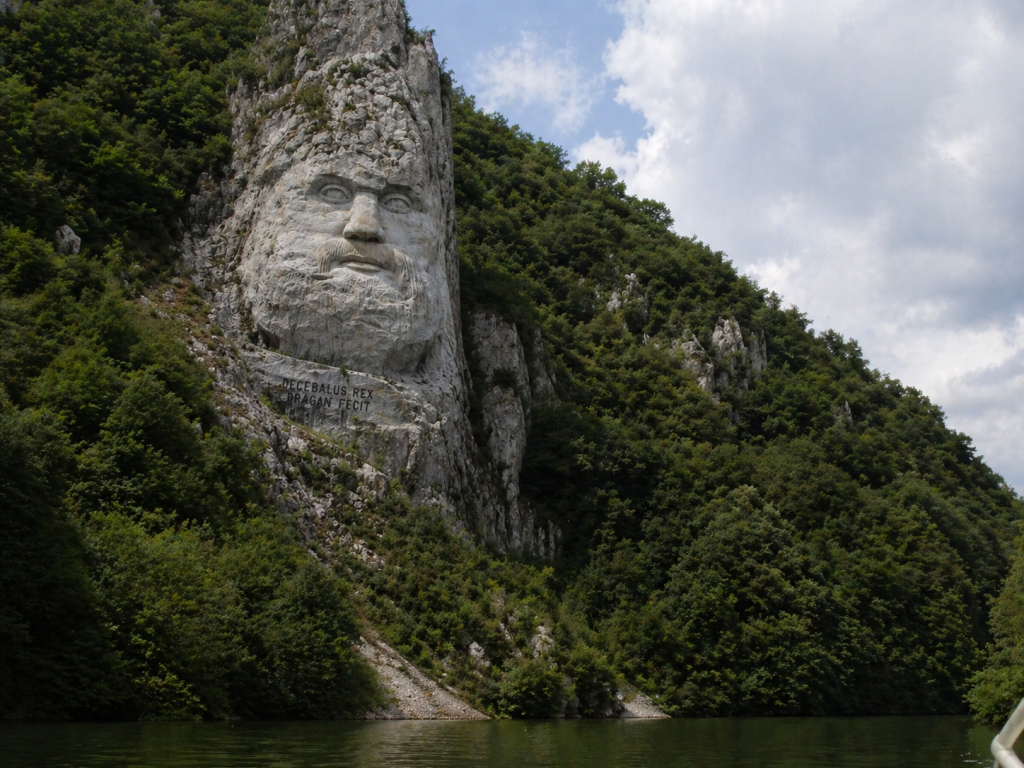
That is part of what makes the final result so striking. It is not just a sculpture placed into nature, but one carved out of it, under conditions that required both skill and resilience.
Why it feels much older than it really is
One of the most interesting reactions people have when they first see the sculpture is surprise. Many assume it must be centuries old.
That impression comes from the way it blends into the landscape. There are no surrounding buildings, no obvious signs of modern construction. Just rock, forest, and water. The scale of the carving, combined with its natural setting, creates the illusion that it has always been there.
It is a reminder of how strongly context shapes perception. The same sculpture, placed in a city, would likely be seen very differently.
More than a tourist attraction
Today, the face of Decebal has become one of the most recognizable landmarks in Romania. It stands about 55 meters tall, making it one of the largest rock sculptures in Europe.
But beyond its size, what stays with people is the experience of seeing it in person. The contrast between the natural environment and the human intervention is powerful, and that tension is part of what makes the place memorable.
The question that lingers
Even though it is a relatively recent creation, many people instinctively place it much further back in history.
If you didn’t know anything about it, would you assume it was modern… or ancient?