
This question often comes up in simplified, sometimes dramatic forms, but the reality behind it is more nuanced and, at the same time, more meaningful. Life on Earth does not depend on bees alone, yet it relies heavily on pollinators as a whole, and bees happen to be one of the most important pieces in that larger system.
What pollination really is — and why it matters more than it seems
Pollination is the process that allows flowering plants to reproduce, by transferring pollen from the male part of a flower to the female part. Without this step, many plants cannot produce fruits or seeds.
According to data summarized by the Food and Agriculture Organization, roughly three quarters of the world’s major food crops depend, at least to some extent, on animal pollination. That doesn’t mean food would disappear without insects, but it does mean that a significant portion of the variety we rely on would be affected.
Research published in journals such as Proceedings of the Royal Society B suggests that around 35% of global food production is directly influenced by pollinators. The distinction matters: some crops rely entirely on them, while others would still grow but with lower yields and poorer quality.
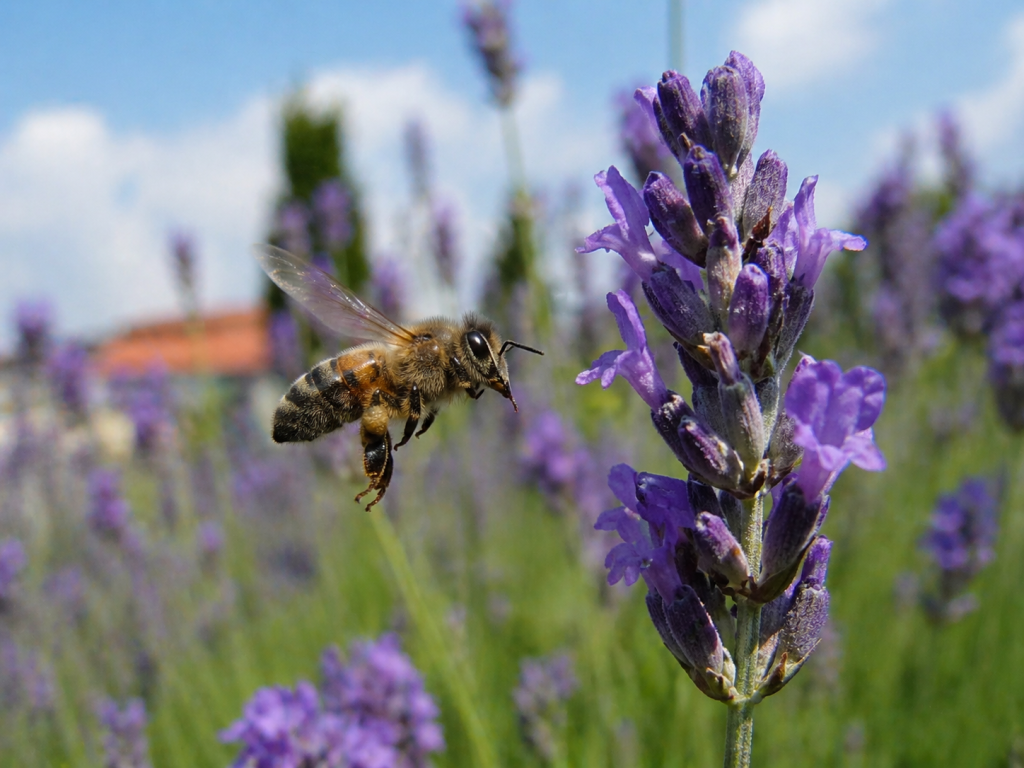
Why bees stand out among pollinators
Bees, especially the Apis mellifera, are particularly effective because of both their biology and behavior. Their bodies are covered in tiny hairs that trap pollen, and they tend to visit the same type of flower repeatedly, which increases the chances of successful pollination.
This relationship is not accidental. It is the result of long-term coevolution, studied within ecology, where plants evolved to produce nectar that attracts insects, and insects adapted to collect it efficiently while carrying pollen from one flower to another.
A clear example is almond farming, where production depends almost entirely on managed bee populations. In some regions, beekeepers transport millions of hives each season just to ensure pollination takes place.
Bees are not alone in this role
Although bees are the most well-known pollinators, they are part of a much broader network. Bumblebees, butterflies, certain flies, beetles, and even some birds and bats contribute to pollination in different ecosystems.
This diversity is what gives ecosystems resilience. If one species declines, others may compensate to a certain degree, but no single group can fully replace the system as a whole. It functions more like an interconnected web than a single critical component.
What would actually happen if bees disappeared
The idea that “humanity would collapse within a few years without bees” is an oversimplification, but it reflects a real concern. The effects would not be immediate, yet they would be significant over time.
Many crops would see reduced yields, in some cases dramatically. Fruits, vegetables, and nutrient-rich foods would become less available and more expensive. Human diets would not vanish, but they would become more limited and less balanced.
At an ecological level, fewer pollinated plants would mean less food for herbivores, which in turn affects predators. This chain reaction is known in ecology as a trophic cascade, where changes at one level ripple through the entire system.
Why bee populations are declining
The decline of bees has been widely documented and is driven by multiple overlapping factors. One of the most studied is the parasite Varroa destructor, which weakens bee colonies and makes them more vulnerable to disease.
Pesticides, especially neonicotinoids, have been linked to navigation and orientation problems, affecting bees’ ability to return to their hives. Habitat loss, driven by intensive agriculture and urban expansion, reduces the diversity of flowering plants they depend on.
Climate change adds another layer, altering flowering seasons and disrupting the timing between plants and pollinators.
The real takeaway, without exaggeration
Life on Earth does not depend on a single species, and bees are no exception. However, they are a key part of a system that supports both natural ecosystems and global food production.
What often gets lost in simplified narratives is that we are not talking about a sudden collapse, but about a gradual erosion of balance. It is the kind of change that doesn’t feel dramatic at first, yet becomes visible over time — in ecosystems, in agriculture, and ultimately in the food that reaches our tables.