
Commercial aviation is built around layers of protection. Some are visible to passengers; many are not. Few are as symbolically important as the reinforced cockpit door — a barrier designed to ensure that an unauthorized person cannot reach the pilots or the controls of an aircraft.
On September 30, 2026, aboard flydubai flight FZ1073 from Dubai to Tel Aviv, that principle was confronted with an extraordinary reversal.
The threat was not trying to get into the cockpit. It was already inside.
Saudi authorities said their preliminary investigation found that the captain had been assaulted by the co-pilot during the flight. Both pilots were injured. Subsequent accounts, including statements from Captain Smit Machchhar, described him being stabbed as the aircraft entered a dramatic descent.
Despite his injuries, Machchhar managed to unlock the cockpit door. People from the cabin were then able to intervene, while other flydubai pilots travelling aboard the aircraft ultimately took control.
The Boeing landed safely in Tabuk, Saudi Arabia.
It is an extraordinary survival story. But it also raises a much larger question about modern aviation: how do you design a barrier that is extremely difficult to breach while still allowing intervention in the rare situation where the danger is on the protected side of that barrier?
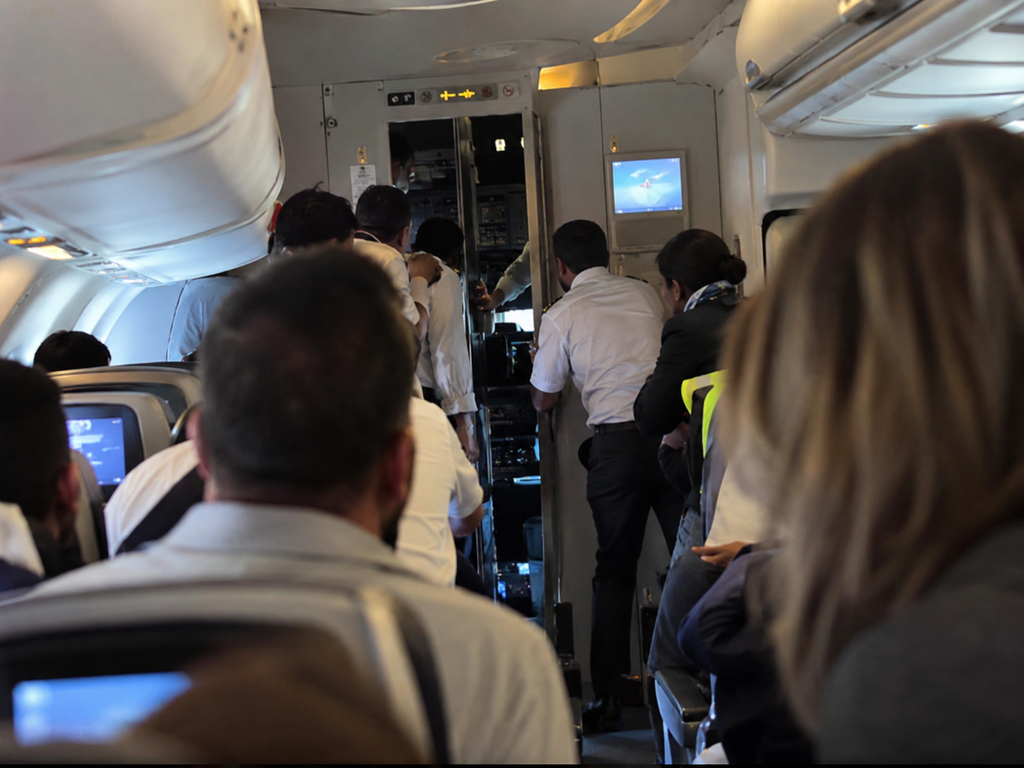
What Happened on Flight FZ1073?
Flight FZ1073 departed Dubai International Airport for Ben Gurion International Airport on September 30.
flydubai subsequently confirmed that the aircraft had experienced an incident during the flight and was diverted to Tabuk, where it landed safely.
The UAE General Civil Aviation Authority described what happened as a security incident and confirmed that crew members had been injured and taken to hospital.
Saudi investigators later provided a crucial additional detail: their preliminary findings indicated that the co-pilot had assaulted the captain inside the cockpit.
What investigators have not yet definitively established publicly is why.
Israeli officials alleged that the co-pilot had attempted to crash the aircraft. UAE authorities, meanwhile, opened an investigation examining the circumstances and motives behind the incident, including whether there was any connection to terrorist activity and whether advance planning or coordination was involved.
That distinction matters.
An assault inside the cockpit is part of the established account of the incident. The precise motive and intent behind it require the conclusions of the investigation.
A Terrifying Loss of Altitude
While events unfolded inside the cockpit, the passengers experienced something unmistakably wrong with the aircraft.
Reuters reported that the plane underwent an extremely rapid loss of altitude during the incident. Accounts based on flight-tracking information described a descent involving thousands of feet within seconds.
For the people in the cabin, however, the numbers were secondary.
Passengers described believing that the aircraft might crash.
Inside the cockpit, Captain Smit Machchhar had been injured and was on the floor. Two days later, speaking from a hospital bed in Abu Dhabi during a video call with Indian Prime Minister Narendra Modi, he described realizing that the aircraft was descending.
Machchhar had 17 years of aviation experience, including 11 years as a captain.
But in those moments, the immediate problem was not simply flying the aircraft.
He needed to reach the cockpit door.
The Decision That Changed the Outcome
Machchhar said he realized he needed to open the door.
Despite his injuries, he managed to do so.
That action fundamentally changed what was possible aboard FZ1073. People outside the cockpit could now intervene and help bring the situation under control.
There was another critical advantage aboard the aircraft: another pair of flydubai pilots were travelling on the flight. Once the immediate threat had been contained, qualified pilots were therefore available to take over the aircraft.
FZ1073 was diverted to Tabuk and landed safely.
Saudi authorities reported that there were 174 passengers and eight crew members aboard — 182 people in total.
All reached the ground alive.
It is difficult to imagine a clearer demonstration of how one action can alter the outcome of an aviation emergency. Yet the fact that opening a door became so consequential is not accidental.
That door was deliberately designed to be difficult to open.
Why Cockpit Doors Are So Difficult to Breach
The modern reinforced cockpit door is, to a significant extent, a product of lessons learned from hijackings and particularly from the September 11, 2001 terrorist attacks.
Aviation authorities subsequently strengthened requirements intended to prevent unauthorized people from reaching flight controls.
In the United States, Federal Aviation Administration standards address the ability of cockpit structures to resist forcible intrusion. European aviation rules similarly require secure flight-deck doors on relevant categories of commercial aircraft and establish procedures surrounding access.
The logic is compelling.
If someone in the passenger cabin becomes violent or attempts to hijack an aircraft, reaching the pilots should be extremely difficult.
The system is therefore primarily designed around one assumption: the dangerous person is outside the cockpit.
FZ1073 highlights the opposite scenario.
What happens when the person posing the danger is already behind the reinforced door?
Aviation’s Cockpit-Door Paradox
This creates a genuine security dilemma.
Make the cockpit door too easy to override from the passenger side and an attacker could exploit that mechanism. Make it extremely difficult to override and intervention becomes more complicated in the exceptional situation where the threat originates inside.
There is no simple engineering solution in which one side of that equation disappears.
Aviation security therefore relies on multiple safeguards rather than assuming that one physical barrier can address every possible emergency.
The cockpit door is one layer. Crew procedures are another. Pilot selection, security screening, psychological assessment, reporting systems, training and emergency procedures all contribute to the broader safety architecture.
This approach is especially important because aviation has encountered the insider-threat problem before.
The Germanwings Disaster Changed the Conversation
On March 24, 2015, Germanwings Flight 9525 crashed in the French Alps. All 150 people aboard were killed.
Investigators concluded that the co-pilot, who was alone in the cockpit at the time, deliberately initiated the descent and prevented the captain from getting back inside.
The disaster forced aviation authorities to reconsider a difficult question: could the very security measures designed to prevent hijacking also obstruct intervention during a crisis originating inside the cockpit?
In the immediate aftermath, the European Union Aviation Safety Agency recommended that at least two authorized people, including at least one qualified pilot, remain in the cockpit.
The European approach subsequently evolved. Rather than retaining a universal two-person requirement indefinitely, EASA moved toward a risk-based framework in which operators assess factors including psychological and security screening, crew-support systems and other mitigation measures.
The circumstances surrounding FZ1073 are substantially different from Germanwings.
According to the information available so far, both pilots were already inside the cockpit when the flydubai incident began.
That difference is important because it demonstrates another uncomfortable reality: keeping two people on the flight deck can reduce some risks, but it cannot eliminate every conceivable insider threat.
Why Aviation Safety Is Built in Layers
A modern airliner does not depend on one component working perfectly.
Aviation safety is deliberately constructed around redundancy — technical and procedural barriers that overlap so that a single failure does not automatically become a catastrophe.
Cockpit security follows the same principle.
A reinforced door protects against unauthorized entry. Crew procedures regulate when and how that door is opened. Screening and training are intended to reduce human risk. Communication and emergency procedures provide additional defenses when something unexpected happens.
Regulators have continued adding layers as new vulnerabilities become apparent.
In the United States, for example, the FAA has adopted requirements for secondary physical barriers on certain newly manufactured commercial aircraft. Their purpose is to protect the flight deck during one of its most vulnerable moments: when the main cockpit door must be opened during flight.
This is an important distinction. Secondary barriers primarily address the risk of someone attempting to enter the cockpit from the cabin while its reinforced door is open. They are not, by themselves, a solution to every possible threat originating inside the flight deck.
That illustrates why the FZ1073 investigation matters. Before drawing conclusions about what should change, investigators first need to establish precisely what happened, in what sequence and how the aircraft’s existing systems and procedures performed.
What Investigators Still Need to Establish
Dramatic events create an information vacuum, and social media tends to fill it quickly.
That makes separating established facts from allegations particularly important.
Authorities have confirmed the diversion to Tabuk and the safe landing. Saudi investigators said their preliminary findings showed that the captain was assaulted by the co-pilot. Both men required medical treatment.
After doctors determined that they were fit to travel, the two pilots were transferred to Abu Dhabi.
Machchhar has also publicly described reaching and opening the cockpit door, allowing intervention from the cabin.
What has not yet been established through a final judicial investigation is the motive behind the assault.
The UAE Attorney General ordered a specialized team to investigate the circumstances and causes of the incident. Authorities said the inquiry would examine whether the episode had any connection with terrorist activity or intent and whether there had been prior planning or coordination.
Until those findings are available, claims circulating online about the attacker’s ideology or motives should not be presented as established fact.
182 People Were Aboard the Aircraft
One numerical detail deserves clarification because different early reports produced some confusion.
Saudi authorities reported 174 passengers and eight crew members, meaning that 182 people were aboard FZ1073.
Later that day, the passengers continued their journey aboard a replacement flydubai aircraft. Saudi authorities said that flight departed Tabuk at approximately 5:40 p.m.
The remaining crew returned to Dubai, while the two injured pilots initially stayed behind for medical treatment before later travelling to Abu Dhabi.
For the passengers, boarding another aircraft only hours after such an experience must have been an extraordinary psychological transition: returning to the same environment in which, earlier that day, they had believed they might die.
A Door Built to Save Lives — and the Captain Who Had to Open It
There is a striking contradiction at the center of the FZ1073 story.
The reinforced cockpit door exists because aviation learned, often through tragedy, how dangerous it can be when an unauthorized person reaches the controls of a passenger aircraft.
Its job is to keep people out.
On September 30, 2026, the equation was reversed.
An injured captain needed the people on the other side of that security barrier to get in.
The investigation may ultimately reveal procedural, security or human factors that are not yet publicly known. Until then, it would be premature to turn FZ1073 into evidence that a particular aviation safety rule has failed.
But the incident already illustrates something fundamental about safety engineering: every protective system is designed around assumptions about where danger will come from. The hardest emergencies are often the ones that reverse those assumptions.
And that leaves aviation with a question for which there can never be a perfectly simple answer:
How do you build a barrier strong enough to keep a threat out, while preserving a way to intervene when the threat is already inside?
Sources consulted: Reuters, Associated Press, flydubai, UAE General Civil Aviation Authority and UAE authorities for reporting on the FZ1073 incident and investigation; FAA and EASA materials for cockpit-security standards, flight-deck procedures and regulatory context.