
At first glance, the image almost looks digitally altered.
One woman towers above the room at more than two metres tall. Beside her is another adult woman who stands just 62.8 centimetres. The contrast is so dramatic that it is easy to suspect camera perspective, editing, or some carefully staged visual illusion.
But the proportions are real.
Rumeysa Gelgi, from Türkiye, is 215.16 centimetres (7 ft 0.7 in) tall. Jyoti Amge, from India, measures 62.8 centimetres (2 ft 0.7 in). Guinness World Records recognizes them as the tallest woman living and the shortest woman living, respectively.
Put those measurements together and the difference is remarkable: 152.36 centimetres — almost exactly five feet.
Yet when the two women finally met in London in November 2024, their extraordinary difference in height turned out to be only the most immediately visible part of the story.
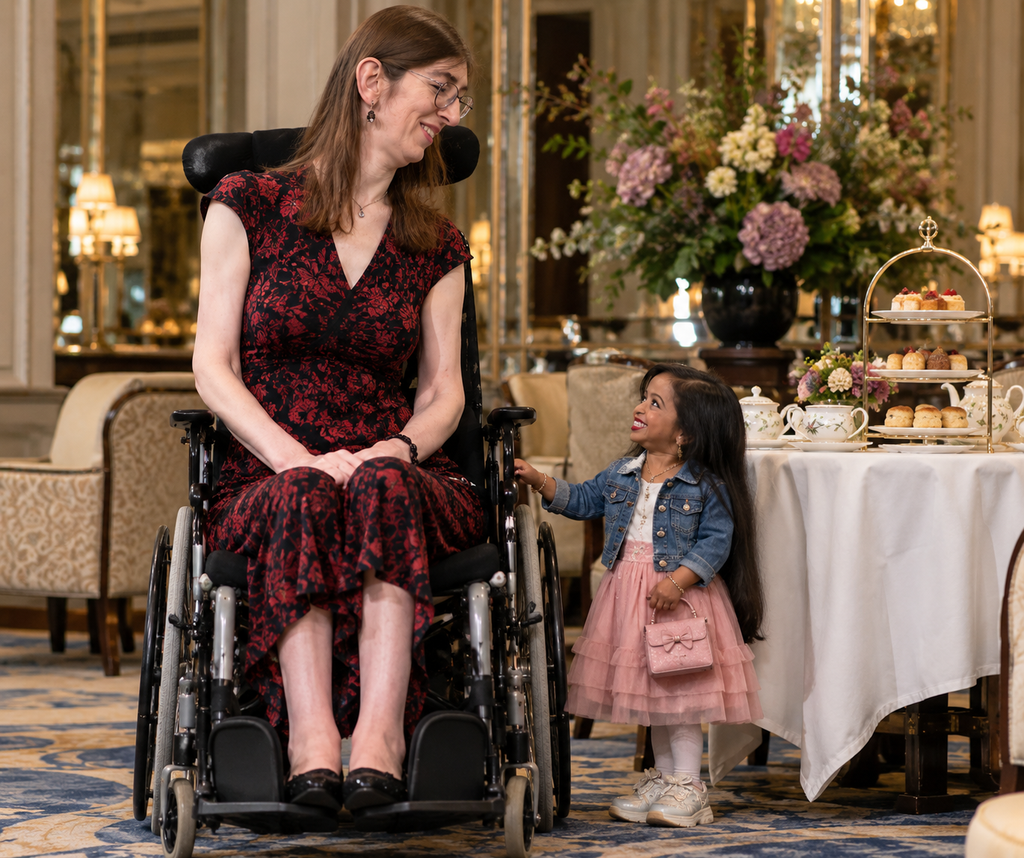
A meeting that brought two opposite records together
Guinness World Records arranged the meeting at The Savoy in London as part of Guinness World Records Day 2024 and celebrations surrounding the organization’s 70th anniversary.
Gelgi and Amge sat down for a traditional afternoon tea, producing the striking photographs that later circulated widely online. They also appeared together on British television, including This Morning.
The visual contrast inevitably attracted attention. One woman lives at an extreme of human height in one direction, the other at the opposite extreme.
But once they began talking, the record-book narrative became less important.
The two reportedly discovered shared interests in fashion, makeup, jewellery and self-care. Amge later described how comfortable she felt talking with Gelgi.
It was a surprisingly ordinary conversation between two people whose bodies have ensured that much of their public attention has been anything but ordinary.
Rumeysa Gelgi’s height has a rare genetic explanation
Rumeysa Gelgi was born in Türkiye on January 1, 1997. Her unusual growth was apparent from birth. Guinness World Records reports that she was approximately 59 centimetres long and weighed 5.9 kilograms when she was born.
Her exceptional height is not simply an extreme version of normal inherited tallness.
Gelgi has Weaver syndrome, a rare genetic overgrowth disorder associated with changes involving the EZH2 gene. Medical descriptions of the condition include accelerated growth, advanced bone age and a range of possible skeletal and developmental characteristics. Not everyone with the condition is affected in precisely the same way.
EZH2 is involved in regulating the activity of other genes. Certain pathogenic variants can disrupt normal developmental processes, producing effects that extend beyond height alone.
That distinction matters. Weaver syndrome is not simply a condition that makes someone extremely tall; it is a complex genetic disorder affecting development.
By the time Gelgi was 17, she measured 213.6 centimetres and was recognized as the world’s tallest living female teenager. In 2021, an official measurement of 215.16 centimetres earned her the adult record for tallest woman living.
Her height also comes with significant physical challenges. She primarily uses a wheelchair and can walk for short periods with assistance from a walker.
Jyoti Amge reached the opposite end of the height spectrum
Jyoti Amge was born on December 16, 1993, in Nagpur, India.
Her short stature results from achondroplasia, the most common genetic cause of disproportionate short stature.
The biology is very different from Weaver syndrome.
Achondroplasia is associated with pathogenic variants in FGFR3, a gene that plays an important role in regulating bone growth. The resulting overactivity of the FGFR3 protein interferes with the normal process by which cartilage contributes to the lengthening of bones during development.
This is why achondroplasia does not simply produce a proportionally smaller version of an average-sized body. The long bones of the arms and legs are particularly affected, while the trunk is relatively less shortened. Other anatomical features and medical complications can also occur, although their extent varies between individuals.
The photograph of Gelgi and Amge therefore captures something scientifically fascinating as well as visually striking.
Both women have genetic conditions that influence skeletal development, yet those conditions affect growth through entirely different biological mechanisms and lead to dramatically different outcomes.
How do you officially establish a height of 62.8 centimetres?
Amge was already a Guinness record holder as a teenager.
In 2009, at age 15, she measured 61.95 centimetres and was recognized as the shortest living female teenager. Once she turned 18, she became eligible for the adult category.
Establishing the record involved more than taking a single measurement.
Guinness reported that Amge was measured several times by a medical professional over a 24-hour period. This is relevant because human height can vary slightly throughout the day as the spine experiences compression.
Her official adult height was established at 62.8 centimetres.
That measurement explains why photographs beside Gelgi can look almost surreal without requiring any digital manipulation.
The 152-centimetre difference really is that dramatic
The arithmetic is straightforward:
215.16 cm − 62.8 cm = 152.36 cm.
The difference between their official heights is therefore greater than the entire height of many adults.
Photography can, of course, change how dramatic that difference appears. Camera position, focal length and the distance between each subject and the lens can exaggerate or reduce apparent size.
But no photographic trick is needed to create the fundamental contrast seen here.
Place the officially recognized tallest living woman beside the officially recognized shortest living woman, and reality itself produces an extraordinary image.
Their biggest shared challenge may be something most of us never notice
At first, Gelgi and Amge seem to inhabit opposite physical realities.
One frequently encounters things that are too small. The other encounters things that are too large or too high.
Yet this creates a surprisingly similar problem.
Much of the human-built environment is designed around a relatively narrow range of body dimensions. Chairs, beds, kitchen counters, door handles, public transport, stairs, toilets, ATMs and countless other objects quietly assume that the person using them will fall somewhere reasonably close to an average adult size.
Most people rarely notice those assumptions because the environment largely fits them.
At the extremes, those invisible design choices become impossible to ignore.
As a child, Amge attended school with other children but needed a desk and chair made to accommodate her size.
For someone taller than 2.15 metres, many of the same environments present the reverse difficulty. Furniture, clothing, vehicles and sleeping spaces may simply not accommodate the body they are expected to serve.
Their experiences illustrate a broader point about accessibility: a physical difference can become far more disabling when the surrounding environment was never designed to accommodate it.
A record became an acting career for Jyoti Amge
Amge did not want her public life to end with a Guinness certificate.
She had ambitions in entertainment, and international recognition eventually helped her pursue them. Millions of viewers came to know her through American Horror Story: Freak Show, where she played Ma Petite. Guinness World Records also recognizes her as the shortest actress.
Gelgi followed a different path. She became a web developer and has used the attention surrounding her records to raise awareness of Weaver syndrome and speak publicly about living with rare physical differences.
Neither woman chose the genetic condition that first brought her international attention.
What each chose to do with that attention is another matter entirely.
There is a problem with treating unusual bodies as curiosities
Human records are inherently fascinating. We are drawn to extremes: the tallest, shortest, oldest, fastest or strongest.
There is nothing particularly surprising about looking twice at the photograph of Gelgi and Amge. The difference between them genuinely is extraordinary.
But fascination can easily flatten a person into a measurement.
A height of 215.16 centimetres tells us something remarkable about Gelgi’s body, but very little about Gelgi herself. The same is true of Amge’s 62.8 centimetres.
Their genetic conditions have shaped their health, mobility and everyday experiences. They have also influenced how strangers react to them before either woman has said a word.
Yet neither woman’s medical diagnosis is a complete description of her life.
That may be why their London meeting becomes more interesting the longer you look beyond the photograph. The image initially invites us to compare their differences. Their conversation revealed how quickly two people living at opposite physical extremes could begin finding similarities.
The photograph can be measured. Their lives cannot.
Guinness World Records has included both women among its “ICONS,” highlighting individuals associated with some of the organization’s most recognizable records.
The photograph of them together will probably continue circulating for a simple reason: it compresses two extraordinary extremes of human height into a single frame.
The numbers alone are memorable.
215.16 centimetres.
62.8 centimetres.
152.36 centimetres between them.
But those numbers are ultimately only the doorway into the story.
Behind them are two very different genetic conditions, years of adapting to environments designed around other people’s bodies, and two women who became internationally recognizable because of characteristics they never chose.
The world noticed their measurements first.
What they built around those measurements is the more interesting story.