
When people think about the Second World War, they usually picture tanks rolling across Europe, fighter planes battling in the skies, or soldiers storming heavily defended beaches. Yet some of the war’s most important victories were influenced far from the battlefield, inside workshops, offices, and laboratories where ordinary-looking objects were transformed into tools of survival.
Among the people working in that hidden world was Charles Fraser-Smith, a British inventor whose name remained largely unknown for decades. While generals planned campaigns and pilots fought in the air, Fraser-Smith was helping create devices that could mean the difference between captivity and freedom. Many historians believe his work later contributed to the image of the famous gadget master “Q” from the James Bond universe.
His story is remarkable not only because of what he accomplished during the war, but because almost nothing in his early life suggested that he would become part of one of the most secretive chapters in modern history.
A Difficult Beginning
Born in London in 1905, Fraser-Smith did not grow up surrounded by privilege or opportunity. He lost his parents at a young age and spent much of his childhood under the care of relatives. Later accounts describe a life marked by uncertainty, financial hardship, and a constant search for direction.
Unlike many of the scientists and military planners who would shape the war effort, he did not follow a prestigious academic path. His early adulthood was a series of experiments, occupations, and ventures that rarely delivered lasting success.
At one point he traveled to Morocco to pursue agricultural opportunities, hoping to build a future through farming. The venture failed. Like several of his earlier attempts, it ended in disappointment rather than prosperity.
By the late 1930s, he was hardly the sort of person anyone would have predicted would play a role in military history. Yet he possessed something difficult to measure on paper: an unusual talent for solving practical problems and finding creative solutions where others saw obstacles.
Britain’s Need for Unconventional Thinking
When war broke out in 1939, Britain faced challenges that extended far beyond the front lines.
Thousands of airmen flew dangerous missions over occupied Europe. If their aircraft were shot down, survival often depended on their ability to avoid capture, navigate unfamiliar territory, and reach friendly forces or resistance networks.
At the same time, large numbers of British servicemen were being held in prisoner-of-war camps across the continent. Escaping from those facilities was difficult enough. Doing so without maps, navigation tools, or resources was often nearly impossible.
British intelligence and military planners began searching for ways to provide hidden assistance to men trapped behind enemy lines. The answer would require imagination as much as engineering.
The Secret Workshop Behind the Gadgets
Fraser-Smith eventually joined the British Ministry of Supply, where his practical skills found an unexpected purpose.
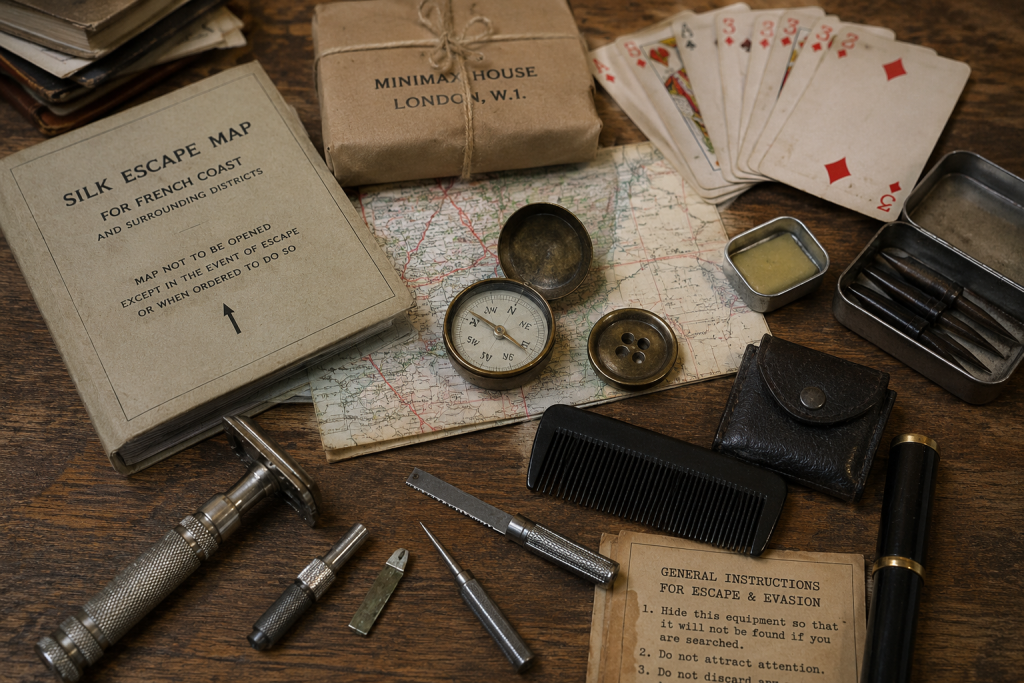
Working from facilities associated with what became known as Minimax House, he became involved in the design and procurement of specialized equipment intended for intelligence operations, military personnel, and prisoners of war.
His assignments rarely resembled traditional engineering projects.
Instead of building large machines, he was asked to conceal essential survival tools inside everyday objects. Every item had to withstand inspection while remaining functional when needed most.
The challenge was simple to describe but incredibly difficult to execute: create something useful without making it look useful.
Silk Maps: A Small Innovation With a Huge Impact
One of the most successful developments of the period was the production of escape maps printed on silk and other durable fabrics.
Paper maps had obvious weaknesses. They tore easily, deteriorated when wet, and produced noise when unfolded. Those flaws might seem insignificant under normal circumstances, but for someone hiding from enemy patrols, they could become serious liabilities.
Fabric maps offered several advantages. They were lightweight, waterproof, nearly silent, and could be folded into extremely small spaces. Pilots could carry them inside clothing, life jackets, or emergency kits without attracting attention.
Millions of specialized maps were eventually produced during the war. Today they are often regarded as one of the most innovative survival tools developed by the Allies.
Hidden Compasses and Disguised Escape Tools
Maps alone were not enough.
A person trying to cross occupied territory also needed a reliable way to determine direction. Traditional compasses were easy to discover during searches, so engineers developed miniature versions that could be hidden in seemingly ordinary objects.
Some were concealed inside uniform buttons. Others were built into pens, pencils, or personal accessories.
Additional escape aids followed. Certain combs contained tiny saw blades capable of cutting through restraints or barriers. Shaving kits were modified to hold concealed equipment. Shoes, clothing, and personal items were adapted to carry hidden resources without drawing suspicion.
The effectiveness of these devices came from their simplicity. Most enemy guards never imagined that a common household object could serve an entirely different purpose.
Playing Cards With a Secret
Among the most ingenious creations were specially manufactured decks of playing cards.
To anyone examining them casually, they appeared perfectly ordinary. Yet some versions contained hidden information embedded within their layers.
When treated in a particular way, sections could be separated to reveal maps and escape routes. These decks found their way into prisoner-of-war camps through approved channels and humanitarian shipments.
What appeared to be entertainment was, in reality, a carefully designed survival resource.
The concept demonstrated a principle that defined much of Fraser-Smith’s work: the best hiding place is often in plain sight.
Operation Mincemeat and One of the War’s Greatest Deceptions
Perhaps the most famous story connected to Fraser-Smith involves the extraordinary wartime deception known as Operation Mincemeat.
In 1943, Allied planners sought to convince German commanders that an invasion would target Greece and Sardinia rather than Sicily, which was the true objective.
To support the deception, British intelligence used the body of a deceased man who was given a carefully constructed false identity. Documents placed on the body contained misleading military information intended to fall into enemy hands.
Maintaining the body in a believable condition required specialized handling and transportation systems. Historical accounts have linked Fraser-Smith to equipment associated with this logistical challenge, although the precise details remain the subject of ongoing historical discussion.
The operation succeeded beyond expectations. German forces redirected attention and resources toward the wrong locations, helping the Allies achieve strategic advantages during the invasion of Sicily.
Military historians frequently rank Operation Mincemeat among the most effective deception operations ever conducted.
The Real-Life Inspiration Behind Q?
After the war, many of the details surrounding Fraser-Smith’s work remained classified for years.
Meanwhile, author Ian Fleming introduced readers to a fictional world filled with espionage, secret missions, and extraordinary technology.
One character in particular stood out: Q, the brilliant specialist responsible for providing James Bond with his famous gadgets.
Although Fleming never officially identified a single real-world model for the character, numerous researchers have pointed to Fraser-Smith as one of the strongest candidates. The similarities are difficult to ignore. Both operated behind the scenes. Both specialized in transforming ordinary objects into sophisticated tools. Both contributed to missions without seeking public recognition.
Whether or not he was the direct inspiration, Fraser-Smith undoubtedly embodied many of the qualities that later became associated with the iconic character.
A Legacy Hidden in Plain Sight
Unlike many wartime figures, Charles Fraser-Smith did not emerge from the conflict as a household name.
Much of his work remained secret for years, and public recognition arrived only gradually through memoirs, historical research, and the release of previously restricted information.
He died in 1992 at the age of 87, having witnessed the transformation of wartime technology from hidden escape tools to modern intelligence systems.
Today, his story serves as a reminder that history is not shaped solely by those who stand at the front of armies or occupy positions of political power.
Sometimes the course of events is altered by individuals working quietly in the background, solving problems no one else has solved and creating tools that save lives without ever revealing the hands that made them.
In an era defined by massive military campaigns, Charles Fraser-Smith proved that a silk map, a concealed compass, or a cleverly modified button could sometimes be just as important as a weapon on the battlefield.