
The Day Farmers Found What Looked Like a Moving Boulder
In the rugged landscapes of New Zealand’s South Island, where rocky hills stretch for miles and sheep farms cover vast areas of open countryside, farmers occasionally encounter surprises. Few, however, have ever matched the discovery made in 2004 when a strange white shape was spotted moving among the rocks of Central Otago.
At first glance, nobody was entirely sure what they were looking at.
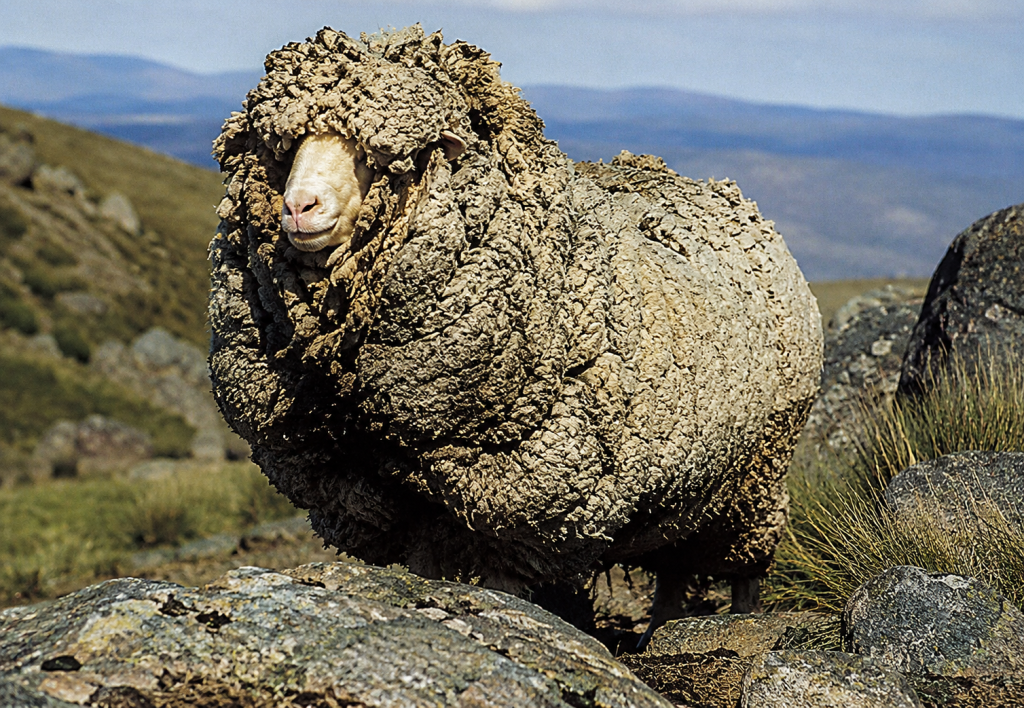
The animal appeared far too large and oddly shaped to resemble an ordinary sheep. Its body was hidden beneath an enormous mass of wool that had accumulated over many years, giving it the appearance of a living mound rather than a farm animal.
When farmers finally got close enough to identify it, they realized they had found a Merino sheep that had been missing for years.
The animal would soon become known around the world as Shrek, a sheep whose remarkable story would capture international attention and spark conversations about agriculture, animal welfare, genetics, and the long history of domestication.
What seemed like a humorous tale about a sheep avoiding a haircut was, in reality, a fascinating example of how deeply humans have shaped the animals they rely upon.
A Partnership Between Humans and Sheep That Began Thousands of Years Ago
To understand why Shrek’s story became so significant, it helps to look far beyond modern New Zealand.
Sheep were among the earliest animals domesticated by humans. Archaeological evidence suggests that the process began roughly 10,000 to 11,000 years ago in regions of the Near East during the rise of early agriculture.
The sheep that lived alongside those first farming communities looked quite different from many modern breeds. Their coats were closer to those of wild relatives and were naturally shed as seasons changed.
Over centuries, people selectively bred animals with desirable traits. Among the most valuable characteristics was wool production. Farmers repeatedly favored sheep that produced thicker, finer, and more abundant fleece.
Generation after generation, this process transformed the species.
The result was the emergence of highly specialized breeds, including one of the most famous wool-producing sheep in history: the Merino.
How Merino Sheep Became One of the World’s Most Valuable Breeds
The Merino breed is widely associated with exceptionally fine wool, prized for its softness, durability, and ability to regulate temperature.
Although historians continue to debate certain aspects of its origins, Merino sheep became strongly linked with Spain, where their wool was considered so valuable that export restrictions existed for centuries.
Eventually, Merino sheep spread across the globe, finding ideal conditions in countries such as Australia and New Zealand.
Their fleece became an important economic resource. Merino wool was used in everything from luxury garments to military uniforms and outdoor clothing, helping build major agricultural industries in the Southern Hemisphere.
The breed’s success, however, came with an unintended consequence.
As wool production increased through selective breeding, many sheep lost much of their natural ability to shed excess fleece on their own.
Why Modern Sheep Depend on Human Care
Wild sheep survive without annual grooming because nature provides a balance between coat growth and seasonal shedding.
Many modern wool breeds operate differently.
Selective breeding encouraged continuous wool production, creating animals capable of generating far greater quantities of fleece than their wild ancestors ever could. While this is beneficial for wool production, it also means that many domestic sheep require regular shearing to remain comfortable and healthy.
Without intervention, fleece continues growing year after year.
Excess wool can trap moisture, dirt, vegetation, and parasites. During warmer months, it may contribute to heat stress. Heavy fleece can also increase energy demands and reduce mobility, especially when wet.
Shrek became one of the most dramatic examples of what happens when that maintenance is absent for an extended period.
Six Years Hidden in the Mountains
Shrek lived at Bendigo Station in Central Otago before disappearing sometime in the late 1990s.
The region’s geography likely played a major role in his survival. Steep hillsides, rocky outcrops, and natural shelters create countless hiding places across the landscape.
Most experts believe the sheep simply avoided human contact and found refuge in remote areas where routine farm operations rarely reached.
Years passed without any sign of him.
While many assumed he was long gone, Shrek continued living independently in the rugged terrain, quietly accumulating more and more wool as time went on.
By the time he was rediscovered, he had become something few people had ever seen before.
The Shearing That Captured International Attention
After being found in 2004, Shrek underwent a shearing that quickly became a media event.
Television crews documented the process, and the images soon appeared in newspapers and broadcasts around the world.
What emerged during the shearing surprised nearly everyone.
Approximately 27 kilograms (around 60 pounds) of wool were removed from his body.
The amount was extraordinary compared with the fleece typically collected from a sheep that is shorn regularly. Reports at the time estimated that the wool could be used to produce enough fabric for roughly twenty men’s suits.
Perhaps the most striking moment came after the shearing was complete.
The massive creature that had seemed so enormous was revealed to be a much smaller sheep hidden beneath layers upon layers of fleece.
The before-and-after photographs quickly became iconic.
More Than a Curiosity: What Shrek Revealed About Selective Breeding
Scientists and agricultural specialists viewed Shrek’s story as more than a novelty.
His condition illustrated a fundamental principle of domestication: when humans selectively breed animals for specific traits, those animals often become increasingly dependent on human management.
The fleece covering Shrek was not the result of disease or an unusual mutation. It was the predictable outcome of centuries of breeding aimed at maximizing wool production.
In many ways, Shrek served as a living demonstration of how dramatically humans can influence the biology of domesticated species.
The same processes that created abundant wool also created a need for ongoing care.
Without shearing, the very trait that made Merino sheep valuable could become a burden.
From Missing Sheep to National Celebrity
Following his rediscovery, Shrek became one of New Zealand’s most recognizable animals.
His story resonated with the public because it combined humor, resilience, and a uniquely agricultural connection that many New Zealanders understood immediately.
He appeared at public events, participated in charity campaigns, and became a symbol of the country’s farming heritage.
One of his most memorable appearances took place at New Zealand’s Parliament, where the famous sheep received attention normally reserved for politicians and public figures.
For years, he remained a beloved cultural icon and a reminder of the important role sheep have played in shaping New Zealand’s economy and identity.
The Legacy of a Sheep That Changed How People Viewed Wool Animals
Shrek died in 2011 at approximately sixteen years of age, but his story continues to circulate around the world more than a decade later.
Part of its appeal comes from its simplicity. A sheep disappears, survives alone for years, and returns carrying an astonishing amount of wool.
Yet beneath that straightforward narrative lies a deeper lesson.
Shrek’s story highlights the profound relationship between humans and domesticated animals. It demonstrates how thousands of years of selective breeding can reshape a species and create dependencies that would never exist in the wild.
What began as a surprising discovery in the hills of Central Otago ultimately became a powerful illustration of humanity’s influence on the natural world.
Few animals have ever told that story as clearly as the sheep that vanished into the mountains and returned carrying nearly three decades’ worth of evidence on its back.