
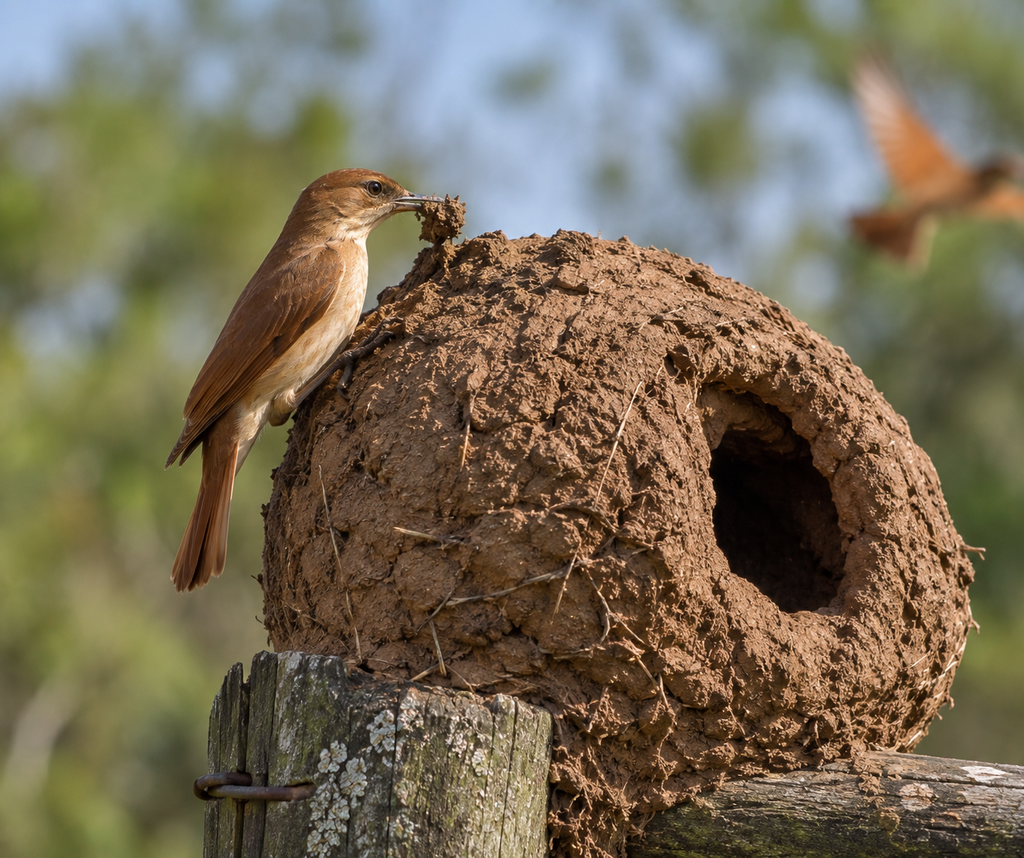
At first glance, the structure looks almost man-made: a rounded shell of hardened mud, a carefully positioned entrance and, hidden inside, a separate chamber where eggs can be protected.
Yet no hands, tools or architectural plans are involved.
The builder is the Rufous Hornero (Furnarius rufus), a South American bird weighing only around 60 grams. Working together, a pair can create a nest weighing several kilograms — in exceptional cases, roughly 80 times the weight of one of the birds.
But the remarkable engineering is only part of the story. Horneros can remain with the same partner for years, defend a territory together and perform coordinated duets carrying recognizable acoustic information about both individuals and pairs.
And despite investing so much effort in a remarkably durable home, they commonly build another one when a new breeding season arrives.
A bird named after an oven
The Rufous Hornero occurs across parts of South America, including Argentina, Uruguay, Paraguay, Bolivia and Brazil. It is particularly iconic in Argentina, where it is recognized as the national bird.
Its appearance is relatively understated. The bird has warm reddish-brown plumage, slender legs and a slightly curved bill. Males and females look very similar.
Its nest is anything but understated.
The Spanish word horno means “oven,” and the resemblance between the bird’s rounded mud nest and a traditional clay oven gave the hornero its name.
The comparison is immediately understandable when a completed nest is seen from the side: it looks less like the open cup most people associate with a bird’s nest and more like a miniature earthen building.
A 60-gram builder can produce a nest weighing several kilograms
Mud forms the bulk of the structure, combined with grasses and other organic material.
Building it requires persistence. The birds repeatedly collect small amounts of material, carry them to the construction site and incorporate them into the growing walls.
Scientific descriptions report walls approximately 3–5 centimeters thick, while a completed nest can weigh around 5 kilograms. Compared with a bird weighing roughly 60 grams, the largest nests can therefore approach 80 times the builder’s body mass.
As a simple scale comparison, multiplying the body weight of a 70-kilogram person by the same factor would produce something weighing well over five metric tons.
That does not mean the physiological effort is directly comparable between humans and birds. It simply illustrates how massive the structure is relative to the animal responsible for making it.
This is a construction project for two
The female is not left to build the nest alone.
Rufous Horneros are socially monogamous, and both members of the pair participate in nest construction. Their cooperation continues after the structure is finished, with both parents contributing to reproduction and care of their young.
How long construction takes varies considerably. Under favorable circumstances, nests can be completed surprisingly quickly, while other projects may continue for weeks or months.
Weather matters because suitable mud has to be available. Rain can therefore create particularly favorable building conditions by providing workable material close to the nesting territory.
Piece by piece, the birds turn that material into something far more elaborate than a simple pile of dried earth.
There is another wall hidden inside
The most interesting architectural feature may be invisible from outside.
A completed hornero nest is not simply a hollow sphere with a hole in the front. Inside is a partition separating the entrance area from the breeding chamber.
The eggs therefore do not sit directly in front of the opening.
This creates something loosely comparable to an entrance passage leading to a more secluded room. The comparison with human architecture should not be taken literally, but it helps illustrate just how different this structure is from the familiar open, bowl-shaped nests of many other birds.
The result is an enclosed and compartmentalized nesting space made largely from material collected from the ground.
Those thick walls may influence the temperature inside
Why would natural selection favor such an expensive construction project?
Protection from the outside world is an obvious possibility, but scientists have also investigated another property of the nest: its microclimate.
Researchers studying Rufous Hornero nests placed temperature sensors inside and outside the structures and recorded how conditions changed over time.
The interior showed smaller temperature fluctuations than the surrounding environment, and under some conditions it was also warmer. The findings suggest that the substantial walls can help create a more thermally buffered environment.
That does not mean the nest works as an autonomous incubator. The parents still incubate their eggs and care for their offspring.
Instead, the research suggests that the physical properties of the nest itself may contribute to the conditions experienced by developing eggs.
Are Rufous Horneros mates for life?
Calling the species monogamous requires an important qualification.
Rufous Horneros are socially monogamous. A male and female form a social pair, share a territory, cooperate in construction and raise offspring together. Pair bonds can persist across multiple breeding seasons.
That is not the same thing as saying every bird remains with one partner until death.
Partners can change.
Nor does social monogamy necessarily guarantee absolute genetic exclusivity. A genetic study of Rufous Horneros found extra-pair paternity in 4 of 120 offspring examined, or about 3.3%.
So the picture is more nuanced than the familiar phrase “mates for life”: long-lasting social partnerships occur, but lifelong partnership is not an absolute rule.
Their duets may carry something like an acoustic signature
Long-term partnerships raise another fascinating question: how do these birds distinguish familiar individuals?
Sound appears to contain remarkably rich information.
Rufous Horneros are famous for coordinated male-female duets. Each partner contributes differently to the performance, producing a complex joint vocalization rather than simply two birds singing independently at the same moment.
Researchers recently examined 471 duets from 43 pairs and found acoustic information that allowed both individuals and pairs to be distinguished.
In other words, the songs contain recognizable individual and pair-level vocal signatures.
Other experiments have shown that horneros can discriminate between the duets of neighboring pairs and unfamiliar birds.
It would be slightly too strong to turn those findings into the simple statement that “a hornero recognizes its mate by voice.” What the evidence does show is that their vocalizations contain information about individual and pair identity and that the birds themselves are capable of meaningful auditory discrimination.
Voice is therefore a highly plausible component of their social recognition system.
They keep singing together beyond the breeding season
The duet is not simply a courtship performance that becomes irrelevant once eggs appear.
Pairs vocalize together outside the immediate breeding context as well, and duetting is associated with maintaining and defending their shared territory.
That fits another important aspect of hornero biology.
These birds generally do not undertake the kind of long-distance seasonal migration that would carry them thousands of kilometers away from their nesting area.
They can remain on their territory throughout the year.
So do they migrate?
Rufous Horneros are generally regarded as resident birds rather than long-distance seasonal migrants.
Research following birds during breeding and non-breeding periods has found continued year-round use and defense of territories. Pair bonds can also persist for several years.
This produces an intriguing combination:
the territory can remain the same, the partner can remain the same, yet the next breeding nest may be new.
And that brings us to one of the strangest parts of their story.
Do they really build another nest after all that work?
Often, yes.
The usual pattern described for Rufous Horneros is to construct a new nest for a new breeding season, despite the enormous investment involved.
It is not an absolute rule. Older nests can sometimes be repaired and reused, so it would be inaccurate to say that every hornero abandons every nest after a single breeding season.
A nest may also support more than one reproductive attempt during the same season.
What should not be assumed, however, is that horneros routinely avoid construction by simply moving into another pair’s old home. Building is a defining feature of their reproductive behavior.
From a human perspective, starting again can seem extraordinarily wasteful. But natural selection does not favor a behavior because an animal has already invested effort in something. What matters is whether the behavior contributes to successful survival and reproduction.
The old house may remain standing for years
Mud might sound like a temporary building material, but some hornero nests are remarkably durable.
Field observations have documented old nests persisting for several years, with some structures surviving for around eight years.
Meanwhile, new construction may take place nearby. Over time, multiple mud “ovens” can therefore appear in the same area, and nests may occasionally be built in very close proximity to older structures.
What looks like a tiny collection of mud houses can effectively preserve evidence of several previous breeding seasons.
An old nest can still be useful
A nest that is no longer being used to raise the next brood is not necessarily worthless to its original builders.
Horneros have been observed using nests as shelter or roosting sites outside the breeding season, including under unfavorable weather conditions.
For that reason, even the word “abandoned” needs some qualification. A structure may no longer contain eggs or chicks while still remaining useful to the birds living within the territory.
And if the original builders truly stop using it, another animal may take an interest.
Other birds can inherit the architecture
A hardened hornero nest represents something extremely valuable in nature: an already constructed, enclosed cavity.
Other bird species have been documented using old Rufous Hornero nests for shelter or reproduction.
One particularly interesting example involves the Saffron Finch (Sicalis flaveola). Research cited in the ornithological literature found greater reproductive success when these birds used Rufous Hornero nests than when they nested in other types of cavities.
The horneros are obviously not building homes for other species intentionally. Nevertheless, their behavior can leave behind physical structures that become resources for other animals.
In that sense, the ecological life of the nest can extend well beyond the breeding attempt for which it was originally constructed.
Even the doorway reveals something surprising
Look at enough hornero nests and another pattern emerges: the entrance is not always positioned on the same side.
The nests show left-right asymmetry.
Research published in Current Biology found that this asymmetry is not entirely random and that individual building tendencies can be repeatable.
More recent work took the question further. In a large-scale study published in 2026, researchers analyzed more than 12,000 photographs of Rufous Hornero nests and investigated whether nearby physical structures influenced nest architecture.
They found an association between lateral structures beside a nest and the side on which its entrance was constructed.
The implication is fascinating. Horneros are not necessarily executing one completely inflexible architectural program regardless of their surroundings. Features of the construction site can help shape the final building.
A new home without ever really leaving home
The Rufous Hornero story begins with something that already seems extraordinary: a tiny bird carrying mud in its bill.
But the closer scientists look, the richer the story becomes.
Two birds can maintain a social partnership for years. They cooperate on a structure weighing dozens of times more than either bird. They create an enclosed breeding chamber behind an internal partition. They defend a shared territory and perform coordinated duets carrying information about individual and pair identity.
They may remain in that same territory throughout the year.
And when another breeding season arrives, they often begin building again.
The previous mud house may remain standing for years. It might still provide shelter, become occupied by another species or simply sit beside structures created in later seasons.
Then somewhere nearby, the process begins once more: a small mouthful of wet earth, followed by another, and another, until two birds weighing only a few dozen grams have created a structure weighing several kilograms.
What initially looks like an unusual bird nest turns out to be something much more interesting — a remarkable intersection of animal architecture, cooperation, communication and adaptation.