
A Town That Lost Almost an Entire Community
Today, the small Romanian town of Șimleu Silvaniei is quiet and unassuming. Few visitors realize that before World War II it was home to one of the most vibrant Jewish communities in northern Transylvania. Synagogues stood at the center of community life, Jewish-owned businesses were woven into the local economy, and families planned their futures much as they did elsewhere across Europe.
Among those families were Zvi and Rosalia Csengeri and their twin daughters, Yehudit and Lea, born on June 6, 1937.
At the time of their birth, Europe was already changing. Political extremism was spreading, antisemitism was becoming institutionalized in several countries, and forces were gathering that would soon reshape the continent. Yet for the Csengeri family, life still revolved around ordinary concerns: work, faith, education, and raising children.
Within a few years, that world would disappear.
The story of Yehudit and Lea is not simply a story of survival. It is a story that reveals how the Holocaust unfolded at the level of individual lives—one family, one mother, and two children caught inside one of history’s most destructive systems.
When the Political Became Personal
The transformation of northern Transylvania began long before the deportations.
In 1940, following the Second Vienna Award, the region was transferred from Romania to Hungary. For local Jewish communities, the change brought increasingly restrictive antisemitic legislation. Rights were gradually reduced, professional opportunities disappeared, and social exclusion became part of daily life.
For many families, the erosion of freedom happened step by step rather than all at once.
In 1942, Yehudit and Lea’s father, Zvi Csengeri, was conscripted into a Hungarian forced-labor battalion. These units were primarily used for Jewish men and were notorious for their brutal conditions. Assigned dangerous work near military operations, labor servicemen faced hunger, disease, exposure, and violence.
Thousands never returned.
Zvi was sent to Ukraine, leaving Rosalia—known as Rosie—to care for the twins alone.
The family had no way of knowing whether they would ever see him again.
The Spring of 1944
On March 19, 1944, Nazi Germany occupied Hungary.
What followed was one of the fastest deportation campaigns of the Holocaust. Historians continue to view it as a chilling example of how quickly a modern bureaucracy can be mobilized for mass persecution.
Within weeks, ghettos were established, Jewish property was confiscated, and deportation trains were organized across Hungary and the territories under Hungarian control.
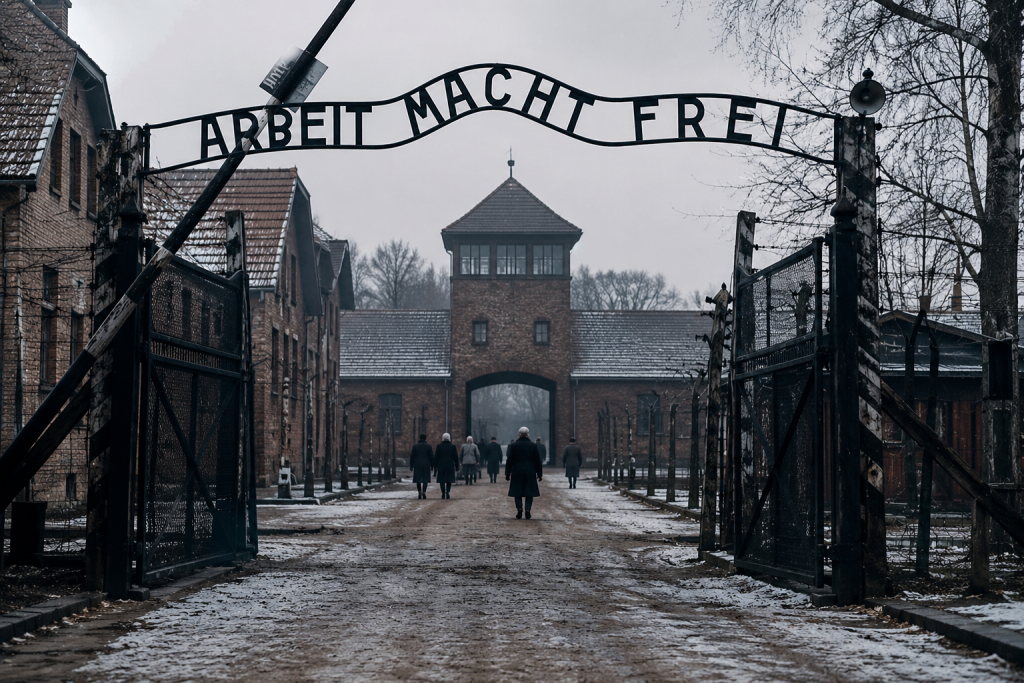
Between May and July 1944, approximately 437,000 Jews were deported to Auschwitz-Birkenau.
Most were murdered shortly after arrival.
Rosie and her daughters were among those caught in this operation.
Before being deported, Rosie managed to send a postcard to her husband. It was a simple act, but one filled with uncertainty. She did not know whether he was alive, whether she and the girls would survive, or whether the family would ever be reunited.
The Journey Into the Unknown
Like countless others, the Csengeri family was transported in overcrowded cattle cars.
The journey was marked by thirst, fear, and confusion. Information was scarce, rumors spread constantly, and many deportees still hoped they were being relocated for labor rather than sent to a death camp.
Among the passengers on their transport were sixteen pairs of twins.
It was a detail that would ultimately save Yehudit and Lea from immediate execution.
When the train finally arrived at Auschwitz-Birkenau, the new arrivals stepped into a world governed by speed, violence, and arbitrary decisions. Families were separated within minutes. Guards shouted orders. Dogs barked. Searchlights illuminated the platform.
Most people had no idea that their fate would be determined in seconds.
The Selection Ramp
For the majority of Jewish children arriving at Auschwitz, survival was unlikely.
Those considered incapable of labor were typically sent directly to the gas chambers. Young children almost always fell into that category.
But twins occupied a special place within the camp’s hierarchy of cruelty.
As soon as SS personnel recognized Yehudit and Lea as identical twins, they were removed from the normal selection process and identified for a separate program overseen by SS physician Josef Mengele.
That decision spared their lives.
At least for the moment.
Why Mengele Was Obsessed With Twins
Josef Mengele remains one of the most infamous figures associated with Auschwitz, yet modern historians caution against viewing him as a brilliant scientist.
Although he possessed academic credentials and medical training, much of his work at Auschwitz lacked scientific rigor. Many of his experiments were driven less by genuine research and more by Nazi racial ideology.
Twins were central to his interests because Nazi leaders believed genetic research could help them understand heredity and potentially increase the birth rate of what they considered the “ideal” population.
To Mengele, twins represented a unique opportunity to compare two individuals with nearly identical genetic backgrounds.
To the children selected for his experiments, however, they represented something very different.
Survivors later described repeated examinations, blood draws, injections, measurements, photographs, and procedures whose purposes were often never explained.
Modern medical historians generally agree that the scientific value of these experiments was extremely limited. Their lasting legacy lies not in medical advancement but in the suffering inflicted on vulnerable children.
Roughly 1,500 sets of twins are believed to have entered Mengele’s program.
Only a fraction survived the war.
Rosie’s Determination
If there is a central figure in this story, it is not Mengele.
It is Rosie Csengeri.
Inside a camp specifically designed to destroy families, she refused to abandon her daughters.
She fought to remain close to them, taking on grueling work assignments and enduring conditions that would have broken many people. Her determination provided the twins with something extraordinarily rare in Auschwitz: the continued presence of a parent.
Researchers studying survivor testimonies have frequently noted the importance of emotional bonds in helping prisoners endure extreme circumstances. For Yehudit and Lea, Rosie’s presence became a source of strength in an environment built on isolation and fear.
The cost was enormous.
According to family accounts, Rosie was punished after attempting to intervene on behalf of her daughters. She received injections that severely affected her health, eventually causing hearing loss and significant speech difficulties.
Even then, she continued fighting for her children’s survival.
Several times, she narrowly escaped selections that could have sent her to the gas chambers.
Against overwhelming odds, she survived.
The Collapse of Auschwitz
By early 1945, the Third Reich was retreating on all fronts.
Soviet forces were advancing toward Auschwitz, and camp authorities began evacuating prisoners westward in what became known as the death marches.
Thousands died from exposure, exhaustion, starvation, or execution during these forced evacuations.
Many of the children used in medical experiments, however, were left behind.
Yehudit and Lea were among them.
On January 27, 1945, Soviet troops entered Auschwitz and liberated the camp. They found approximately 7,000 surviving prisoners, many of them sick, starving, and barely alive.
The images captured in the aftermath would become some of the most powerful evidence of Nazi crimes ever recorded.
For the twins from Șimleu Silvaniei, liberation marked the beginning of a new and uncertain chapter.
Rebuilding a Life After the Holocaust
Freedom did not immediately bring stability.
Europe was in ruins. Millions of people were displaced, and families across the continent searched desperately for relatives whose fates remained unknown.
For a time, Rosie and the twins lived in Katowice, Poland.
There, Rosie learned about another pair of twin sisters who had survived Mengele’s experiments: Eva and Miriam Mozes.
Despite her own fragile condition, she chose to care for them as well, bringing them into her household alongside her daughters.
It was an extraordinary act of compassion from a woman who had already endured more than most people could imagine.
Eventually, the family returned to Romania.
What happened next was something increasingly rare in postwar Europe.
A reunion.
Against all expectations, Zvi Csengeri had survived forced labor and returned home.
The twins recognized him immediately. Throughout the war, Rosie had preserved photographs of their father and continued showing them to the girls whenever possible, determined that they would not forget his face.
In a period defined by separation and loss, that small act of memory became a bridge back to family.
A Future the Nazis Failed to Destroy
The years that followed were devoted to rebuilding.
The twins returned to school. Their younger brother, Michael, was born. Gradually, the family began creating a future that once seemed impossible.
In 1960, they emigrated to Israel, joining many Holocaust survivors who chose to start new lives there.
Yehudit and Lea grew up, married, and built families of their own.
In many ways, that may be the most important part of their story.
The Holocaust was not only an attempt to murder individuals. It was an attempt to erase entire communities, family lines, cultures, and futures.
When the twin sisters stepped off a train at Auschwitz in 1944, few would have imagined they would survive. Fewer still could have imagined that future generations would one day carry their family name forward.
Today, visitors to the Holocaust Memorial Museum in Șimleu Silvaniei can learn about a community that was nearly destroyed during the war.
Among the countless stories preserved there is that of two young girls who survived one of the darkest chapters in human history.
Their survival was not inevitable.
It was not the result of luck alone.
It was shaped by resilience, by the determination of a mother who refused to give up, and by the extraordinary will to live that carried a family through events designed to extinguish it.
That is why the story of Yehudit and Lea Csengeri continues to matter—not only as a Holocaust testimony, but as a reminder of what can endure even in the face of unimaginable loss.