
A child falls off a bicycle and lands face-first on the pavement. The chin takes the impact. There are a few tears, perhaps a scrape, and then life goes on.
The next day, however, something unexpected appears.
Not on the chin.
Not where the accident happened.
Instead, a dark bruise begins to form near the ear.
To most people, that seems impossible. If the injury occurred at the front of the jaw, why would the visible signs show up somewhere else entirely? It is the kind of detail that often causes confusion among patients and concern among parents.
Yet doctors have been observing this phenomenon for generations. Far from being unusual, it reveals something remarkable about the way the human body handles force, injury, and healing.
The answer lies deep within the structure of the jaw itself.
More Than Just a Chin
Most of us think of the chin as a small, isolated part of the face. Anatomically, however, it is only the front end of a much larger structure.
The lower jaw, or mandible, is the largest and strongest movable bone in the skull. It extends from the chin all the way back toward the ears, where it connects to the skull through the temporomandibular joints, commonly known as the TMJs.
These joints sit just in front of the ears and allow us to perform countless everyday actions, from chewing and speaking to yawning and swallowing.
Because the mandible forms a continuous structure, an impact to one end of the bone can affect areas far away from the point of contact.
That fact puzzled physicians long before modern medical imaging existed.
The Clues That Early Surgeons Could Not Ignore
During the nineteenth century, surgeons began documenting patterns they repeatedly encountered in patients who had suffered facial injuries.
People who fell directly onto their chins often complained of pain near their ears. Some developed swelling in that region. Others experienced difficulty opening their mouths despite having no visible injury around the jaw joints themselves.
Even more surprising were cases in which fractures occurred not at the point of impact, but near the back of the jaw.
At first glance, these injuries seemed counterintuitive. Common sense suggested that damage should occur where the force was applied.
Clinical observations told a different story.
As medical records accumulated, a consistent pattern emerged: injuries to the chin could produce effects far from the original impact site.
The challenge was understanding why.
How Force Travels Through Bone
Modern biomechanics eventually provided the explanation.
Although bones appear rigid, they are not passive structures. When subjected to a significant force, they distribute stress throughout their framework.
Engineers often compare this process to striking one end of a metal bar. The energy does not remain confined to the point of impact. Instead, it travels through the entire structure, creating stress and vibration along the way.
The mandible behaves in a similar fashion.
When a person receives a strong blow to the chin, the force is transmitted along the length of the jaw toward its posterior ends. These ends, known as the mandibular condyles, are pushed against the temporomandibular joints located near the ears.
In many cases, the surrounding tissues absorb the force without consequence.
Sometimes, however, small blood vessels rupture. Soft tissues become bruised. Minor bleeding beneath the skin can occur in areas that were never directly struck.
The result is a bruise appearing near the ear even though the original impact occurred several inches away.
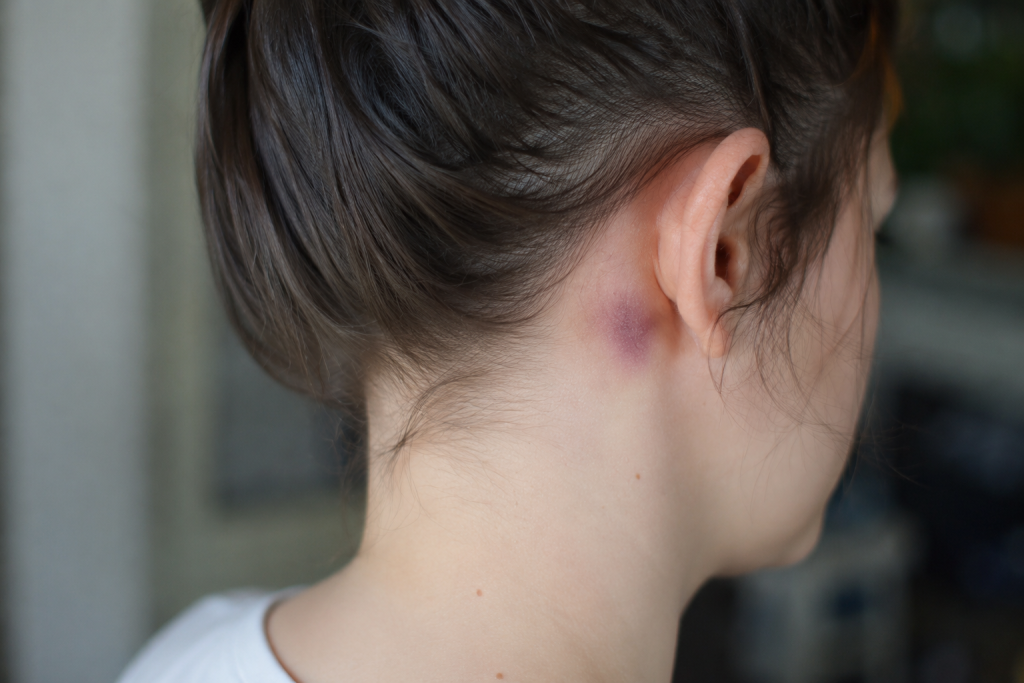
What seems like a contradiction is actually a predictable outcome of human anatomy.
Why the Bruise Often Appears Later
Another aspect of this phenomenon can be equally confusing.
The injury happens immediately, but the bruise may not appear until hours later or even the following day.
This delay occurs because a bruise is not the injury itself. It is the visible result of blood leaking from damaged vessels into surrounding tissues.
That process takes time.
As blood gradually spreads through connective tissue layers, discoloration becomes visible beneath the skin. Depending on the location and severity of the injury, the final bruise may appear some distance away from where the damage initially occurred.
The same principle explains why nasal fractures can produce black eyes or why scalp injuries sometimes lead to bruising around the eyelids.
The body does not always reveal trauma in a straightforward way.
Hidden Injuries and What Doctors Learned
Throughout the twentieth century, advances in radiology and facial surgery revealed another important lesson.
In some patients—particularly children—a seemingly minor impact to the chin could cause fractures near the jaw joints rather than at the front of the face.
Externally, the injury might look insignificant. A small scrape on the chin could be the only obvious sign.
Internally, however, the force may have caused damage much farther back along the jaw.
These discoveries changed the way physicians evaluate facial trauma. Instead of focusing solely on the visible injury, doctors learned to consider how force moves through the entire skeletal structure.
Today, pain near the ear following a chin injury is recognized as a clue that warrants careful assessment, even when the chin itself appears relatively unharmed.
Why Forensic Specialists Pay Close Attention
This understanding has also become important in forensic medicine.
Television dramas often portray injuries as simple pieces of evidence that immediately reveal what happened. Real life is rarely that straightforward.
Forensic experts know that bruises do not always develop where an impact occurred. Blood can migrate through tissues. Mechanical forces can be transmitted through bones. Visible injuries may represent only part of a much larger picture.
That is why specialists evaluate trauma within the context of anatomy, medical imaging, clinical findings, and the circumstances surrounding an injury rather than relying solely on photographs.
The location of a bruise can provide valuable information, but it does not always tell the entire story.
When a Bruise Near the Ear Requires Medical Attention
While force transmission through the jaw is a well-documented phenomenon, doctors also recognize that bruising around the ear can occasionally signal something more serious.
In the late nineteenth century, British surgeon William Henry Battle described a distinctive bruise that appears behind the ear following certain skull base fractures. This finding later became known as Battle’s sign.
Although uncommon, it serves as an important reminder that not all bruises in this region have the same cause.
For that reason, any head injury accompanied by symptoms such as loss of consciousness, severe dizziness, vomiting, confusion, visual disturbances, or bleeding from the ear should be evaluated promptly by a medical professional.
The surrounding circumstances matter just as much as the bruise itself.
A Reminder That the Body Is More Complex Than It Appears
At first glance, a bruise near the ear after a blow to the chin seems to defy logic.
In reality, it demonstrates the extraordinary complexity of the human body.
Bones transmit force. Blood vessels respond to trauma. Soft tissues guide the movement of blood beneath the skin. Together, these processes can create visible effects far from where an injury began.
It is one of many examples showing that the body does not always follow the assumptions we make based on appearances alone.
Sometimes the most obvious mark of an injury is not found where the story started—but where anatomy ultimately decides to reveal it.