
For many children, getting to school is such an ordinary part of the day that the journey barely registers. A short walk, a bus ride, perhaps a few minutes in the family car, and the school day begins.
For three young sisters living in a remote part of Nicaragua, reaching the classroom once meant something entirely different.
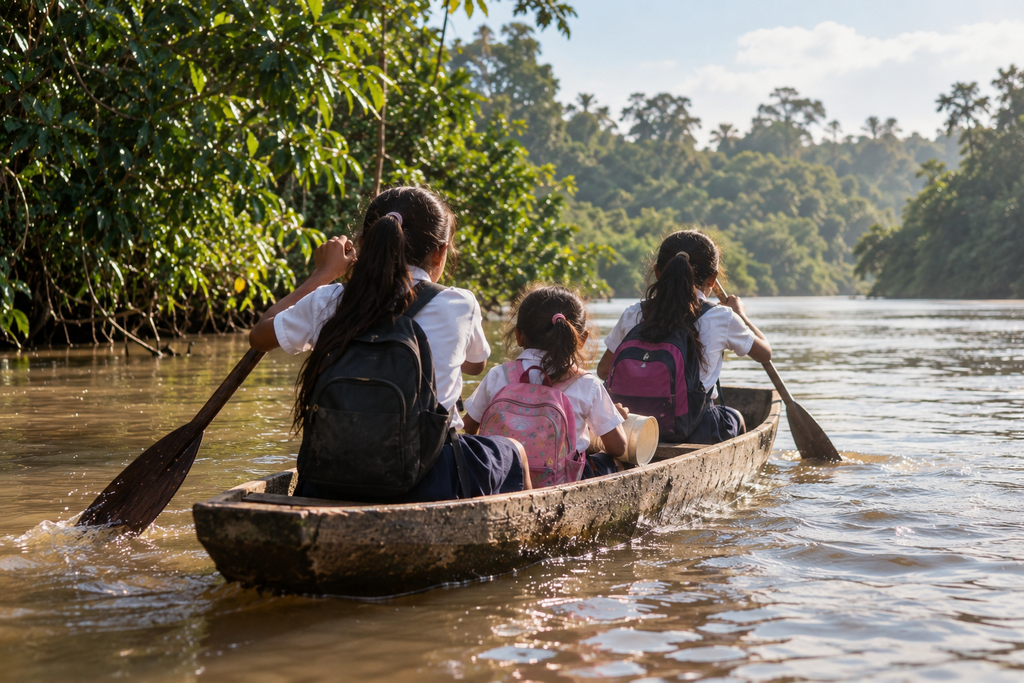
Kenya was nine years old, Julia was seven, and Yulissa was only five when their daily journey was documented. Instead of waiting for a school bus, the girls climbed into a traditional wooden canoe and paddled for roughly three kilometers through mangroves and along the Río Escondido.
The trip could take more than an hour.
Their canoe was old enough to let water seep inside, and the youngest sister had an important job during the crossing: removing that water before too much accumulated in the boat.
There was another unsettling detail. At the time she was filmed, five-year-old Yulissa could not swim.
The scenes have resurfaced repeatedly on social media, where they can easily look like a recent viral story. They are real, but they are not new. The sisters appeared in the Nicaragua episode of the documentary series The Most Dangerous Ways to School, released in 2016.
Behind those striking images is a story that is less about extraordinary children than about something much more fundamental: how dramatically a child’s access to education can depend on geography.
Their school day began long before they reached a classroom
The girls lived with their family in an isolated area of eastern Nicaragua, where waterways were part of everyday transportation.
School mornings did not begin simply with getting dressed and picking up a backpack. The children also had responsibilities at home, including helping with household chores and caring for the family’s animals.
Only then could the journey to school begin.
The canoe used by the sisters was a traditional wooden vessel measuring roughly five meters. Moving it required considerable effort from the older girls. Once they were on the water, each child had a role.
Kenya, the eldest, helped control the canoe. Julia paddled alongside her. Yulissa helped remove the water that continuously found its way inside.
The first part of the route led through dense mangrove vegetation. The sisters had to navigate narrow waterways before eventually reaching the broader Río Escondido.
What looks almost peaceful from a distance was far less simple from inside the canoe. Overhanging vegetation could conceal insects, spiders and snakes, while the condition of the boat itself demanded constant attention.
For their mother, however, one concern outweighed many of the others: her youngest daughter did not know how to swim.
Three sisters who depended on one another
One of the most revealing aspects of their story is that school attendance was not entirely an individual decision.
The girls depended on one another to complete the journey.
If one of the sisters became ill and could not make the trip, it could prevent the others from attending as well. There was no convenient alternative waiting nearby, no second transportation route that could easily replace the canoe.
This changes the meaning of something as ordinary as missing a day of school.
In a city, a child might miss class because of illness and return the following day. In an isolated community, the illness of one family member could disrupt several children’s access to education because transportation itself depended on their cooperation.
Their journey illustrates an important distinction: having a school in a region is not necessarily the same thing as having practical access to education.
After the river came the classroom
Eventually, the sisters reached San Mariano, where their small school was located.
Their work was not finished when the canoe touched land. They had to pull the heavy boat far enough onto the riverbank to prevent rising water from carrying it away while they were in class.
Losing the canoe would not merely have meant losing a possession. It would have meant losing their way home.
The sisters also shared a backpack. After traveling through rain, river spray and a canoe that admitted water, arriving with damp clothes or school materials was hardly surprising.
The documentary portrays a school serving children from a geographically scattered community, some of whom faced difficult journeys simply to reach their lessons.
And the sisters were not the only students whose commute presented serious challenges.
The children arriving by land faced different obstacles
The same documentary follows another student, an 11-year-old boy whose route to school took him for approximately three kilometers through the jungle.
His journey did not involve a leaking canoe, but that did not necessarily make it easy. Snakes were among the hazards children could encounter along the route, particularly in a tropical environment where heavy rain and dense vegetation shape everyday movement.
The comparison is useful because it shows why distance alone tells us surprisingly little.
Three kilometers on a paved sidewalk is one journey.
Three kilometers through tropical vegetation is another.
Three kilometers in a wooden canoe on a river is something else entirely.
When researchers discuss access to education, therefore, the number of kilometers separating a child’s home from a school tells only part of the story. Roads, transportation, weather, safety and family resources determine what those kilometers actually mean.
The viral footage is about a decade old
This is an important piece of context that is frequently lost when clips from the documentary circulate online.
The girls shown in these images are not currently five, seven and nine years old.
The Nicaragua episode of The Most Dangerous Ways to School dates from 2016. Apple TV lists the episode with a September 30, 2016 release date. The Most Dangerous Ways to School: Nicaragua on Apple TV
That distinction matters.
Social media has a way of separating powerful footage from its original date and context. A clip may suddenly reach millions of people years after it was filmed, giving viewers the impression that they are watching events happening now.
In this case, the underlying story is authentic, but the footage documents the sisters’ childhood approximately a decade ago.
It should therefore be understood as a record of their lives at that time rather than as evidence of their present circumstances.
Their mother’s story adds another layer
Perhaps one of the most meaningful parts of the documentary is not the river crossing at all.
The girls’ mother had not learned to read or write.
She understood the risks involved in sending her daughters across the water and worried about them while they were away. Yet education represented something she wanted her children to have precisely because she had not had the same opportunity herself.
That makes the daily crossing more complicated than a simple story about courageous children.
The girls were not paddling across the river because they wanted an adventure. Their family was accepting a difficult journey because the classroom on the other side offered something they considered worth pursuing.
For the sisters, education meant access to knowledge their mother’s generation had been denied.
The wider issue was never just one canoe
The circumstances shown in the documentary also fit into a broader historical picture of educational inequality between urban and rural Nicaragua.
World Bank material examining education in the country during the period surrounding the documentary identified substantial differences between rural and urban students. Historical figures cited by the institution showed, for example, that lower-secondary net enrollment in 2010 was about 28 percent in rural areas compared with 61 percent in urban areas. Distance from educational facilities was also recognized as an obstacle affecting children in rural communities. World Bank education report on Nicaragua
Those numbers are historical and should not be presented as a description of Nicaragua today. Their value is in helping us understand the environment in which the sisters’ story was filmed.
UNICEF has likewise worked on expanding educational opportunities for vulnerable and rural children in Nicaragua, illustrating that physical access to schooling is part of a much larger development challenge. UNICEF: All Children Learn in Nicaragua
The canoe, in other words, makes the problem visible. It does not define the entire problem.
There is a danger in turning hardship into inspiration
Stories like this often acquire a particular message when they travel across social media: Look how determined these children are. They will do anything to go to school.
Their determination deserves recognition.
But there is another conclusion worth considering.
A child’s ability to endure an obstacle does not make that obstacle acceptable.
A leaking canoe should not have to become a test of commitment to education. A dangerous journey through a remote landscape should not be romanticized simply because children prove capable of completing it.
Celebrating resilience without discussing why so much resilience is required can obscure the real issue.
The remarkable part of the sisters’ story is not that children can adapt to difficult circumstances. Children all over the world do that every day.
The important question is why the circumstances are so different in the first place.
The real distance to school cannot always be measured in kilometers
On a map, three kilometers can look insignificant.
But distance changes depending on who must travel it and what lies between the starting point and the destination.
For one child, three kilometers may mean a comfortable bus ride.
For another, it may mean a jungle path after heavy rain.
For Kenya, Julia and Yulissa, it meant climbing into a wooden canoe, navigating mangroves, reaching a major river and continually dealing with water entering the boat before they could sit down for their first lesson.
And when school ended, the journey had to be made again in reverse.
That is perhaps why footage of the three sisters continues to resonate years after it was recorded. It turns an abstract idea — unequal access to education — into something immediately understandable.
There is a school.
There are children who want to attend it.
And yet between their home and the classroom lies an obstacle that millions of other children never have to consider.
The distance to education, after all, has never been measured only in kilometers.