
You’ve probably noticed it many times.
You stay in the bath, a pool, or even washing dishes for a while, and suddenly your fingertips look wrinkled — almost like your skin aged ten years in a few minutes.
It seems like a small, harmless detail. But your body has actually triggered a surprisingly interesting biological mechanism.
For a long time, people believed the explanation was simple: your skin absorbs water, swells up, and that’s why wrinkles appear. But modern research shows that the reality is more complex. What we see on our fingers isn’t just “water-soaked skin.” It’s actually an active response controlled by the autonomic nervous system — the same system that regulates things you don’t consciously control, like heart rate, sweating, and the tightening or relaxation of blood vessels.
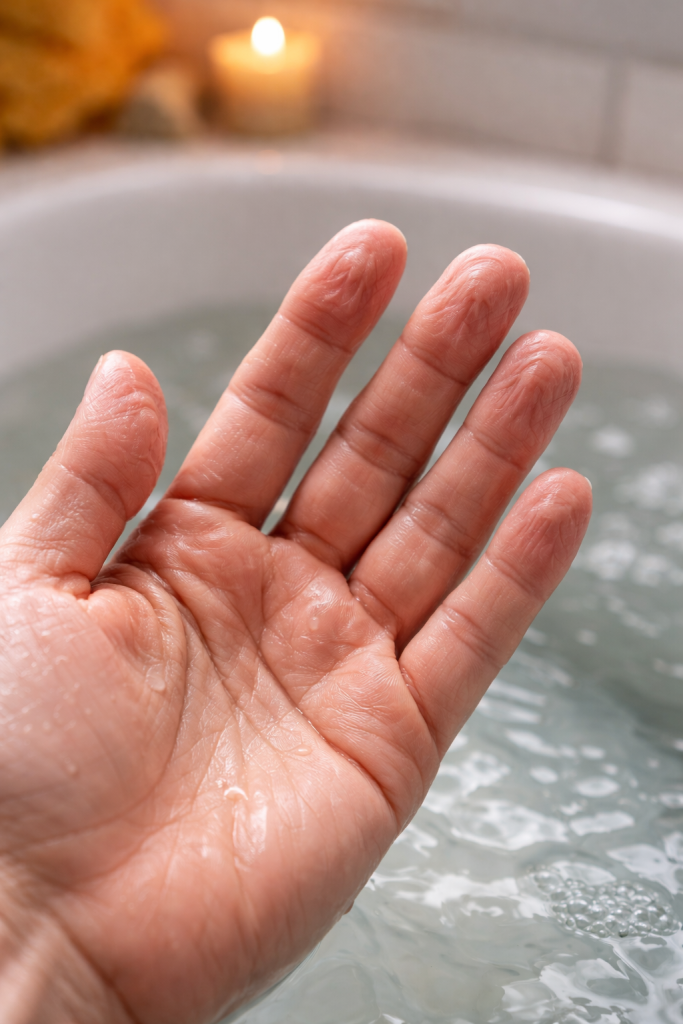
When your fingers stay in water for several minutes, especially warm water, the tiny blood vessels inside the fingertips begin to constrict. In other words, the body slightly reduces the volume of tissue beneath the skin. The outer layer of skin remains the same size, but the tissue underneath shrinks a bit. Because of that mismatch, the skin begins to fold into small ridges and grooves.
That’s why the skin on your fingertips wrinkles.
Interestingly, this happens mainly on the fingers and toes. The skin on the palms and soles is structurally different from the rest of the body — it’s thicker and specialized for grip and contact.
This leads to an intriguing question: why would the body do this at all?
One widely discussed explanation is that wrinkled skin may actually improve your grip on wet objects. Scientists have compared the wrinkles on fingertips to the grooves in tire treads, which help channel water away from the surface. The wrinkles may help water drain away from the skin, allowing you to hold slippery objects more securely.
Experiments have shown that people can sometimes handle wet objects more efficiently when their fingers are wrinkled compared to when they are smooth.
So rather than being a flaw, the wrinkling may actually be an evolutionary adaptation that helps the hand function better in wet environments.
The effect doesn’t look exactly the same in everyone. In children, it’s often noticed quickly because their skin is soft and smooth. In younger and middle-aged adults, the response is usually clear and easy to see. In older adults, the reaction can be less pronounced because skin elasticity and structure change with age.
Other factors can also influence how quickly the skin wrinkles — including hydration, water temperature, and how long the skin stays submerged.
There’s also a curious medical detail: because this process depends on certain nerve signals, doctors have sometimes used water-induced wrinkling as an indirect way to observe how well specific nerve pathways are functioning. If the skin doesn’t wrinkle at all under certain conditions, it may sometimes suggest changes in nerve function.
In other words, when the skin on your fingers wrinkles in water, your body isn’t malfunctioning. It’s adjusting. Tiny blood vessels tighten, the skin forms ridges, and your hands may actually become better suited for gripping objects in a wet environment.
It’s one of those small everyday details that seem odd at first — but quietly reveals how complex and adaptive the human body really is.