
There’s a point when you start to notice that your nails aren’t what they used to be.
It doesn’t happen overnight. There’s no single moment you can point to.
But something feels different.
They peel more easily.
They break without much force.
They catch on fabrics or hair.
They seem thinner — or sometimes oddly rigid and prone to snapping.
And the usual explanation is simple:
“I just have weak nails.”
But what you’re seeing on the surface is only the end result of processes happening deeper inside your body.
What a Nail Really Is — And Why It Reflects More Than You Think
A nail isn’t just a hard, lifeless layer.
It’s made primarily of keratin — a structural protein also found in hair — produced continuously in a living area called the nail matrix, located at the base.
This is where new cells are formed, pushed forward, and compacted into the nail plate.
Healthy nails depend on:
– proper function of the nail matrix
– efficient protein production
– strong cohesion between keratin layers
When any part of this process is disrupted, the effects become visible.
Why Nails Become Brittle
Brittle nails rarely have a single cause.
In most cases, it’s the result of multiple overlapping factors.
One of the most common is dehydration.
Repeated exposure to water, detergents, and cleaning agents causes the nail to lose its ability to retain moisture. Over time, its structure becomes less flexible and more prone to splitting.
This is why nails often become weaker in environments with constant wet–dry cycles.
The Role of Nutrients and Internal Balance
For nails to remain strong, your body needs the right building blocks.
Deficiencies can directly affect their structure:
– iron → can lead to thinner, sometimes spoon-shaped nails
– biotin → often associated with increased fragility
– zinc → plays a role in cellular repair
– protein → essential for keratin formation
Your body prioritizes vital organs first.
Nails are not a priority.
So when resources are limited, their quality is often one of the first things to change.
Hormones, Stress, and Growth Patterns
Hormonal balance influences how nails grow and regenerate.
Shifts can lead to:
– slower growth
– weaker structure
– changes in texture
Chronic stress also plays a role.
It can affect circulation and cellular turnover, including in the nail matrix.
Even though you don’t feel it directly, the impact becomes visible over time.
The Everyday Micro-Damage You Don’t Notice
Your nails go through constant small stresses:
– minor impacts
– pressure
– using nails as tools
– frequent manicures or product removal
Individually, these don’t seem significant.
But over time, they accumulate and weaken the nail’s structure.
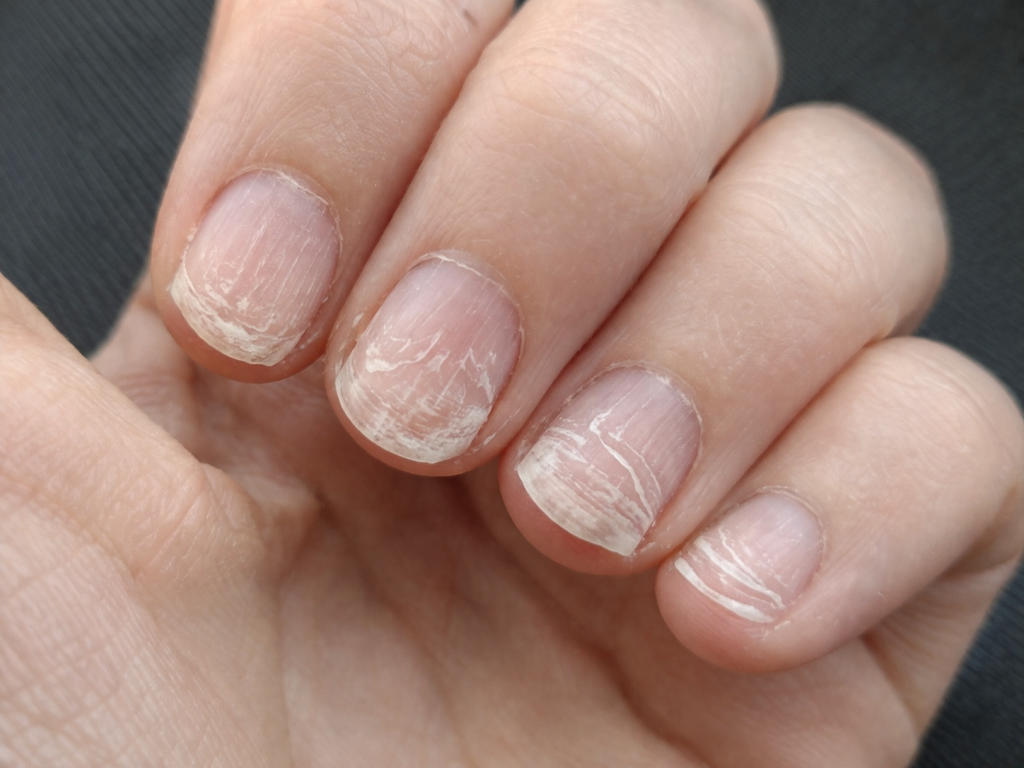
Why Nails Start Peeling in Layers
When nails begin to split into thin layers, it means the keratin structure is no longer tightly bound.
The layers separate.
And the nail loses its integrity.
This isn’t just cosmetic — it’s a sign that the structure itself has been compromised.
Differences by Age and Sex
Nail characteristics change throughout life.
Women tend to report brittle nails more often, partly due to greater exposure to water, cleaning products, and cosmetic treatments.
Men generally have thicker nails, but they can become more brittle with age.
As we get older:
– nail growth slows (on average about 2–3 mm per month for fingernails)
– full regrowth can take 4–6 months
– nails may become more rigid and prone to breaking
These changes are gradual, but noticeable.
External Factors That Quietly Affect Nail Health
Certain habits and products can weaken nails over time:
– frequent use of acetone
– repeated gel or semi-permanent polish removal
– harsh chemicals
– lack of protective care in wet environments
These don’t damage nails instantly, but they affect their structure over repeated exposure.
Is It Just Cosmetic — Or a Sign of Something More?
In many cases, brittle nails are caused by external factors.
But sometimes, they can reflect internal changes such as:
– nutritional deficiencies
– thyroid imbalances
– reduced circulation
– dermatological conditions
Nails don’t diagnose conditions.
But they can signal that something has shifted.
What You Don’t See Beneath the Surface
When a nail breaks or peels, several processes are already at play:
– weakened keratin structure
– altered cell production
– subtle internal imbalances
– repeated external stress
It’s not a sudden event.
It’s the visible outcome of a longer process.
Not Random — But Not a Reason to Panic
Brittle nails don’t happen without a cause.
But they also don’t automatically mean something is seriously wrong.
Most of the time, they reflect how your body is responding to its environment and available resources.
What Your Body Might Be Telling You
Your body doesn’t prioritize appearance.
It prioritizes function.
And nails are often one of the first places where small imbalances become visible.
Not as a warning.
But as a quiet signal.
That your body is adapting, adjusting, and responding — even in the smallest details.