
Most of the time, blood moves through your body without you ever noticing it. It flows continuously, adapting to every movement, every heartbeat. But there are moments when, in a place you can’t see or feel, that flow suddenly slows down—or even stops. A clot begins to form. Small at first, almost insignificant, yet capable of blocking a blood vessel entirely. In that moment, a process meant to protect you can quietly turn into a risk.
Why blood clots exist in the first place
Clot formation is part of a vital process known as blood clotting. Whenever a blood vessel is injured, your body has to act fast to prevent blood loss.
Platelets quickly gather at the site and form an initial plug. At the same time, a cascade of chemical reactions creates fibrin, a protein that acts like a mesh, stabilizing the plug and turning it into a firm clot.
In this context, a clot is not a problem—it’s protection.
When a protective mechanism becomes a problem
The situation changes when this process starts without a real injury. Instead of sealing a wound, the clot begins to obstruct normal blood flow inside a healthy vessel.
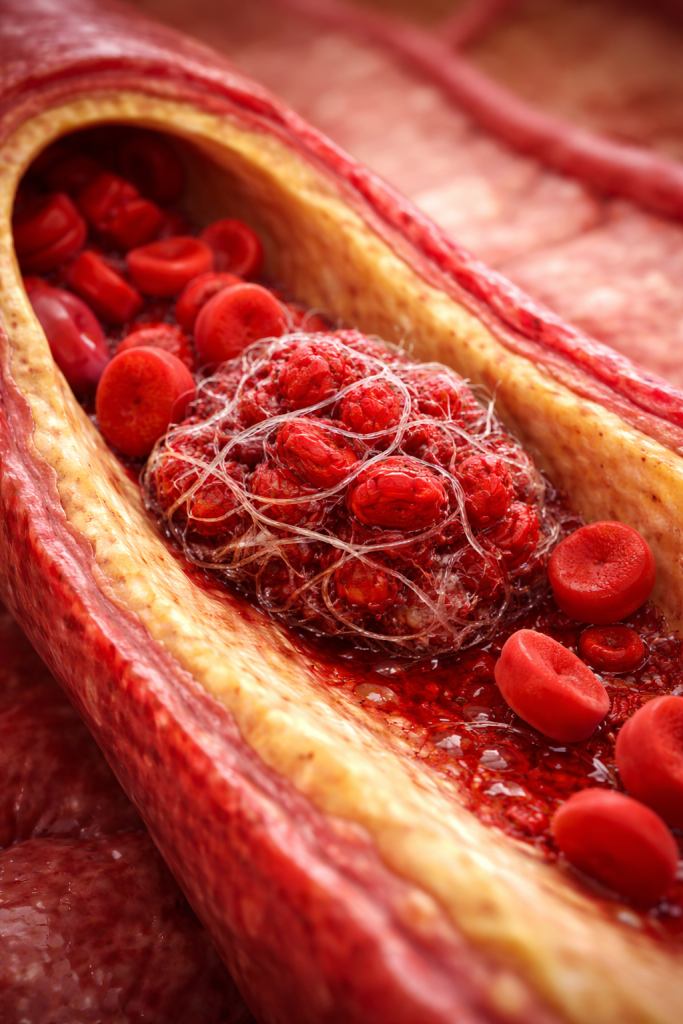
This is known as thrombosis, and its impact depends entirely on where it happens.
If a vessel in the heart is blocked, it can lead to a heart attack. In the brain, it may cause a stroke. In the lungs, it can interfere with oxygen exchange in a serious way.
Why clots form even without injury
In most cases, there isn’t just one cause. Clot formation is usually the result of several factors coming together.
In medicine, these are often described as a combination of slowed blood flow, damage to the vessel wall, and an increased tendency of the blood to clot.
Slower circulation can happen when you remain still for long periods, such as during long travel or recovery after surgery. Damage to blood vessels may come from inflammation or fatty deposits. Increased clotting tendency can appear in certain medical conditions, hormonal changes, or after surgical procedures.
When these factors overlap, the likelihood of a clot forming rises significantly.
Where clots can form in the body
Clots can develop in different parts of the body, and their location makes all the difference.
They often form in the deep veins of the legs, especially when circulation is reduced. In arteries, they are frequently linked to plaques that narrow the vessels and can suddenly block blood flow.
Sometimes, a clot doesn’t stay where it formed. It can break loose and travel through the bloodstream. If it reaches the lungs, it can cause what’s known as a pulmonary embolism, a condition that can become critical very quickly.
What happens after a clot forms
A clot may remain attached to the vessel wall and partially or completely block circulation. It can grow larger over time, or in some cases, it may gradually dissolve through the body’s natural mechanisms.
However, if part of it breaks away, it becomes an embolus and can block smaller vessels elsewhere, sometimes in vital organs.
Differences related to age and sex
The risk of clot formation increases with age, as blood vessels lose elasticity and other health conditions become more common.
In women, certain hormonal contexts—such as pregnancy or the use of hormonal contraceptives—can increase the tendency for blood to clot. In men, lifestyle factors and cardiovascular conditions often play a more significant role.
The key idea
A blood clot is not inherently dangerous. It’s a mechanism your body relies on every day to keep you safe.
It becomes a problem only when it forms in the wrong place or at the wrong time. It’s a clear example of how the same system that protects you can, under certain conditions, create serious risks if the balance is disrupted.