
When people hear that a horse had to be euthanized after breaking a leg, the reaction is often the same:
“Why can’t they just put a cast on it like doctors do for people?”
For humans, a broken leg usually means weeks or months of recovery, but it rarely becomes life-threatening.
For horses, however, a serious leg fracture can quickly turn into a complex medical situation.
The reason isn’t a lack of medical care. It’s mainly because of how horses are built and how their bodies function.
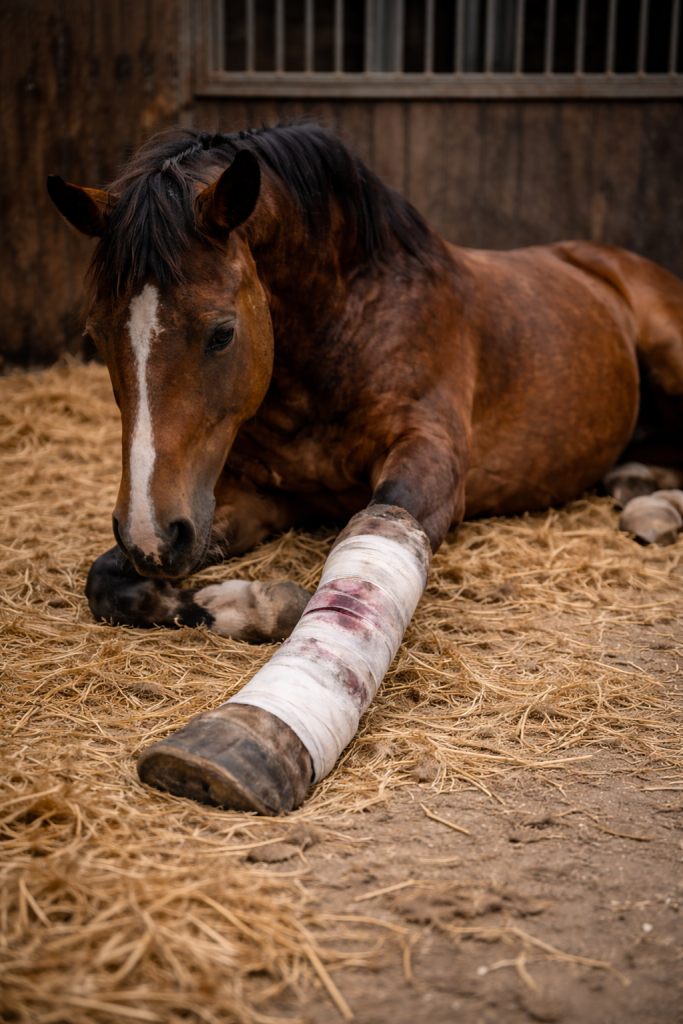
A large body supported by very slender legs
An adult horse typically weighs between 900 and 1,300 pounds (400–600 kg).
That weight is supported by legs that, especially below the knee and hock, contain very little muscle. The lower leg is made mostly of bone, tendons, and ligaments.
This design is perfect for speed and efficiency. Horses evolved to run quickly across open terrain, and their legs function almost like spring-loaded systems that help them move with incredible power.
But this structure has a downside: when a bone breaks, there isn’t much surrounding muscle to stabilize the fracture.
Horses can’t rest the way humans do
Another important factor is behavior.
Horses are prey animals, and their bodies are built to stand for long periods of time. In fact, horses spend most of their lives on their feet.
Unlike humans, they cannot easily remain lying down for weeks during recovery. Long periods of immobility can lead to serious health complications, including circulation problems, muscle damage, and lung issues.
This makes long-term immobilization extremely difficult.
The problem of weight distribution
When one leg is severely injured, the horse shifts most of its body weight onto the remaining three legs.
This extra pressure can sometimes lead to a painful condition known as Laminitis, an inflammation inside the hoof that can damage the structures supporting the bone.
In some cases, the strain placed on the healthy legs becomes another major medical concern.
Not all fractures lead to euthanasia
It’s important to note that not every broken leg leads to euthanasia.
Veterinary medicine has advanced significantly, and many horses today recover from certain fractures through surgery, specialized casts, or external support devices.
Some high-profile cases have shown how advanced equine medicine can be. One well-known example is Barbaro, a famous racehorse who received complex surgical treatment after suffering a severe leg fracture.
While not every case has a positive outcome, many horses with stable fractures can recover and live comfortable lives.
Why euthanasia is sometimes considered
In situations where the fracture is extremely severe — especially if the bone is shattered or involves critical joints — recovery may be unlikely or involve prolonged suffering.
Veterinarians and owners must consider several factors:
- whether the fracture can be stabilized
- the level of pain the horse may experience
- the chances of long-term recovery
- whether the horse could regain normal mobility
When medical experts determine that recovery is unlikely and suffering would be prolonged, humane euthanasia may sometimes be recommended.
The evolutionary trade-off
Horses evolved for speed, endurance, and survival on open plains.
Those same features that make them powerful runners also make severe leg injuries particularly difficult to treat.
In the wild, an animal that cannot run cannot escape predators. Evolution did not need to solve the problem of healing complex fractures — because injured animals rarely survived long enough for that to matter.
Today, modern veterinary medicine continues to push the boundaries of what is possible, helping more horses recover from injuries that once would have been considered hopeless.