
It sounds like one of those facts that feel almost made up the first time you hear them. How could a place buried under ice and rock, nearly nine kilometers above sea level, have anything to do with the ocean? And yet, if you could stand on the summit of Mount Everest, the ground beneath you would carry a history that began in water, not in the sky.
The evidence isn’t abstract — it’s locked inside the rock
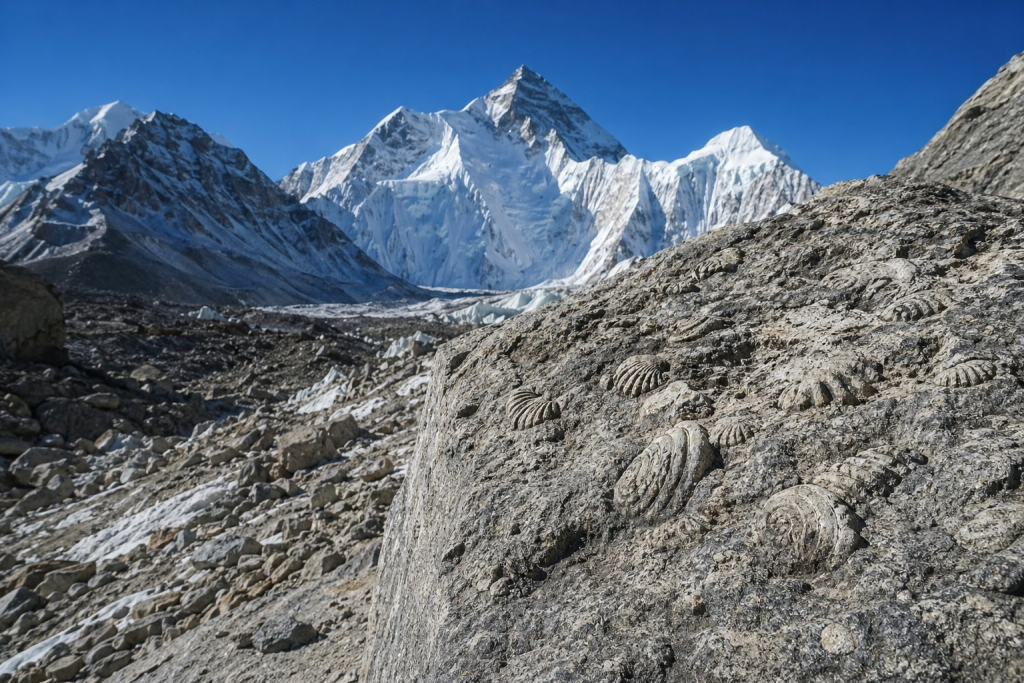
This isn’t speculation or a poetic way of describing nature. The rocks near the top of Everest include marine limestone, a type of rock that forms from the accumulated remains of sea life. Over time, shells, microscopic organisms, and calcium-rich debris settle on the seafloor, compact, and eventually turn into solid stone.
What makes this even more striking is that scientists have found marine fossils embedded in these layers — remnants of ancient organisms such as trilobites and brachiopods, along with traces of algae. These creatures lived in relatively shallow, warm seas, not in deep ocean trenches and certainly not in high-altitude environments. Their presence leaves very little room for doubt about the origin of those الصخور.
These rock layers are part of what geologists call the Qomolangma Formation, and they date back roughly 450 to 470 million years, long before the Himalayas even existed as mountains.
A lost ocean that didn’t really disappear
To understand how marine rock ended up so high, you have to go back to a time when a vast body of water known as the Tethys Ocean separated ancient landmasses. What is now India was once part of a southern supercontinent, while Eurasia lay to the north, with this ocean stretching between them.
For millions of years, sediments quietly built up on the ocean floor. Layer after layer formed without any sign that they would one day be lifted thousands of meters into the air. There was no dramatic beginning — just slow accumulation, shaped by time.
When continents collide, the landscape changes
Everything shifted when the Indian tectonic plate began moving northward. In geological terms, it was moving relatively fast, a few centimeters per year, but the real transformation came when it collided with the Eurasian plate around 50 to 60 million years ago.
This wasn’t a sudden impact, but a long, ongoing process. The ocean floor sediments were compressed, folded, and pushed upward. Over time, this movement gave rise to the Himalaya, lifting former seabed material to extreme altitudes.
What’s fascinating is that this process hasn’t stopped. The Himalayas are still rising today, albeit very slowly, continuing the same geological story that began tens of millions of years ago.
So, was Everest really once the bottom of the ocean?
In simple terms, yes — but with a bit of nuance. Everest isn’t made entirely of marine limestone, and its structure includes a variety of rock types. However, the upper sections do contain rock formed in a marine environment, and the fossils found there confirm that origin.
So while the statement is often simplified online, the core idea holds true. Part of what you’d be standing on at the summit really did begin as ocean floor.
A reminder of how slowly everything changes
What makes this story so compelling isn’t just the contrast between ocean and mountain, but the scale of time behind it. We’re talking about hundreds of millions of years, about entire oceans forming and disappearing, about continents shifting without us ever noticing.
Everest is more than just the highest point on Earth. It’s a place where the past hasn’t vanished, but has been lifted and preserved. And the fact that traces of marine life can be found at such an altitude isn’t a coincidence or a curiosity — it’s a quiet, powerful reminder that our planet is constantly changing, even when it seems completely still.