
A quiet morning in a place that felt familiar
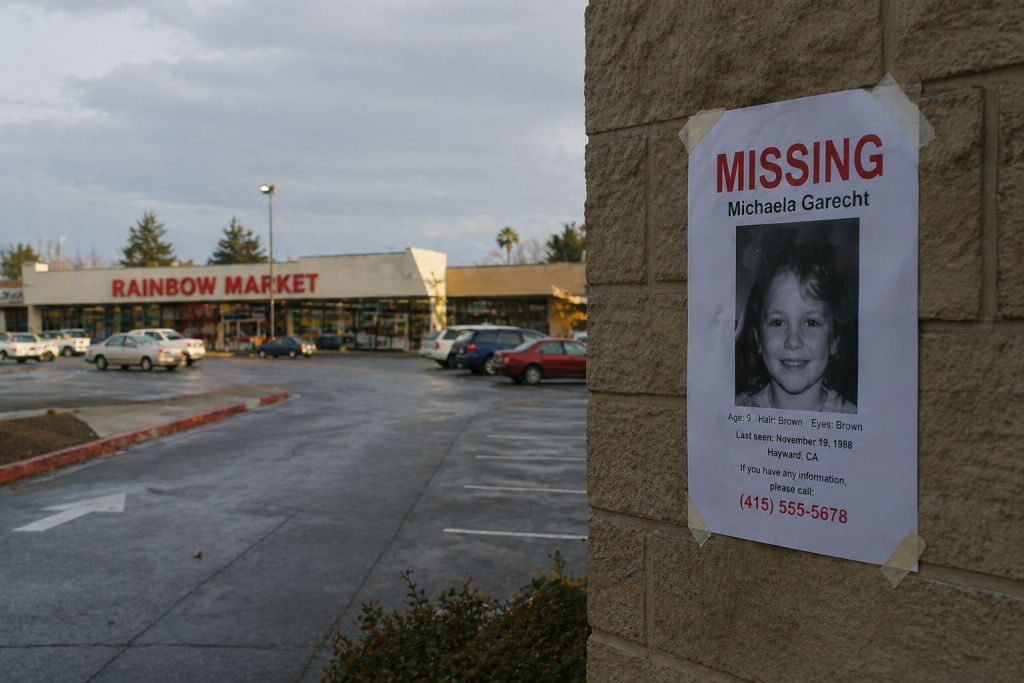
On November 19, 1988, in Hayward, it was a typical Saturday morning. The parking lot outside Rainbow Market had a steady flow of people, but nothing chaotic. Cars came and went, shoppers moved in and out, and children were nearby, just as they often were in places like this.
Michaela Garecht was 9 years old and had walked there with her friend, Katrina Rodriguez. It was a short trip from home, one they had made before. They rode their scooters, talking along the way, with no reason to think the day would turn into anything unusual.
They left their scooters by the entrance and went inside for a few minutes. Everything about the moment felt routine.
A small detail that changed the situation
When they came back out, they started heading home before realizing the scooters were no longer where they had left them. They turned back right away.
One of them was still there. Michaela’s had been moved several feet away, into the parking lot, near a car.
On its own, it didn’t seem like much. But in that moment, it created just enough distance between the two girls.
Michaela walked over to retrieve it.
The moment that didn’t leave time to react
In that short span of time, a man appeared, grabbed her, and forced her into a nearby car. Her friend witnessed what happened and heard her cry out, but everything unfolded so quickly that there was no real chance to intervene.
It wasn’t a prolonged scene, and it didn’t immediately draw widespread attention. It was over in seconds, before most people around could understand what they were seeing.
The car drove away.
Michaela was never seen again.
The first hours and the limits of what can be done
The disappearance was reported quickly, and police began searching the area. Witnesses provided descriptions of the man and the vehicle, and investigators worked to piece together the sequence of events.
In cases like this, time matters. But when everything happens within seconds, even a fast response has its limits. The investigation had to rely on fragments—details that were partially clear and others that were incomplete.
Years without answers
The case remained in the public eye for a long time in Hayward. Michaela’s family continued to speak about her, and the investigation was revisited more than once over the years.
There were leads, persons of interest, and moments when it seemed possible that a breakthrough might happen. Still, for a long time, no clear answer emerged.
For the family, those years were defined not just by the passage of time, but by uncertainty. In psychology, this is often described as “ambiguous loss”—a situation where there is no confirmed outcome, and no clear way to move forward emotionally.
What her family did next
After Michaela’s disappearance, her family chose not to step back. Her mother, Sharon Murch, remained actively involved, speaking publicly and keeping attention on the case over the years.
She worked with investigators, participated in interviews, and supported efforts to ensure that Michaela’s story continued to be heard. In a time before social media, this meant staying present in traditional media and public discussions.
Her photograph continued to circulate, and every possible lead was taken seriously, even when the chances seemed small. There was no point where the family decided it was too late to keep searching.
This kind of continued involvement is often connected to what psychologists describe as ambiguous loss—when the absence of answers prevents both closure and the ability to let go.
Developments decades later
More than thirty years after the disappearance, the case saw a significant development. A suspect was identified and charged, based on evidence reexamined using modern forensic methods.
These advances brought new direction to the case, though they did not resolve every question. In situations like this, there is often a difference between what can be established legally and what brings a sense of closure.
What this case reveals
Michaela’s case is often referenced in discussions about rapid abductions in public spaces. These incidents are rare, but when they occur, they happen quickly and in environments that feel safe.
It’s not about constant inattention. It’s about those brief moments when everything appears normal, and nothing signals danger.
What stays with people
What makes this case difficult to process isn’t just what happened, but how it began.
It wasn’t late at night.
It wasn’t an isolated place.
It didn’t look like a dangerous situation.
It was a parking lot, two girls, and a scooter moved a few feet away—a small detail that changed everything in seconds.
Sometimes things don’t shift gradually.
They change in a single moment, before anyone realizes that moment matters.